2012-08-12

What I don´t know about this book

Allow me to complain a bit about how hard it is to find something really, really interesting to read. I mean interesting in the "stay-up-all-night-hardly-even-thinking-about-food" kind of interesting. Since Murnane´s "Barley Patch" there has been nothing.

I had high hopes for Jenny Diski´s "What I don´t know about animals" (= allt jag inte vet om djur). It was a short loan, as there was a queue to it, and what you see in the picture is exactly how far I got in a fortnight.

I loooved Diski´s travel books, particularly the one where she goes to the Antarctic on a ship, and the one where she travels across North America on a train, and the one where she goes to Jukkasjärvi - wait - that´s all of them! I haven´t read any of her novels, though. This is not a novel, nor is it a reportage, it´s more of an auto-biographical essay, I think. Can´t really say for sure, as I didn´t read through it.

I should, really, give Diski one more chance, sometime when there is more time available. But for sure, it´s not something that pulls me in. I´d have to make an effort. It´s the subject. I don´t know much about animals either, and I´m not that interested in the way animals are used and misused in culture, which is what I´m guessing this is all about.

I´m continually on the look-out.

2012-08-10

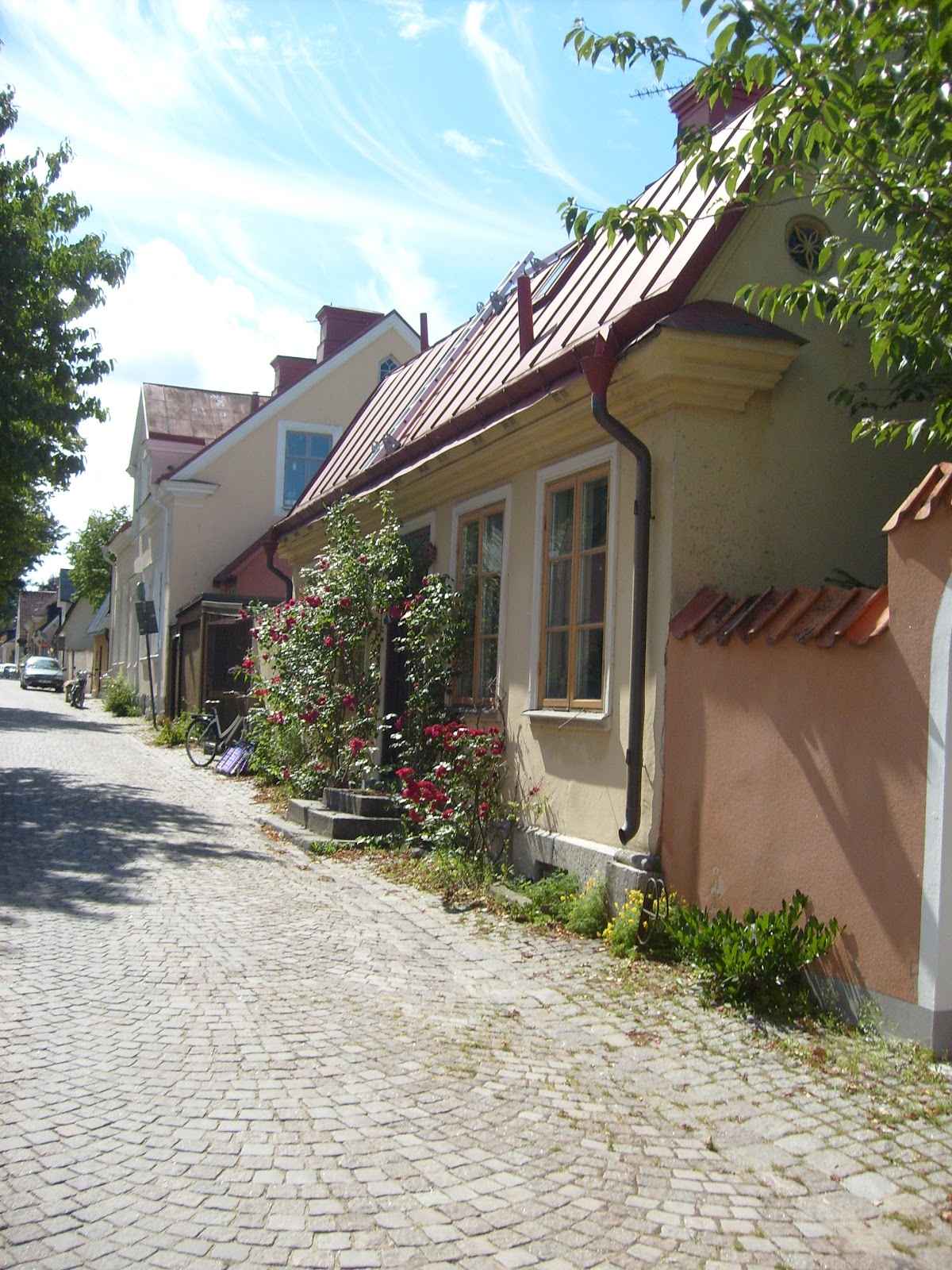
Visby, Gotland - Day One

Coming here is a bit like going abroad. Weather, culture, magic!
I was superlucky to be able to come with my husband to Visby this year. He was at a conference all day - poor him! - while I was taking in the sights with a collegue´s wife, Margareta, who - my brilliant luck! - has lived here as a kid, and is also very well-read on history and such. I can´t think of a better guide for the short stay (two nights) we had.

A few images just to give you an idea of the things that caught my eye:

Nature! In the cultured manner of the Bothanical Gardens.


And the smell of the roses!

The old hotels.

The medieval defensive wall goes all around the town.

And some more modern defenses.

A reminder of the town´s former status as part of the Hansa trading system.

The old mote, where I´m told the kids used to do tricks on their bikes.


St Gertrude had her own convent & church.

A walnut tree!

And it´s fruit.

From the cathedral.


What the cathedral used to look like when spanking new.

I have an affinity for gargoyles.


The main square - jesters and their audience.

Remember the Cold War

Shall I compare thee to a summer´s day? What does one do on one of the prettiest days of the year? One goes underground. One goes looking at a canon. A secret canon. A Cold War canon.

This is the Victoria Fort in Vuollerim. It´s basically a canon and a cave in the rock under it for the people tending it. The canon was taken from the warship "The Queen Victoria" (not the English Queen Victoria, but the Swedish Queen Victoria of Baden, who was a bit younger, German, and married to the Swedish king Gustav III) when it was taken out of service in the 50´s. It´s still an impressive piece, though it´s around 100 years old it still looks fit for fight (no rust whatsoever, the guide assures us) and deadly enough.

It´s in the middle of absolutely nowhere, from a global perspective, but on a day like this one can see pretty far, and the view is stunning. That´s Vuollerim down there, and the water you see is Big Lule River and Small Lule River joining up.

Somewhere among the houses is that cute Stone Age Museum that we had been to earlier in the day, the one I posted about before.

I understand that the sheer vastness of our forrests and the wildness of our rivers are on some impressive scale to Englishmen, Germans, etc, coming to visit. And I suppose, when I look at where they are from, I can see their points of view. To us, however, this is just the natural order of things. Forrests are not dangerous places, as long as you don´t have a dog pissing off the occassional elk or bear (it happens! they are deadly!), but don´t expect to be anywhere near "the other side" (forget about pubs!) or within range of the mobil phone services. Make sure you know where you are at all times. Don´t wander off absentmindedly. Wear a bright jacket.

Anyroad. Of course, we wanted to see this canon, and what lay beneath, and so ventured into the underground with our charming and very well informed guide, Emil. He had lots of interesting facts and told us that the installation has been kept almost exactly as it was left by the military when they closed it down for good in 1997. What they have done is take up a few doors, as access was just available through escape hatches, except for one single proper door at the top, near the canon. I´m grateful we didn´t have to crawl our way out of there.

Posters on the walls, reminding everyone about professional secrecy. This one says: "Nowadays everyone is open about everything - but not about the service, of course. Remember the professional secrecy." Notice the late 60´s - 70´s esthetic. "Open about everything" - this was the years of the sexual revolution, the pill, psycho therapy, and LSD trips. But there was also the fear of the big bad Russian wolf and the impending third world war, with nuclear bombs and whatnot.

The canon under ground. They call it the "stalk".

Fat to grease the hinges and ball bearings.

A view inside the canon stalk.

The power generator.

My first phone looked like that! It was green, though. I want that lamp!

The jackets had been washed (smelly, perhaps) before hung in their original places.

Our guide, Emil. I had to buy one of those t-shirts.

The plates were extra heavy, so they could be used to kill the enemy! (or was that a joke?)

The upper crawl-hatch was all there used to be by way of entrance down the mountain.

The over-ground part of the canon.


All in all, a very rewarding day. I warmly recommend it, if you are historically inclined and want to reminisce about the bad old days.

Historical Report

Being always interested in different aspects of early history, I thought this might be an easy and interesting read. It´s Lena Huldén´s "Med blod och svärd, 1000 - 1520" (= with blood and sword), about Scandinavian political history in the Middle Ages.

Plenty illustrated, which was nice. I have nothing to complain about regarding language, but clearly, Huldén is no storyteller. This is more like a report, and she is really trying to tell it ALL. Every little detail. So, if you want to know everything about royal affairs and power struggle in Sweden, Denmark, Norway, the northern provinces of Germany, and the other countries around the Baltic Sea, this is the book for you.

Being really interested, I hung in there for quite a while. Only the last 25 pages or so I started leafing through it more quickly, mostly looking at the pictures. But then I´m more into Iron Age than later periods.

For the historically inclined, who often need a bit of a brush up on who did what, this would be an excellent addition to a personal reference library. Also, I think you can find this at most Swedish libraries of moderate size.

Home-help Cartoons

What to read while on vacation? With all the action this summer, with friends and family visiting, I haven´t had the peace and quiet and long stretches of time (did anyone mention the Olympics?) to really dig into something serious. Cartoons are the perfect thing, really.

This is cartoons for grown-ups, eight short stories by Pelle Forshed, in a collection entitled "De anhöriga" (= the relatives). The stories are inspired by Forshed´s work in the home-help service, caring for the elderly and dying. The stories are told from different perspectives, but hook into each other, "Short Cuts"-style.

Forshed´s drawings remind me of Tintin in the early days, but of course the stories are much bleaker. He has great affection for his protagonists, but does not hesitate to expose them, and all their faults. While I really felt for them, I could also see the bullshit that we tend to use to cushion ourselves from the harsness of suffering and decline in those that we have depended on all our lives. He says some profound things about parents and grown children.

I think it´s also a book that should be read by everyone who has a parent or relative that needs home care, since it really exposes the day-to-day reality of those who care for our elders. Sometimes I think we just want our aging parents to be as self-sufficient as they always were, and when they are not, we´d rather have others fill in the gaps, so that we ourselves can remain in the child-position, free of responsibility.

2012-07-27

Visiting the Stone Age

Yesterday we had a great outing with our Niece and Nephew, to a small village in the middle of Swedish Lapland, called Vuollerim. One of our stops were at the Vuollerim 6000, the Stone Age Museum, that´s been built around the excavations of two houses from around 4000 BC.

The museum itself is an impressive building, modern, good looking, and it sticks out in the general mood of Vuollerim´s rural community - 40´s esthetic. As one approaches there is a strong smell of tar in the air. This is how the wood of the building is treated, just like the wooden church in Kiruna, which reaked of tar when I visited it, some 15 years ago.

As you know, I´m an ardent admirer of Time Team profiles like Phil Harding, and how can one not be? Consider that this is what they have found on the banks of the Luleå river:
burnt stone

quarts and slate
And this is what they have reconstructed:
museum model

and actual dwelling
The focus of the museum was to trigger the visitor´s imagination, to make you think about what it would have been like to live here 6000 years ago. There was a great amount of clothing, tools, and examples of what they would have eaten, and so on. One of the party was particularly keen to try everything on.

Which was great, since two of us are enthusiastic photographers.

Another member of the party is a musician, and entertained with Stone Age funky music.

Unfortunately, they have no guide to the excavation site down by the river at this time, and we felt that perhaps that was necessary to appreciate it, so although one can go there, we decided to refrain and make this our one reason to return to Vuollerim.

Personally, I am - as usual - coveting a handbag.

To top this off: a perfect lunch at the local hotel, yellow peasoup (yum!), pancakes with raspberrys, and excellently brewed coffee.

After which we headed for the next interesting visit in Vuollerim. More about that later.

2012-07-19

Vacation at home

Lovely gift from my nephews.
It´s summer and we are on vacation, finally. This year, we are not travelling anywhere (except for a short trip to Gotland), just staying home, doing a few repairs (the washing machine is in molecules, waiting for a new heating element), sleeping late, watching some film on rainy days, taking long walks.

We are also having guests. My sister from Gothenburg & family have just been, and the house has been unusually lively and full of energy. Children are such an effective reminder of the basic joys in life.
Being so impressed with Gerald Murnane, I immediately jumped onto his novel "The Plains". I got one thirds into it, it´s rather short, and I was so bored my body hurt. Sorry, Murnane. As much as I loved "Barley Patch", I just don´t get this. I imagine it´s very Australian, very metaphorical, very something that I just don´t recognize and can´t assimilate. So I gave up.

I have something I ordered and forgot about waiting for me at the library. Perhaps, I hope, a great read. I´m in need of one.