I am not getting a whole lot of reading done, and considering how much I anticipated the new Russell&Holmes adventure, "Dreaming Spies", by Laurie R King, it has taken me an uncharacteristically long time to get through it. The last quarter, however, was so exciting I sacrificed a few hours of sleep for it.
Our detective partners are just come home from their latest adventure in Marocko ("Garment of Shadows") and finds Mrs Hudson puzzled about a rock that has been delivered and carefully placed in their garden. The Holmeses do not take this as a puzzle to be solved, so we understand that they know what this rock is and why it has been given to them. Russell goes up to her house in Oxford, where she is met by an intruder, asking for her help. And so starts a lengthy flashback of their round-the-world trip and visit to Japan, one year earlier. (This would have taken place between "The Game" and "Locked Doors".)
One of the things I really like about King is how well she seems to understand the context in which she places her protagonists. Japanese culture - that whole thing about loosing face - is usually incomprehensible to me (I recently read an article in the paper about a Swedish exchange student in China who got into trouble with the police when trying to stop a fight in a nightclub, and how his attitude - perfectly understandable to a European - caused him a year of grief with the justice system, until he swallowed his pride and was promptly released after having begged forgiveness for something he hadn´t done) but King explains it well through the situations she puts the husband/wife team in.
This is the first of the novels where Russell and Holmes are really one hundred percent comfortable with each other as working partners - there is a higher level of trust and confidence, and a natural and easy division of labour - and I like how King has let her characters evolve through the series. She is, as always, very humouristic, sometimes slapstick funny. And again, she gives the most interesting and complex roles to the women of her cast; not that one really notices, as she is never overtly feminist.
Well, you can tell, I find it hard indeed to find fault with King´s work. I have realized that this series is not to everyone´s taste, although I can´t really understand why, but there it is. I do wish, however, that every reader finds a few series that he or she can relish as much as I do this!
Showing posts with label whodunit. Show all posts
2015-03-21
2015-03-03
The Man with a Load of Mischief
I rarely buy real, physical books these days, stopping when my asthma was really bad a few years ago. However, the asthma is better (so is my general health and well-being, which I attribute to better sleep) and I have started picking up the odd paper book when there is no e-book alternative. Certainly, art-books are hard to come by in a decent electronic form, and I have been buying quite a few of those lately - though they have not made it onto the blog, not actually being literature, I think.
I have also been drawn to detective stories, preferably long series of well-drawn characters that one can get to know and like. Comfort reading, I realize, but sometimes that´s what´s called for. I have finished the entire Dalziel&Pascoe-series by Reginald Hill years ago and he will not be making any more, sadly, being dead and all. Laurie R King is alive and well, but is hardly turning out a new Russell&Holmes adventure every year (though her Stuyvesant-series is good too). I have plenty of Lord Peter Wimsey left to read, but am in no hurry to get to the end of them.
After a favourable review by Divers and Sundry, I ordered this one via amazon from a second-hand book dealer in the UK, for a penny, I think. "The Man with a Load of Mischief" is the title of not just the novel, but also an inn where the first (or so it seems) in a series of murders takes place, by Martha Grimes, an American author writing a whole series (23 books!) of whodunits (all named after pubs, I understand) with Scotland Yard Inspector Richard Jury as the investigating sleuth.
A bit of googling (imdb knows nothing about this) revealed that the Germans have adapted this to television in 2013, English countryside and all (but those white cliffs suggests they may have moved the action from the Yorkshire countryside a bit). It turns out to be on DVD and as I feel that we don´t see enough German television, I have ordered it. The reviews were mixed, but I don´t care; it´ll be a lark, I´m sure.
To return to the book, I have to say, I am not in my most critical mood here. It is the first of a long series (published in 1981), and considering the spectacular development of Reginald Hill´s authorship over the years, I am forgiving of certain flaws in a first novel. Like overdescribing - Grimes does not hesitate to stop the action to linger for an entire page on how prettily the snow has fallen on the thatched roofs, etc - and not being entirely British in her vocabulary - I think, for instance, that Inspector Jury would not really reflect much on the cut of a man´s pants, as they would not be visible to him (pants are underwear in Britain, trousers are outerwear). Also, I did figure out who the murderer was much sooner than the good Inspector, but you know, it didn´t really lessen my enjoyment. I like the characters and I look forward to seeing what she will make of them. With 22 books ahead of me (and perhaps more coming, she is 83, but turned out her latest in 2014) I hope I have much to look forward to.
I have also been drawn to detective stories, preferably long series of well-drawn characters that one can get to know and like. Comfort reading, I realize, but sometimes that´s what´s called for. I have finished the entire Dalziel&Pascoe-series by Reginald Hill years ago and he will not be making any more, sadly, being dead and all. Laurie R King is alive and well, but is hardly turning out a new Russell&Holmes adventure every year (though her Stuyvesant-series is good too). I have plenty of Lord Peter Wimsey left to read, but am in no hurry to get to the end of them.
After a favourable review by Divers and Sundry, I ordered this one via amazon from a second-hand book dealer in the UK, for a penny, I think. "The Man with a Load of Mischief" is the title of not just the novel, but also an inn where the first (or so it seems) in a series of murders takes place, by Martha Grimes, an American author writing a whole series (23 books!) of whodunits (all named after pubs, I understand) with Scotland Yard Inspector Richard Jury as the investigating sleuth.
A bit of googling (imdb knows nothing about this) revealed that the Germans have adapted this to television in 2013, English countryside and all (but those white cliffs suggests they may have moved the action from the Yorkshire countryside a bit). It turns out to be on DVD and as I feel that we don´t see enough German television, I have ordered it. The reviews were mixed, but I don´t care; it´ll be a lark, I´m sure.
To return to the book, I have to say, I am not in my most critical mood here. It is the first of a long series (published in 1981), and considering the spectacular development of Reginald Hill´s authorship over the years, I am forgiving of certain flaws in a first novel. Like overdescribing - Grimes does not hesitate to stop the action to linger for an entire page on how prettily the snow has fallen on the thatched roofs, etc - and not being entirely British in her vocabulary - I think, for instance, that Inspector Jury would not really reflect much on the cut of a man´s pants, as they would not be visible to him (pants are underwear in Britain, trousers are outerwear). Also, I did figure out who the murderer was much sooner than the good Inspector, but you know, it didn´t really lessen my enjoyment. I like the characters and I look forward to seeing what she will make of them. With 22 books ahead of me (and perhaps more coming, she is 83, but turned out her latest in 2014) I hope I have much to look forward to.
2015-01-11
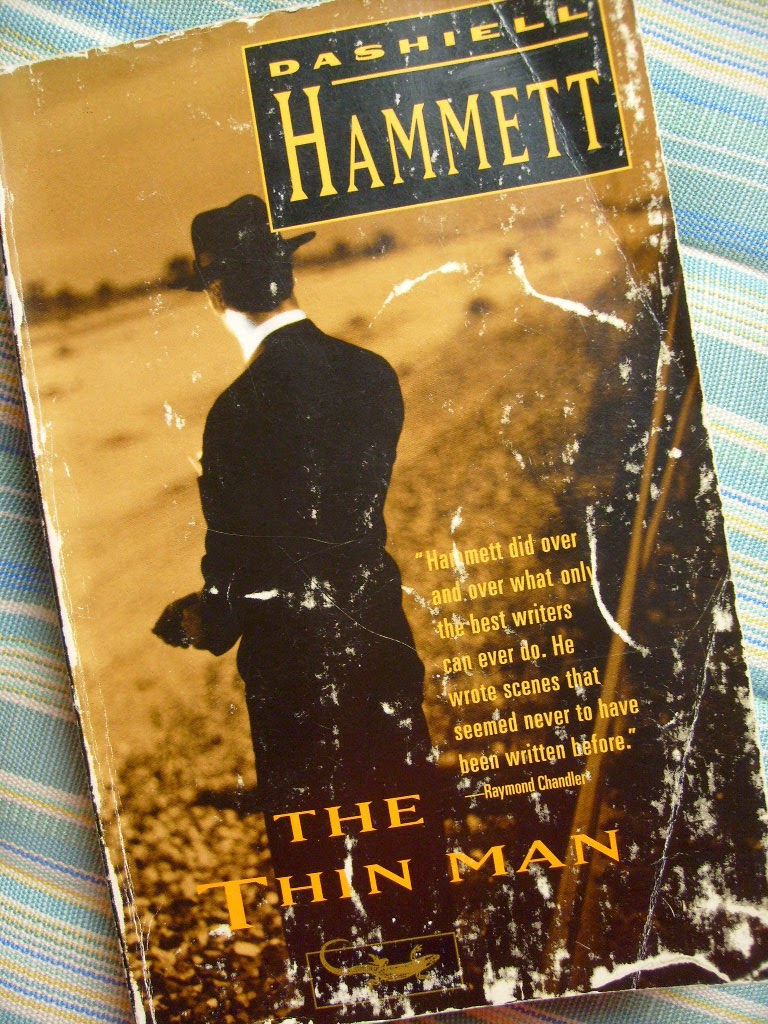
The Thin Man
I have had Dashiell Hammett in mind for a long time. He is a fictional character in one of Laurie R King´s novels, "Locked Rooms", which I recently re-read. When blogger Divers and Sundry blogged about suitable reading for Christmas, I decided to try and find "The Thin Man" by Hammett and this rather well-read copy was waiting for me at the library in Kalix.
I enjoyed this read; Hammett has a fast-paced writing style, he doesn´t linger at anything that doesn´t drive the story forward. I confess some of the slang was a bit hard to get, and sometimes I just didn´t get the banter. Likely, I missed the best jokes, but what can you do? I enjoyed it well enough, but not so much that I will be looking for the rest of them; I understand Hammett also wrote some short stories about the main characters, Nick and Nora Charles.
However, I checked out some of the films that was made in the 30´s and 40´s with William Powell and Myrna Loy, and became so infatuated with them that I ordered a four-film-box. A good detective story with a bit of humour is never wrong on a Friday night.
I enjoyed this read; Hammett has a fast-paced writing style, he doesn´t linger at anything that doesn´t drive the story forward. I confess some of the slang was a bit hard to get, and sometimes I just didn´t get the banter. Likely, I missed the best jokes, but what can you do? I enjoyed it well enough, but not so much that I will be looking for the rest of them; I understand Hammett also wrote some short stories about the main characters, Nick and Nora Charles.
However, I checked out some of the films that was made in the 30´s and 40´s with William Powell and Myrna Loy, and became so infatuated with them that I ordered a four-film-box. A good detective story with a bit of humour is never wrong on a Friday night.
2014-12-08
A Retro Crime Series
A few weeks ago, I saw the first episode of a new detective series on television (available on amazon as "Crimes of Passion"), based on a book series (three novels available in English on Kindle) by Maria Lang (pen name for Dagmar Lange) that was first published in 1949 and that she kept writing until 1990, which featured her rural Swedish version of Lord Peter Wimsey (or so the Wikipedia article on her claims - I find the comparison preposterous), Christer Wijk. I didn´t really know what to expect, I hadn´t read the books, but I was surprised how well made it was (though not perfect, for sure). It has a funny kind of noir vibe to it, as well as a 50´s retro milieu, with a slightly anachronistic adaptation to suit modern (feminist) sensibilities (which I know now, since having read three of the novels). And, of course, excellent actors, some of whom can say some pretty corny dialogue without making the audience too embarassed, particularly Tuva Novotny, who is perhaps the best Swedish actress of her generation.
Actually, my first thought, about five minutes into the first episode, was how much the male body has changed over the last decades. One hears all the time how fashions have changed for the female body, from the 20´s gamine to the 50´s bosomy glamour girl, the 70´s fresh-faced "Charlie" girl to the heroin chic Kate Moss of the 90´s. But think how the male body has changed since body building started to become mainstream in the late 80´s, early 90´s. You know, when I started going to the gym in 1992 or thereabouts, I still had friends who refused to lift a single dumbbell, as they thought it would make them instantly look like Arnold Schwarzenegger, even though they were girls. The pumped up bodies of Schwarzenegger and Sylvester Stallone were controversial in those days, I remember a lot of heated discussions for or against that kind of training.
Now, there are very few actors who doesn´t look like that, to some extent. (And even a fair amount of regular people, at least here, where winter outdoors training for the desk bound male is grim, and the gym a cozy option. I just have to look over at the husband and remember that he comes from a stock of wiry lumber jacks!) But they didn´t look like that in the 50´s (and they ate differently) which is why this first episode felt a bit off to me. Yes, the male actors Ola Rapace (ex-husband of more internationally known Noomi) and Linus Wahlgren do look very dishy in their suits, hats, topcoats, bowties and slipovers. And sleeve garters! Remember those? My dad used to wear them all the time, and I had a pair myself (I nicked some of his old 60´s suits and wore all through the 80´s). Now they accent the fact that both Rapace (particularly Rapace) and Wahlgren have very sexy upper arms. Novotny is made out more like a tomboy, but the other women in the series are gorgeously made out in colourful gowns, pinched waists and high hair.
Maria Lang wasn´t anything we read, in my generation. My mother didn´t read her either (at least I think not). The characters have been much changed. The narrator and our hero, Puck, is not a perky little 50´s academic young wife who stumble over corpses left and right, but rather a serious, introverted career-woman with a taste for analysis and writing crime fiction. Her husband Eje has been changed from what Puck has now become (in the books he is the crime writer), into a bumbling, slightly naiv teacher who goes back and forth between being proud of his wife and jealous of her attachment to his oldest friend and the real hero: police investigator Christer Wijk, who in the books is a skinny, tall, jovial, pipe-smoking man with a taste for checked tweed (even in summer), a father-figure for Puck. In the films, he is a sexy womanizer, a real contender to Eje, at the end of most episodes making due with a widow or other woman left-over from their latest investigation when Puck has turned away from his advances (yeah, his best friend´s wife, but he can´t help himself because of the passion, you see...).
Maria Lang would not have approved, I´m sure, though she was no stranger, even in the 40´s, to writing quite candidly about sex. Still, the films are entertaining, and so are the books, as long as you take them for what they are. I like. Oddly, I like quite a lot, both the books and the films.
| Borrowed from tv4. Wahlgren, Novotny, and Rapace. |
![]() |
| Borrowed from Finnish television. |
(a short peak from tv4 on youtube)
Maria Lang wasn´t anything we read, in my generation. My mother didn´t read her either (at least I think not). The characters have been much changed. The narrator and our hero, Puck, is not a perky little 50´s academic young wife who stumble over corpses left and right, but rather a serious, introverted career-woman with a taste for analysis and writing crime fiction. Her husband Eje has been changed from what Puck has now become (in the books he is the crime writer), into a bumbling, slightly naiv teacher who goes back and forth between being proud of his wife and jealous of her attachment to his oldest friend and the real hero: police investigator Christer Wijk, who in the books is a skinny, tall, jovial, pipe-smoking man with a taste for checked tweed (even in summer), a father-figure for Puck. In the films, he is a sexy womanizer, a real contender to Eje, at the end of most episodes making due with a widow or other woman left-over from their latest investigation when Puck has turned away from his advances (yeah, his best friend´s wife, but he can´t help himself because of the passion, you see...).
Maria Lang would not have approved, I´m sure, though she was no stranger, even in the 40´s, to writing quite candidly about sex. Still, the films are entertaining, and so are the books, as long as you take them for what they are. I like. Oddly, I like quite a lot, both the books and the films.
2014-10-05
The Bones of Paris
I had finished the third novel in the Lord Peter Wimsey series and felt like I needed a change. Not a big change, but a little one. I decided to stay in the 1920´s and in the genre, and bought the second in what I imagine is becoming a longer series about former US agent Harris Stuyvesant, who was the hero of "Touchstone" by Laurie R King. This one is titled "The Bones of Paris", and Paris is where we find Harris now. It´s been three years since the last story took place, his friend Bennet Grey is back in his cottage at Land´s End, and Bennet´s sister Sarah, who was also Harris´s love interest, has disappeared, badly wounded from the ordeal they went through together and needing time to heal, alone. Harris is hurt, but also understanding and patiently waiting for her to get in touch again. Not that his emotional loyalty to Sarah stops him from having one or two flings...
After going in circles around Europe, stopping here and there, working both in bars and as a private investigator, Harris is in Berlin when he gets the assignment to locate a missing American heiress, Pip Crosby, with whom he had a short relationship at the south coast of France a few months earlier. He returns to Paris and goes in search of her, expecting to find her in some arts or political commune, doped up by drugs or ideals. He reaquaints himself with the Paris of the artists and American expats, the writers (like Hemingway and Fitzgerald), the visual artists (like Man Ray, Picasso, Matisse, Dali, Buñuel), the models (Kiki, Lee Miller), he sees films like "An Andalusian Dog", and strikes up an awkward friendship with a police officer, Doucet, who is troubled by what he sees as a cult of death in the art community and investigating a disturbingly long list of missing people who were connected to it. As were Pip Crosby.
Pip had also been the mistress of a Parisian count, Dominic Charmentier, the man behind a horror-burlesque type theatre which he claims provides a release to those tormented by the memories and losses of the war. As Harris goes investigating the man and his connections, to his surprise, he finds that the duke´s assistant is his own Sarah Grey. Though she is hardly his any more, but turns out to be engaged to the police officer Doucet!
By now, I did find that the number of coincidences were a bit too remarkable. Or was it that what Stuyvesant was uncovering seemed so disturbing? I try to avoid books with perverse murderers going after women and children, and found myself so eagerly distracted from the reading, that when one of Laurie R King´s newsletters came in my mailbox, I started re-reading old Mary Russell stories instead of going ahead with Harris´s search for Pip.
I realized during this reading how much I like the way King can turn a phrase. I´m not really capable of grading English prose on a scale of beauty, but she is to my taste, that´s for sure. Finally, I pulled myself together and read to the end. Which was happy enough, but pretty hairy just before the finishing line, just as you would expect. And now I am knee-deep in "The Beekeeper´s Apprentice", again...
![]() |
| Laurie R King has a great moodboard on Pinterest! |
Pip had also been the mistress of a Parisian count, Dominic Charmentier, the man behind a horror-burlesque type theatre which he claims provides a release to those tormented by the memories and losses of the war. As Harris goes investigating the man and his connections, to his surprise, he finds that the duke´s assistant is his own Sarah Grey. Though she is hardly his any more, but turns out to be engaged to the police officer Doucet!
By now, I did find that the number of coincidences were a bit too remarkable. Or was it that what Stuyvesant was uncovering seemed so disturbing? I try to avoid books with perverse murderers going after women and children, and found myself so eagerly distracted from the reading, that when one of Laurie R King´s newsletters came in my mailbox, I started re-reading old Mary Russell stories instead of going ahead with Harris´s search for Pip.
I realized during this reading how much I like the way King can turn a phrase. I´m not really capable of grading English prose on a scale of beauty, but she is to my taste, that´s for sure. Finally, I pulled myself together and read to the end. Which was happy enough, but pretty hairy just before the finishing line, just as you would expect. And now I am knee-deep in "The Beekeeper´s Apprentice", again...
2014-09-09
Lord Peter Wimsey Investigates
I started on "Doctor Sleep" after I finished "The Shining", but was easily distracted. I must - reluctantly - confess that Stephen King isn´t really my thing. I really like his book "On Writing", but the fiction just leaves me, ahum, bored. I may finish it some day, but I´m not going to read it out of a sense of duty.
Instead, I read an article, I forget where, about Dorothy L Sayers, and realized that I had never read her. I immediately bought the first book "Whose body?" about Lord Peter Wimsey, which was 99 cents on amazon (Kindle version), and by serving the first third of the second novel, "Clouds of Witness", at the end of the first, I was hooked. Now I´m on the third one, "Unnatural Death". There are around fifteen, I think.
It reminded me at first a lot of Nancy Mitford´s novels, but it´s really just the similarity in the character gallery, and the way people talk. Wimsey is like a cross between Sherlock Holmes and Bertie Wooster, and I even think Sayers herself has said so. Sayers is a much better writer than Mitford, and she is just as interested in portraying the lower classes as her upper class hero and his entourage. She delights in dialects, to the point that it can become tiresome, but I forgive her.
We meet Lord Peter Wimsey, younger brother of the Duke of Denver, in the 1920´s, a few years after the War. He is a man of leisure, with a flat on Piccadilly, a faithful bulter called Bunter (who tells him what to wear, what to read, where to go and how to get there, more or less), and a couple of hobbies: collecting rare first editions, and solving crime. His mother, the Dowager Duchess, encourages him (to the irritation of his much more conservative older brother and wife, the present Duchess of Denver) and some pages into the novel, we see why:
Wimsey´s crime solving is much facilitated by the fact that he is friends with the head of Scotland Yard, who welcomes any help he can give and puts the Yard´s recources completely at his disposal, and his close friendship with Charles Parker, a very good detective at the Yard who collaborates with him. Or, as Wimsey likes to say:
Two actors have played Lord Peter on television, Edward Petherbridge being the most recent one. I didn´t see it when it was on, in the 80´s, had much more interesting things to do then, and from what I have seen on youtube, it hasn´t aged very well. The husband is old enough to remember Ian Carmichael from the 70´s. Both can be seen on youtube, if you are curious, but I personally think that they should do a revival instead of doing the same Austen and Sherlock films over and over every five or ten years. I see Laurence Fox as Lord Peter, Judi Dench as the Dowager Duchess (she a bit too old, but who cares, so is Fox), and anyone really as Parker, since he is described by Sayers as "nondescript". The Duke of Denver, who is most inconveniently accused of murder in the second book, would be played by Benedict Cumberbatch, and oh, Bunter, who should play him? Someone able-looking, like Douglas Henshall, perhaps. Too old again, of course, but I think that war aged them at least 20 years, so it wouldn´t matter much.
I can´t really recommend this enough. I expect you know your own taste well enough to know if you should try it yourself.
Instead, I read an article, I forget where, about Dorothy L Sayers, and realized that I had never read her. I immediately bought the first book "Whose body?" about Lord Peter Wimsey, which was 99 cents on amazon (Kindle version), and by serving the first third of the second novel, "Clouds of Witness", at the end of the first, I was hooked. Now I´m on the third one, "Unnatural Death". There are around fifteen, I think.
It reminded me at first a lot of Nancy Mitford´s novels, but it´s really just the similarity in the character gallery, and the way people talk. Wimsey is like a cross between Sherlock Holmes and Bertie Wooster, and I even think Sayers herself has said so. Sayers is a much better writer than Mitford, and she is just as interested in portraying the lower classes as her upper class hero and his entourage. She delights in dialects, to the point that it can become tiresome, but I forgive her.
We meet Lord Peter Wimsey, younger brother of the Duke of Denver, in the 1920´s, a few years after the War. He is a man of leisure, with a flat on Piccadilly, a faithful bulter called Bunter (who tells him what to wear, what to read, where to go and how to get there, more or less), and a couple of hobbies: collecting rare first editions, and solving crime. His mother, the Dowager Duchess, encourages him (to the irritation of his much more conservative older brother and wife, the present Duchess of Denver) and some pages into the novel, we see why:
"...Mr. Bunter, sleeping the sleep of the true and faithful servant, was aroused in the small hours by a hoars whisper, "Bunter!" "Yes, my lord," said Bunter, sitting up and switching on the light. "Put that thing out, damn you!"[...] Listen! Oh my God! I can´t hear - I can´t hear anything for the noise of the guns. Can´t they stop the guns?" "Oh, dear!" said Mr. Bunter to himself. "No, no - it´s all right, Major, - don´t you worry." [...] "Thought we´d had the last of these attacks," he said [later, to himself]. "Been overdoin´ of himself. Asleep?" He peered at him anxiously. An affectionate note crept into his voice. "Bloody little fool!" said Sergeant Bunter."Many young men returned home from the front with shell shock, and being a lord doesn´t make one immune to this affliction, as we see. We also understand more about the depth and history of the relationship with Bunter. The Dowager Duchess´s opinion is that investigating is good for her son, as it distracts him and gives him something useful to do (a modern writer might phrase it as a matter of self-esteem).
Wimsey´s crime solving is much facilitated by the fact that he is friends with the head of Scotland Yard, who welcomes any help he can give and puts the Yard´s recources completely at his disposal, and his close friendship with Charles Parker, a very good detective at the Yard who collaborates with him. Or, as Wimsey likes to say:
"This is the real sleuth - my friend Detective-Inspector Parker of Scotland Yard. He´s the one who really does the work. I make imbecile suggestions and he does the work of elaborately disproving them. Then, by a process of elimination, we find the right explanation, and the world says, 'My god, what intuition that young man has!'"I love this. A good, honest murder mystery in the English tradition. A clever and sympathetic hero, some excellent supporting characters, they all feel like real people, even if they talk like "Hullo! Look here, I say, deuces!" (Note to Swedes: hullo, is hello pronounced upper class-like, as Maggie Smith does in "Downton Abbey": höllöu)
Two actors have played Lord Peter on television, Edward Petherbridge being the most recent one. I didn´t see it when it was on, in the 80´s, had much more interesting things to do then, and from what I have seen on youtube, it hasn´t aged very well. The husband is old enough to remember Ian Carmichael from the 70´s. Both can be seen on youtube, if you are curious, but I personally think that they should do a revival instead of doing the same Austen and Sherlock films over and over every five or ten years. I see Laurence Fox as Lord Peter, Judi Dench as the Dowager Duchess (she a bit too old, but who cares, so is Fox), and anyone really as Parker, since he is described by Sayers as "nondescript". The Duke of Denver, who is most inconveniently accused of murder in the second book, would be played by Benedict Cumberbatch, and oh, Bunter, who should play him? Someone able-looking, like Douglas Henshall, perhaps. Too old again, of course, but I think that war aged them at least 20 years, so it wouldn´t matter much.
I can´t really recommend this enough. I expect you know your own taste well enough to know if you should try it yourself.
2014-04-10
To Like or Not To Like?
I have been arguing with myself for some time if, and what, I should write about Ann Cleeves´s Shetland Island crime novels: "Raven Black", "White Nights", "Red Bones", and "Blue Lightning". I have read all the four first novels in one go (there is a fifth, and I expect there will be more) and I am conflicted about them. Most of all, I really like her main man, Detective Jimmy Perez. I dislike what she lets him go through in the fourth book, and judging by the reviews on amazon, I´m not the only one. Nor am I the only one to think that sometimes she crosses the boundary of what is believable in how people behave. It gets just a little too Midsumer Murder-crazy at times, if you know what I mean.
I suppose reading her has taught me something important about writing. I am still rather upset by what I thought was a violation of the writer-reader contract, particularly considering this is genre fiction, a pretty standard whodunit in all other regards. It is not wrong to test the hero and heroine, to bruise them a little, but there are limits to what I think you should do. And if you must let it all go absolutely pear-shaped, at least have a good reason for it. I could find no good reason for her to do what I can´t tell you she did without spoiling the reading for you, if you plan on taking her on. I am probably one leg over that line, anyway (talking about contracts, huh-hm).
The second thing I learned was how limited my imagination really is. She could write herself blue in the face about what it looks like on the Shetlands, but only after reading the last book did I google images of the islands, and realized that there really are no trees there. No trees at all. I could not imagine it. For me, there is always a tree in the background. Only when she described a character´s uneasiness about standing in what must have been a small, artifical grove, did I understand. I suppose it would be equally hard to imagine plodding through thigh-deep drifts of snow if you live in, say, Kenya. It really hammered into me how important it is to have good characters, and how I, the reader, focus on them, even skimming the descriptive parts (and barely noticing that I do).
Thing is, now that I find there is a fifth book out there, "Dead Water", I really want to read it. Damn. Totally against my will (for I want to punish the author for what she did to Perez, while at the same time I want to see him again). I suppose this is a kind of reluctant recommendation.
![]() |
| Land´s End - the most treeless landscape in my files. |
The second thing I learned was how limited my imagination really is. She could write herself blue in the face about what it looks like on the Shetlands, but only after reading the last book did I google images of the islands, and realized that there really are no trees there. No trees at all. I could not imagine it. For me, there is always a tree in the background. Only when she described a character´s uneasiness about standing in what must have been a small, artifical grove, did I understand. I suppose it would be equally hard to imagine plodding through thigh-deep drifts of snow if you live in, say, Kenya. It really hammered into me how important it is to have good characters, and how I, the reader, focus on them, even skimming the descriptive parts (and barely noticing that I do).
Thing is, now that I find there is a fifth book out there, "Dead Water", I really want to read it. Damn. Totally against my will (for I want to punish the author for what she did to Perez, while at the same time I want to see him again). I suppose this is a kind of reluctant recommendation.
2014-04-06
The Last Policeman
I did, when we had the post-Christmas health crisis, as one does: reach for a stack of detective stories. Just like they are the perfect vacation reads, they are also the perfect getting-away-from-ugly-reality reads. And the best of the bunch were a pair, part one and two in what is to be a trilogy, "The Last Policeman"-series, by Ben H Winters. If I remember correctly, I got the tip from blogger Divers&Sundry, and I´m glad I took note, since this is a really enjoyable read. The first is "The Last Policeman: A Novel" and the second "Countdown City: The Last Policeman Book II".
On one hand, it´s a traditional detective story, told in first-person by Detective Henry Palace of the Concord Police Department´s Criminal Investigations Division. He is young, having been quickly promoted since many colleagues have quit. This is happening a lot, not just in the Police Department, since a meteor is heading straight for Earth and the world as we know it is about to perish in just a few months. That is, I guess, what makes this novel stick out a bit from the rest of them.
So, it´s the end of the world, many people are going "Bucket List," which means that they suddenly, and often without telling anyone, leave their jobs and lives to do what they always dreamed of doing, whatever that is. Others stubbornly try to live their lives and do their jobs as best they can, and for Henry Palace, being a Detective is all he ever wanted. As we get to know him better, we realize that he has a lot more emotional baggage than just the pressure from the End of the world-thing. For him, doing the work is clearly a way of escaping his own worries, and whatever happens, he stays with the case. And things do happen. Society is breaking down all around him: hospitals, electricity, communications, food and water supplies, and finally he looses his job when the police- and justice system is replaced by a kind of military peace keeping force.
It´s been a few months since I read it, but I realize now how much this story affected me. I really like the main character, he is kind, good, obsessed with justice, and has little regard for his own safety - I suppose there is quite a bit of passive self-destructivness about him. He is, however, not the only good character in this story, and when he finally finds himself on the street, things do turn out all right for him. For now, that is. The meteor is still coming, after all.
It´s a well-written series, the whole breakdown of society scenario sounds plausible to me, and I really want to know what´s going to happen to my friend Palace. And to the Earth. The third book is on its way and will be along this summer, I think.
![]() |
| Not a meteor, obviously, but the closest I have of a fitting illustration. |
So, it´s the end of the world, many people are going "Bucket List," which means that they suddenly, and often without telling anyone, leave their jobs and lives to do what they always dreamed of doing, whatever that is. Others stubbornly try to live their lives and do their jobs as best they can, and for Henry Palace, being a Detective is all he ever wanted. As we get to know him better, we realize that he has a lot more emotional baggage than just the pressure from the End of the world-thing. For him, doing the work is clearly a way of escaping his own worries, and whatever happens, he stays with the case. And things do happen. Society is breaking down all around him: hospitals, electricity, communications, food and water supplies, and finally he looses his job when the police- and justice system is replaced by a kind of military peace keeping force.
It´s been a few months since I read it, but I realize now how much this story affected me. I really like the main character, he is kind, good, obsessed with justice, and has little regard for his own safety - I suppose there is quite a bit of passive self-destructivness about him. He is, however, not the only good character in this story, and when he finally finds himself on the street, things do turn out all right for him. For now, that is. The meteor is still coming, after all.
It´s a well-written series, the whole breakdown of society scenario sounds plausible to me, and I really want to know what´s going to happen to my friend Palace. And to the Earth. The third book is on its way and will be along this summer, I think.
2013-01-31
Inside Pride & Prejudice
I would argue that in a way, all literature is fan fiction. A person does not write a book in a vacuum. Aspiring novelists come from an army of dedicated readers, who all have their favourite genres and authors. And I imagine that many are driven by a wish to, on some level, respond. However, some books are more obviously based on particular authors or particular works. I am myself an ardent admirer of Jane Austen, as any reader of this blog will know, and some of my favourite reads are fan fiction related to her, like Reginald Hill´s "Pictures of Perfection", a Dalziel&Pascoe-mystery, where he uses Austen´s guidelines and advice to write a book where no crime is committed and where the deserving all get married in the end. And he even uses whole chunks of dialogue borrowed from Austen and casts the gay, very ugly, Sgt Wield as his own version of Elisabeth Bennett. I love that.
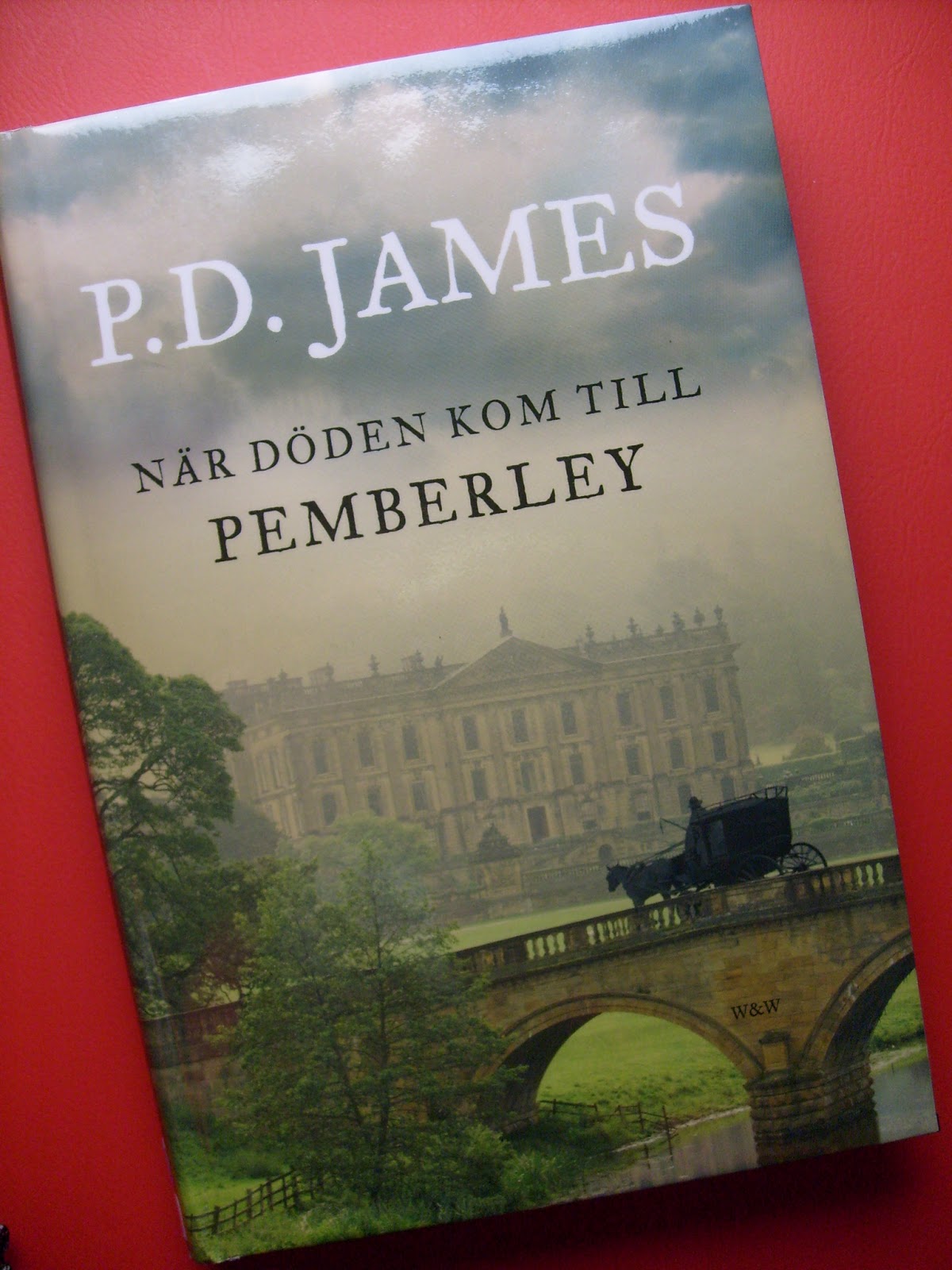
I have only attempted P D James once, and failed to get through one of her Dalgliesh-mysteries. Frankly, I found her boring, though I like Roy Marsden´s Dalgliesh on television. (We saw a re-run of "Death of an Expert Witness" from 1983 about a year ago - and wow! is that a slow tale. The murder happened in the third episode, if I remember correctly!) Still, I couldn´t resist "Death Comes to Pemberley" when I saw it.
I read it in Swedish ("När döden kom till Pemberley"), and the translator is reputable, but in one or two places I felt like perhaps she had misunderstood some archaic turn of phrase. I could be wrong though, without the original text to compare. I do prefer to read English books in English. When I don´t, I tend to translate the dialogue in my head, particularly when it´s set in an environment that I associate strongly with particular types of language. This is a tiresome way to read.
James has been very respectful to Austen. Unlike Hill, who takes Austen´s style and stories and runs away with them, putting his own spin on it, James stays firmly within the boundries of "Pride & Prejudice". And even though she writes what is technically a who-done-it, a murder mystery, and sets it six years later, it´s more or less a repeat of P&P. It reminds me of all those Star Wars comics I read in the 80´s, with writers trying to come up with stories that didn´t take the characters anywhere, that didn´t allow them to develop. Here, the characters spend a lot of time reiterating what happened in P&P. And the bad guys still make all the trouble, the good guys are still paying for it - actually, they are all competing with Jane Bennett for the prize Most Meek Character in fiction, ever. James never manages to go outside Austen´s work, doesn´t pull it a single inch forward. Or sideways, or anywhere.
Mr and Mrs Darcy keep talking to each other "mildly", touching each other "mildly", and giving each other "mild" looks. This is perhaps why no one should write a sequel to "happy ever after", unless they are willing to disregard the original author´s intentions. Like Hill did when he turned Emma Woodhouse/Knightley into a murderess in the short story "Poor Emma" in the collection "There are no ghosts in the Soviet Union" (which I highly recommend). Not that I think Jane Austen imagined the Darcy marriage would evolve quite like this. Elisabeth has lost all her wit, Darcy all his confidence and experience. If James longed to prove herself inferior to another author, she certainly has succeded. Or perhaps she has lost it; this novel was published in her 91st year!
And you know, whatever I might think of the book, just being alive at that age is an achievement! Also, she dedicates the book to her loyal secretary of 35 years, and having personally helped my mother-in-law write her memoir, I know how much work a secretary does. I do think people doing this kind of work full-time all deserve to have books dedicated to them!
If you like P D James, perhaps you will not be disappointed. If you like Austen, you certainly will.
I have only attempted P D James once, and failed to get through one of her Dalgliesh-mysteries. Frankly, I found her boring, though I like Roy Marsden´s Dalgliesh on television. (We saw a re-run of "Death of an Expert Witness" from 1983 about a year ago - and wow! is that a slow tale. The murder happened in the third episode, if I remember correctly!) Still, I couldn´t resist "Death Comes to Pemberley" when I saw it.
I read it in Swedish ("När döden kom till Pemberley"), and the translator is reputable, but in one or two places I felt like perhaps she had misunderstood some archaic turn of phrase. I could be wrong though, without the original text to compare. I do prefer to read English books in English. When I don´t, I tend to translate the dialogue in my head, particularly when it´s set in an environment that I associate strongly with particular types of language. This is a tiresome way to read.
James has been very respectful to Austen. Unlike Hill, who takes Austen´s style and stories and runs away with them, putting his own spin on it, James stays firmly within the boundries of "Pride & Prejudice". And even though she writes what is technically a who-done-it, a murder mystery, and sets it six years later, it´s more or less a repeat of P&P. It reminds me of all those Star Wars comics I read in the 80´s, with writers trying to come up with stories that didn´t take the characters anywhere, that didn´t allow them to develop. Here, the characters spend a lot of time reiterating what happened in P&P. And the bad guys still make all the trouble, the good guys are still paying for it - actually, they are all competing with Jane Bennett for the prize Most Meek Character in fiction, ever. James never manages to go outside Austen´s work, doesn´t pull it a single inch forward. Or sideways, or anywhere.
Mr and Mrs Darcy keep talking to each other "mildly", touching each other "mildly", and giving each other "mild" looks. This is perhaps why no one should write a sequel to "happy ever after", unless they are willing to disregard the original author´s intentions. Like Hill did when he turned Emma Woodhouse/Knightley into a murderess in the short story "Poor Emma" in the collection "There are no ghosts in the Soviet Union" (which I highly recommend). Not that I think Jane Austen imagined the Darcy marriage would evolve quite like this. Elisabeth has lost all her wit, Darcy all his confidence and experience. If James longed to prove herself inferior to another author, she certainly has succeded. Or perhaps she has lost it; this novel was published in her 91st year!
And you know, whatever I might think of the book, just being alive at that age is an achievement! Also, she dedicates the book to her loyal secretary of 35 years, and having personally helped my mother-in-law write her memoir, I know how much work a secretary does. I do think people doing this kind of work full-time all deserve to have books dedicated to them!
If you like P D James, perhaps you will not be disappointed. If you like Austen, you certainly will.
2013-01-08
Murder in lala-land
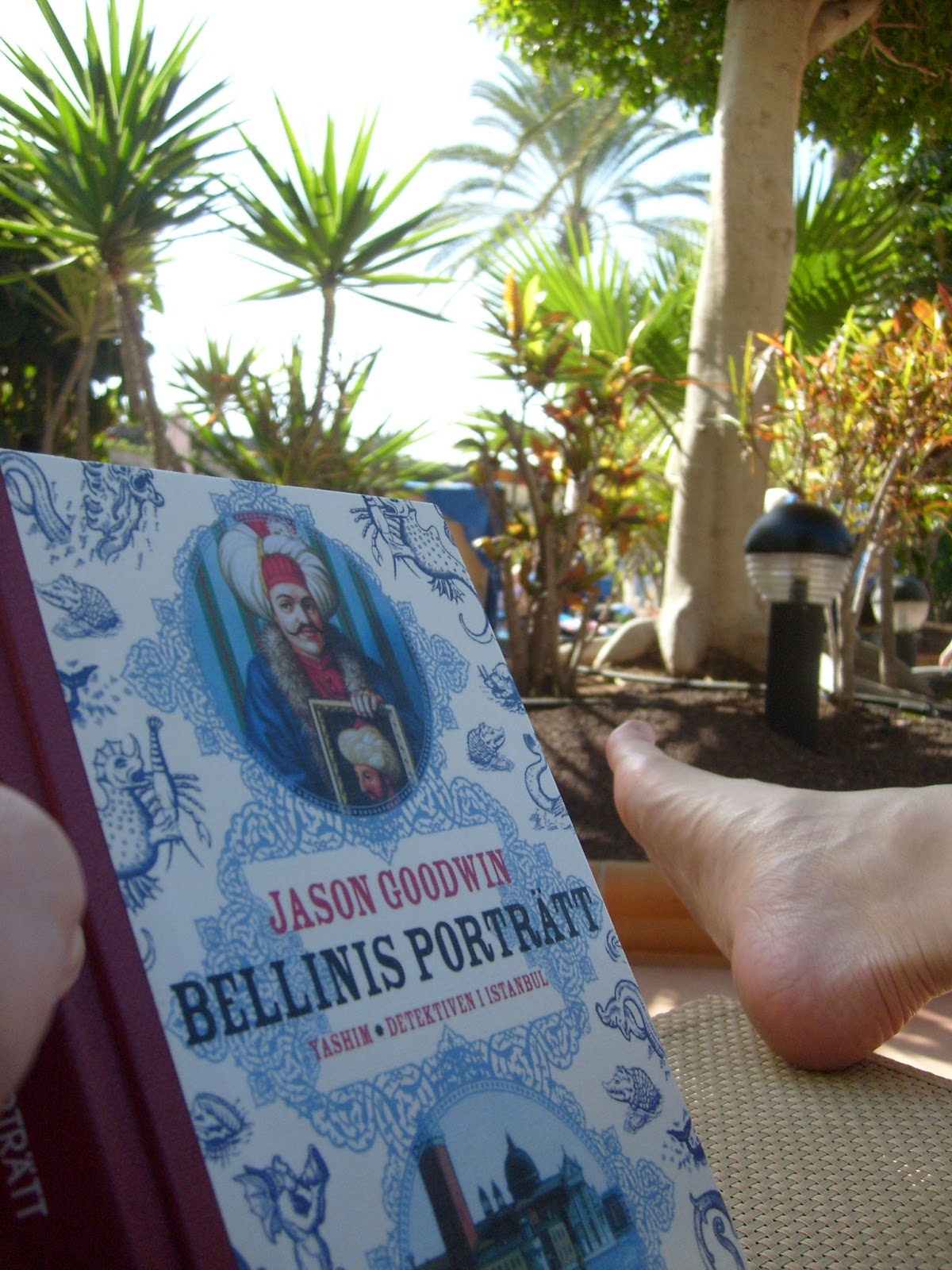
For a week on a lounger, it is necessary to bring a proper detective story. I brought two, and one of them I finished while still under the palmtrees. Jason Goodwin, historian and Byzantine specialist, has written four volumes so far in a series about the eunuch Yashim, and this is the third, "The Bellini Card". I chose it after seeing Goodwin appear in a documentary on Swedish television only a week or so before Christmas, about Topkapi Palace, the old residence of the Sultans. The library had it, and so I packed it.
I just searched my own blog, to see what I had written about the other two, but I can´t find that I have written about this author before. It doesn´t seem that long ago that I read him, but it must be pre-blog, I presume. It really, really doesn´t feel that long. Probably because Yashim and the stories of Istanbul in the 1800´s made an impression on me, and is very much alive in my memory. I have read better books than Goodwin´s last year, that I can hardly remember at all, so there you are: quality and impact is not necessarily linked.
Yashim is not the kind of eunuch you might think of, when you think of a sultan´s palace. He is not fat, soft-skinned, or squeeky-voiced. He was already a young man, well into puberty, when enemies of his father killed his mother and kastrated him. After that, he was sent to the Ottoman Sultan´s court, to be educated and given a place in life. And he has worked for the Sultan since, doing "special services" suited to his talent of being "invisible" and really, really clever. He is like the Sultan´s own James Bond, when he needs to be. When he doesn´t, he is a quiet and peaceful man, mostly interested in cooking. He is such a foodie that he can´t even go on a dangerous mission, without stopping somewhere to make a pilaff or a moussaka. He uses his cooking knife for a weapon, even.
This time, the new, young Sultan wants a painting. This painting, a portrait of a legendary ancestor, is supposedly for sale in Venice. However, an advisor of the Sultan, a pasha, tells Yashim to lay low, that the Sultan is young, inexperienced and that some of his wishes are "like water". Yashim decides to send his best friend, the Polish ambassador Palewski, who is itching to get away from Istanbul for a while (the background story of Palewski is very interesting), to see if the painting can be acquired. He goes disguised as an American art collector, Mr Brett.
Of course, Venitian art dealers turn up dead in the canals of Venice, and Yashim has to come sort things out. And cook a meal. He meets some interesting characters on the way, does some fighting, beds a woman (I know, who would´ve thought - he is a eunuch, isn´t he?) solves the riddle, and in the process the reader has learned quite a few interesting things about Venice´s history.
The one thing that bugs me just a little bit has to do with the tempo. The action scenes just doesn´t feel right in all of this. Yashim is more of a Poirot than a Bond, but Goodwin makes him both. Ok, there is a second thing that isn´t quite ... and that is the sex. Yashim has a very androgynous feel to him, he is considered sexless in Istanbul, and perhaps all that cooking and history also contributes to that. He is called Yashim lala, sort of like "uncle", which is what the eunuchs were called, who had access to the harem, the women´s house, and the Sultan´s private quarters. I can´t really see him make love to... but that would be to spoil it for you. My objections are small, after all, Goodwin is certainly not the only writer who writes crappy sex scenes for no reason at all. And maybe these odd bits that stand out are what makes him so particularly memorable.
The books about Yashim are special. The hero is special, the milieu is special, the plots are well thought out. There is more brain than heart in these books, but what do you expect from an academic? And sometimes (perhaps most of the time), that is just what I want. And I´m not the only one. This series is translated into almost 40 languages.
I just searched my own blog, to see what I had written about the other two, but I can´t find that I have written about this author before. It doesn´t seem that long ago that I read him, but it must be pre-blog, I presume. It really, really doesn´t feel that long. Probably because Yashim and the stories of Istanbul in the 1800´s made an impression on me, and is very much alive in my memory. I have read better books than Goodwin´s last year, that I can hardly remember at all, so there you are: quality and impact is not necessarily linked.
Yashim is not the kind of eunuch you might think of, when you think of a sultan´s palace. He is not fat, soft-skinned, or squeeky-voiced. He was already a young man, well into puberty, when enemies of his father killed his mother and kastrated him. After that, he was sent to the Ottoman Sultan´s court, to be educated and given a place in life. And he has worked for the Sultan since, doing "special services" suited to his talent of being "invisible" and really, really clever. He is like the Sultan´s own James Bond, when he needs to be. When he doesn´t, he is a quiet and peaceful man, mostly interested in cooking. He is such a foodie that he can´t even go on a dangerous mission, without stopping somewhere to make a pilaff or a moussaka. He uses his cooking knife for a weapon, even.
This time, the new, young Sultan wants a painting. This painting, a portrait of a legendary ancestor, is supposedly for sale in Venice. However, an advisor of the Sultan, a pasha, tells Yashim to lay low, that the Sultan is young, inexperienced and that some of his wishes are "like water". Yashim decides to send his best friend, the Polish ambassador Palewski, who is itching to get away from Istanbul for a while (the background story of Palewski is very interesting), to see if the painting can be acquired. He goes disguised as an American art collector, Mr Brett.
Of course, Venitian art dealers turn up dead in the canals of Venice, and Yashim has to come sort things out. And cook a meal. He meets some interesting characters on the way, does some fighting, beds a woman (I know, who would´ve thought - he is a eunuch, isn´t he?) solves the riddle, and in the process the reader has learned quite a few interesting things about Venice´s history.
The one thing that bugs me just a little bit has to do with the tempo. The action scenes just doesn´t feel right in all of this. Yashim is more of a Poirot than a Bond, but Goodwin makes him both. Ok, there is a second thing that isn´t quite ... and that is the sex. Yashim has a very androgynous feel to him, he is considered sexless in Istanbul, and perhaps all that cooking and history also contributes to that. He is called Yashim lala, sort of like "uncle", which is what the eunuchs were called, who had access to the harem, the women´s house, and the Sultan´s private quarters. I can´t really see him make love to... but that would be to spoil it for you. My objections are small, after all, Goodwin is certainly not the only writer who writes crappy sex scenes for no reason at all. And maybe these odd bits that stand out are what makes him so particularly memorable.
The books about Yashim are special. The hero is special, the milieu is special, the plots are well thought out. There is more brain than heart in these books, but what do you expect from an academic? And sometimes (perhaps most of the time), that is just what I want. And I´m not the only one. This series is translated into almost 40 languages.
2012-10-02
Building a House for the Soul
A man comes shellshocked from the trenches at Passchendaele, leaves his wealthy Boston family to travel across the continent, ending up on an island outside Vancouver, building his house and restoring his health. Then, his house goes up in flame and he disappears. A letter to his brother some few years later suggests he is alive, but after that, there is only silence.
Seventy years later, his great-niece follows in his footsteps, after a sojourn at a mental hospital, following a terrible accident where she is severely injured and which takes the lives of her husband and youngest daugher. She brings with her a tent, lumber, and goes cold turkey on her medicines.
The symbolically named Rae Newborn faces her demons, both imaginary and real, and at the same time she solves the mystery surrounding her great-uncle´s disappearance. Building her house becomes (of course) a metafor for healing, and bit by bit she opens up and is drawn in to the community around her. The novel is "Folly" by Laurie R King, and it´s the most Jungian novel I think I have ever read. In Jungian symbolism, the house is a symbol for the Self, and Desmond´s and Rae´s house has two stone towers, one for each of them. Those of you who have read Jung´s memoars know that he built his own tower. Clues come to Rae in dreams, and she and the reader is given the chance to see beyond the obvious, but both of us (she and this particular reader) are pretty surprised when the reckoning comes.
The book is a thriller, a suspense drama, but also a very good portayal of a woman psychologically frail, and an excellent depiction of what it can be like to have a selfish, manipulative person as part of your family. And one thing that I think King does so well: she can really do happy, harmonious relationships, great friendships and love affairs, without making them boring and too-good-to-be-true. King does not turn away from the shit that happens, she often returns to the trauma of war, particularly the Great War, but she also recognizes that there is profound goodness in the world, that there are many people out there who work in silence and without reward for the good of others. I recognize all of it in my own personal life, and it feels reassuring to read someone who has that same experience.
Sometimes, in the way she ties it all together, she reminds me a bit of Reginald Hill, but she gives her characters an emotional depth that he never manages to do. Ok, so "Folly" will not give her the Nobel Prize, but you know, this story, and these characters, will stay with me a long time. If I had been younger, I might have taken up carpentry, just like Rae Newborn.
Do read it.
Seventy years later, his great-niece follows in his footsteps, after a sojourn at a mental hospital, following a terrible accident where she is severely injured and which takes the lives of her husband and youngest daugher. She brings with her a tent, lumber, and goes cold turkey on her medicines.
The symbolically named Rae Newborn faces her demons, both imaginary and real, and at the same time she solves the mystery surrounding her great-uncle´s disappearance. Building her house becomes (of course) a metafor for healing, and bit by bit she opens up and is drawn in to the community around her. The novel is "Folly" by Laurie R King, and it´s the most Jungian novel I think I have ever read. In Jungian symbolism, the house is a symbol for the Self, and Desmond´s and Rae´s house has two stone towers, one for each of them. Those of you who have read Jung´s memoars know that he built his own tower. Clues come to Rae in dreams, and she and the reader is given the chance to see beyond the obvious, but both of us (she and this particular reader) are pretty surprised when the reckoning comes.
The book is a thriller, a suspense drama, but also a very good portayal of a woman psychologically frail, and an excellent depiction of what it can be like to have a selfish, manipulative person as part of your family. And one thing that I think King does so well: she can really do happy, harmonious relationships, great friendships and love affairs, without making them boring and too-good-to-be-true. King does not turn away from the shit that happens, she often returns to the trauma of war, particularly the Great War, but she also recognizes that there is profound goodness in the world, that there are many people out there who work in silence and without reward for the good of others. I recognize all of it in my own personal life, and it feels reassuring to read someone who has that same experience.
Sometimes, in the way she ties it all together, she reminds me a bit of Reginald Hill, but she gives her characters an emotional depth that he never manages to do. Ok, so "Folly" will not give her the Nobel Prize, but you know, this story, and these characters, will stay with me a long time. If I had been younger, I might have taken up carpentry, just like Rae Newborn.
Do read it.
2012-09-12
Sleuth Sigerson
It was my intention to read all the five books in the Martinelli-series by Laurie R King, but unfortunately the library shelves for detective stories are a mess, and I couldn´t find anything where it was supposed to be. I don´t really think readers of detective stories are generally more careless than other readers, but I´m sure there are more of them. Anyway, I took it as a sign to go straight for my prize, the Martinelli/Holmes merger, "The Art of Detection".
I have to say, it´s nice to read a Holmes story by King again. She does it so well, it´s such a pleasure to read. I´m not as charmed by Martinelli, I think she is a boring and wooden character and her partnership with collegue Alonzo Hawkin just too smooth and conflict free. Even Morse and Lewis had a bit of tension at times. And her domestic situation is very politically correct - actually, the theme of this entire story is very close to Martinelli´s particular home.
But these are small complaints and entirely a matter of personal taste. The riddle is pure joy. A dead man is found in an old abandoned battery on the San Francisco coast, and the case lands on Martinelli´s and Hawkin´s desks. The deceased has been a real Sherlock Holmes-afficionado, a dealer in Holmes collectibles, even looked a bit like Holmes himself, and was a bit of a star among the "sherlockians" of San Francisco. He had even recreated his home to look like Baker Street 221B. Among his possessions they find a manuscript, a rumoured "lost" novel by Arthur Conan Doyle and Martinelli sits down to read it. It´s a story, set in 1924, told by a nameless person, posing though as "Mr Sigerson", an alias of Holmes´. And the murdered man of that mystery is found in exactly the same place, the abandoned battery.
Of course, those of us who are in the know, realize immediately that the text is a diary, written by the real Sherlock Holmes, who, as we know, had some time on his hands while visiting San Francisco in 1924 with Mary Russell, for her to settle some of her father´s affairs (as told in "Locked Rooms"). It has been found in a hidden nook in the attic of Russell´s old house, along with the typewriter it was written on. Of course, no one realizes that it´s anything but fiction and for the Martinelli story it really doesn´t matter that they don´t. While the two cases aren´t directly connected, there is a literary connection, a common theme, and the manuscript itself is the trigger for the present day crime. Which I could write some more about, but I´d rather recommend that you find the book yourself. I will not give the mystery away.
One of the minor female characters that pass by in Martinelli´s enquiries, looks just like Laurie R King herself, or so I imagine. I would not be surprised if some other "sherlockians" have had the pleasure of being written into a Holmes story, of sort, but of course that´s only a speculation on my part. Anyway, I think she had fun writing this. And it´s the last Martinelli story. Or latest, perhaps. And it ends very happily, like the end of a fairytale. And they lived happily ever after? Will King return to Martinelli or devote herself to more Russell&Holmes? You know what I´m hoping for!
Actually, the latest Russell&Holmes book was released just a few days ago. I´m saving it for Christmas. I shall lie on a Spanish sand dune and read.
I have to say, it´s nice to read a Holmes story by King again. She does it so well, it´s such a pleasure to read. I´m not as charmed by Martinelli, I think she is a boring and wooden character and her partnership with collegue Alonzo Hawkin just too smooth and conflict free. Even Morse and Lewis had a bit of tension at times. And her domestic situation is very politically correct - actually, the theme of this entire story is very close to Martinelli´s particular home.
But these are small complaints and entirely a matter of personal taste. The riddle is pure joy. A dead man is found in an old abandoned battery on the San Francisco coast, and the case lands on Martinelli´s and Hawkin´s desks. The deceased has been a real Sherlock Holmes-afficionado, a dealer in Holmes collectibles, even looked a bit like Holmes himself, and was a bit of a star among the "sherlockians" of San Francisco. He had even recreated his home to look like Baker Street 221B. Among his possessions they find a manuscript, a rumoured "lost" novel by Arthur Conan Doyle and Martinelli sits down to read it. It´s a story, set in 1924, told by a nameless person, posing though as "Mr Sigerson", an alias of Holmes´. And the murdered man of that mystery is found in exactly the same place, the abandoned battery.
Of course, those of us who are in the know, realize immediately that the text is a diary, written by the real Sherlock Holmes, who, as we know, had some time on his hands while visiting San Francisco in 1924 with Mary Russell, for her to settle some of her father´s affairs (as told in "Locked Rooms"). It has been found in a hidden nook in the attic of Russell´s old house, along with the typewriter it was written on. Of course, no one realizes that it´s anything but fiction and for the Martinelli story it really doesn´t matter that they don´t. While the two cases aren´t directly connected, there is a literary connection, a common theme, and the manuscript itself is the trigger for the present day crime. Which I could write some more about, but I´d rather recommend that you find the book yourself. I will not give the mystery away.
One of the minor female characters that pass by in Martinelli´s enquiries, looks just like Laurie R King herself, or so I imagine. I would not be surprised if some other "sherlockians" have had the pleasure of being written into a Holmes story, of sort, but of course that´s only a speculation on my part. Anyway, I think she had fun writing this. And it´s the last Martinelli story. Or latest, perhaps. And it ends very happily, like the end of a fairytale. And they lived happily ever after? Will King return to Martinelli or devote herself to more Russell&Holmes? You know what I´m hoping for!
Actually, the latest Russell&Holmes book was released just a few days ago. I´m saving it for Christmas. I shall lie on a Spanish sand dune and read.
2012-09-02
A Decent Mystery
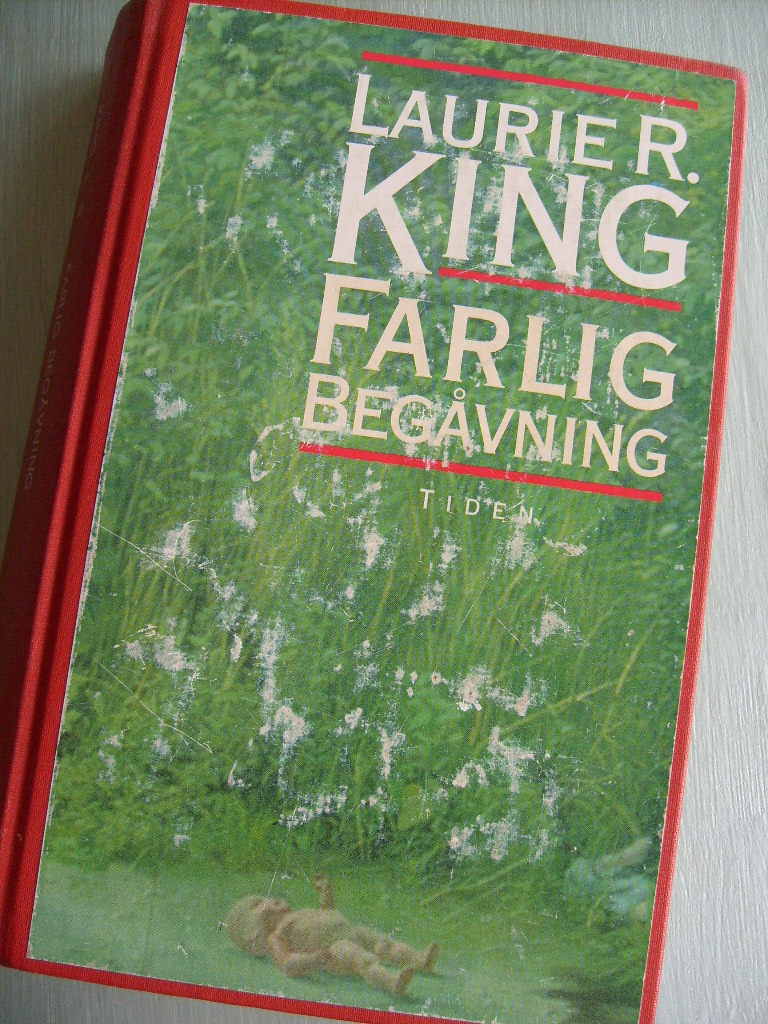
As you may know, I am a great fan of the Russell&Holmes-series by Laurie R King. It came to my attention that she has written another, more modern series of crime novels and that in one of them she connects her modern day heroine with Holmes - as you might imagine, this is something I really want to read. But I decided to get aquainted with her Kate Martinelli-character first. The first book is "A Grave Talent" (Swedish: "Farlig begåvning") and I´m not sure what I think.
First I should say: I know how well King writes. This translation is at times very sloppy. And generally, I don´t like reading books that are set in England or the US, full of dialogue, in Swedish. I tend to translate the dialogue back to English in my head, and it takes forever to get through. Of course, not all translation is sloppy, and not all books are as culturally specific. For example, I will gladly read Coetzee in translation or in English, it doesn´t matter. Reading Reginald Hill in translation is physically painful, particularly the first ones, where some poor sod tried to turn Yorkshire dialect into some Swedish yokel-ect. No, no, no! (Waving garlic braid.) King is, I believe, very exact about how she says things. The most charming character in this book is a young girl, a precocious child, who is very precise (shockingly so, to some adults) with her words. Here, I sense King herself.
The plot is ok. Children are murdered (but not in a shockingly splattery way, thank you very much), new detective Martinelli is paired with oldtimer Hawkin, they get along (both being intelligent creatures - I can´t imagine King making up a fool), there is some secrecy about Martinelli´s personal life, hints made, and so on. For the longest time I thought the victim would turn out to be the killer after all, but no.
I have to say, King does not even by a stretch reach the level of the Russell-books here. But then again, this is her very first published novel. (Though I think she wrote "The Beekeeper´s Apprentice" before this one.) I don´t think she is pouring nearly as much of herself into Kate Martinelli as she does into Russell (and Holmes, for that matter). It just doesn´t have the same charm. Martinelli never really comes to life for me. Perhaps it´s the crappy translation, I don´t know.
That said, compared to most other average detective stories I have read, it measures up more than well. (And she won a prize for it.) If you want a really good novel, perhaps I would not recommend it. If you want a good mystery for your Easter holiday or weekend in bed, I will. And I will go on with the series myself. I like King, I´m loyal to her and I´m expecting Martinelli et al. to grow stronger.
And sometimes, all you want (and need) is a pageturner, not a text that will turn your life around. Which reminds me of a great quote by Stanley Elkin that I think I will share with you:
First I should say: I know how well King writes. This translation is at times very sloppy. And generally, I don´t like reading books that are set in England or the US, full of dialogue, in Swedish. I tend to translate the dialogue back to English in my head, and it takes forever to get through. Of course, not all translation is sloppy, and not all books are as culturally specific. For example, I will gladly read Coetzee in translation or in English, it doesn´t matter. Reading Reginald Hill in translation is physically painful, particularly the first ones, where some poor sod tried to turn Yorkshire dialect into some Swedish yokel-ect. No, no, no! (Waving garlic braid.) King is, I believe, very exact about how she says things. The most charming character in this book is a young girl, a precocious child, who is very precise (shockingly so, to some adults) with her words. Here, I sense King herself.
The plot is ok. Children are murdered (but not in a shockingly splattery way, thank you very much), new detective Martinelli is paired with oldtimer Hawkin, they get along (both being intelligent creatures - I can´t imagine King making up a fool), there is some secrecy about Martinelli´s personal life, hints made, and so on. For the longest time I thought the victim would turn out to be the killer after all, but no.
I have to say, King does not even by a stretch reach the level of the Russell-books here. But then again, this is her very first published novel. (Though I think she wrote "The Beekeeper´s Apprentice" before this one.) I don´t think she is pouring nearly as much of herself into Kate Martinelli as she does into Russell (and Holmes, for that matter). It just doesn´t have the same charm. Martinelli never really comes to life for me. Perhaps it´s the crappy translation, I don´t know.
That said, compared to most other average detective stories I have read, it measures up more than well. (And she won a prize for it.) If you want a really good novel, perhaps I would not recommend it. If you want a good mystery for your Easter holiday or weekend in bed, I will. And I will go on with the series myself. I like King, I´m loyal to her and I´m expecting Martinelli et al. to grow stronger.
And sometimes, all you want (and need) is a pageturner, not a text that will turn your life around. Which reminds me of a great quote by Stanley Elkin that I think I will share with you:
I don’t believe that less is more. I believe that more is more. I believe that less is less, fat fat, thin thin and enough is enough.Amen.
2011-08-26
Mary Russell saves the world from Men in Black
Long time no blogging. Yeah, it´s been a bit busy for a while, with a close relative in and out of hospital and needing a bit of support in the day to day chores, like making dinner and such. I have been focused on needs other than my own and that´s probably a good thing once in a while. If nothing else, I´m glad I´m relatively healthy! However, it slows my reading.
Another thing that has slowed my pace (of blogging, at least) is my decision to re-read "The Language of Bees" by Laurie R King, a book that I have already read and written about. (And, I can see now, I misspelled my heroin´s name all through the post. Oh well, bygones.) Of course, I had a different experience reading it now, when I know Mary Russell, her Holmes, where they came from and how they got to where they are now. And a year on, really one does not remember all the sides to a detective story plot. Not even one by Laurie R King.
I then proceeded with "The God of the Hive". Which continues directly where "The Language of Bees" ended. Russell and Holmes have split up after successfully stopping a mad Reverend carrying out his plan for world domination. They are still wanted by the police and have a few other concerns that I really can´t give away. Holmes ends up abroad due to circumstances beyond his control, and Russell finds herself deeply embedded in a forrest in the Lake District with a motley crew of companions. They both find themselves hunted down and almost caught by "men in black". Is the mad Reverend still alive and kicking? And how powerful is he? Or is someone much more powerful behind him, someone with much greater, and much more realistic ambitions for world domination? And what is happening to Mycroft Holmes?
There were bits about this novel that I loved. Russell has the opportunity to get more acquainted with the ways of airtravel and I find these parts quite interesting. I also love some of the new characters and I hope very much to see more of them in books yet unwritten. One of them should really have a series of her own, I think she is made for adventure (look away if you don´t want to know - it´s Holmes´ granddaughter Estelle, a half-chinese infant prodigy with perfect pitch). There are also bits I´m a bit disappointed with. You don´t really get who the villain in this drama is. There is at least one thread in the storyline that leads nowhere, perhaps it´s there to give us a scare, I don´t know. And a conflict between two of the main characters seems a bit contrived. Perhaps it´s just me.
All in all, it starts like a Russell&Holmes case, and ends like a James Bond adventure. And why not. King has been looking for inspiration in all kinds of literary places, with great results.
I now have one book left in the series to read, and that is "The Pirate King". I shall save it for Christmas, I think. I need a break from Mary Russell just now, I feel. Moderation in all things is best.
Another thing that has slowed my pace (of blogging, at least) is my decision to re-read "The Language of Bees" by Laurie R King, a book that I have already read and written about. (And, I can see now, I misspelled my heroin´s name all through the post. Oh well, bygones.) Of course, I had a different experience reading it now, when I know Mary Russell, her Holmes, where they came from and how they got to where they are now. And a year on, really one does not remember all the sides to a detective story plot. Not even one by Laurie R King.
I then proceeded with "The God of the Hive". Which continues directly where "The Language of Bees" ended. Russell and Holmes have split up after successfully stopping a mad Reverend carrying out his plan for world domination. They are still wanted by the police and have a few other concerns that I really can´t give away. Holmes ends up abroad due to circumstances beyond his control, and Russell finds herself deeply embedded in a forrest in the Lake District with a motley crew of companions. They both find themselves hunted down and almost caught by "men in black". Is the mad Reverend still alive and kicking? And how powerful is he? Or is someone much more powerful behind him, someone with much greater, and much more realistic ambitions for world domination? And what is happening to Mycroft Holmes?
| At the Sherlock Holmes Museum in London. |
There were bits about this novel that I loved. Russell has the opportunity to get more acquainted with the ways of airtravel and I find these parts quite interesting. I also love some of the new characters and I hope very much to see more of them in books yet unwritten. One of them should really have a series of her own, I think she is made for adventure (look away if you don´t want to know - it´s Holmes´ granddaughter Estelle, a half-chinese infant prodigy with perfect pitch). There are also bits I´m a bit disappointed with. You don´t really get who the villain in this drama is. There is at least one thread in the storyline that leads nowhere, perhaps it´s there to give us a scare, I don´t know. And a conflict between two of the main characters seems a bit contrived. Perhaps it´s just me.
All in all, it starts like a Russell&Holmes case, and ends like a James Bond adventure. And why not. King has been looking for inspiration in all kinds of literary places, with great results.
I now have one book left in the series to read, and that is "The Pirate King". I shall save it for Christmas, I think. I need a break from Mary Russell just now, I feel. Moderation in all things is best.
2011-08-01
A Little Vacation Reading
I started with a Swedish, fresh novel come out this year, and after about page ten I was sooo bored. So I gave it up. I shall mention no names. Instead, I reached for my debit card and logged onto ebooks.com and downloaded the next two Mary Russell-mysteries. Actually, I have already read one, "The Language of Bees", it was the first one in the series I read, almost exactly one year ago. However, I want to read it again since it´s part one in a two-part mystery continuing with "The God of the Hive".
Not that I have come anywhere near either of them yet, it´s vacation after all and the weather is fine and we have other things to do (things that make pretty pictures, like the one below).
What I have had time to read, though, is Laurie R King´s little e-novella, "Beekeeping for Beginners". It´s a quick, satisfying read, Holmes´s take on his and Russell´s first meeting and what followed. After "Looked Rooms", I had gotten used to Holmes´s point of view and it didn´t feel at all weird. And that´s all I can say, I think, without spoiling it for you.
Of course, without an e-book-reader, or a computer (but reading books on a hot and noisy computer sucks, in my opinion), this book will not be available to you. I suppose short stories must be much more economical to publish electronically. I wish all authors would publish electronically, but sadly, many still chose not to. And I have met some readers who are opposed (???) to e-books. Not that they have ever actually read one... I´m often asked if "the feeling" is the same. I really don´t get the question. Novels aren´t words on paper or screen, they are Worlds that come to nest inside my head.
Not that I have come anywhere near either of them yet, it´s vacation after all and the weather is fine and we have other things to do (things that make pretty pictures, like the one below).
| Pite River by Grundvattnet |
What I have had time to read, though, is Laurie R King´s little e-novella, "Beekeeping for Beginners". It´s a quick, satisfying read, Holmes´s take on his and Russell´s first meeting and what followed. After "Looked Rooms", I had gotten used to Holmes´s point of view and it didn´t feel at all weird. And that´s all I can say, I think, without spoiling it for you.
Of course, without an e-book-reader, or a computer (but reading books on a hot and noisy computer sucks, in my opinion), this book will not be available to you. I suppose short stories must be much more economical to publish electronically. I wish all authors would publish electronically, but sadly, many still chose not to. And I have met some readers who are opposed (???) to e-books. Not that they have ever actually read one... I´m often asked if "the feeling" is the same. I really don´t get the question. Novels aren´t words on paper or screen, they are Worlds that come to nest inside my head.
2011-07-22
Sherlock the dreamcatcher
The minute I got home, I buried myself in my sofa with my latest Russell&Holmes-mystery, "Locked Rooms" by Laurie R King. This time, by way of India ("The Game"), Japan and Hawaii, our couple arrives in San Francisco, Russell´s childhood home.
After her family´s death in an automobile accident that she barely survived, Russell still owns a couple of houses and has business interests in San Francisco, but she has been reluctant to return. Already on the boat she stops eating and becomes ridden by nightmares and Holmes feels that she is no longer herself. Clearly, this is a great trauma in Russell´s life and she dreads her home-coming.
While she submerges herself in grief and stumbles about in the debris of her past, Holmes starts an investigation into Russell´s dreams by himself, concealing this from Russell. He finds himself a couple of Irregulars, among them the future writer of detective stories, Dashiell Hammett. Now, I have only seen "The Maltese Falcon" and "The Thin Man" on screen, but that´s enough to realize that this book is probably littered with references to Hammett´s work.
Anyway, as per usual, I will not spoil anyone´s fun by telling you what happens, but it´s suspense all the way through. And for the first time in the series, King divides the narrative into the two perspectives of Russell and Holmes, something that didn´t feel entirely comfortable at first (to me, at least) but it´s made necessary by the story, really. And it works.
After her family´s death in an automobile accident that she barely survived, Russell still owns a couple of houses and has business interests in San Francisco, but she has been reluctant to return. Already on the boat she stops eating and becomes ridden by nightmares and Holmes feels that she is no longer herself. Clearly, this is a great trauma in Russell´s life and she dreads her home-coming.
While she submerges herself in grief and stumbles about in the debris of her past, Holmes starts an investigation into Russell´s dreams by himself, concealing this from Russell. He finds himself a couple of Irregulars, among them the future writer of detective stories, Dashiell Hammett. Now, I have only seen "The Maltese Falcon" and "The Thin Man" on screen, but that´s enough to realize that this book is probably littered with references to Hammett´s work.
Anyway, as per usual, I will not spoil anyone´s fun by telling you what happens, but it´s suspense all the way through. And for the first time in the series, King divides the narrative into the two perspectives of Russell and Holmes, something that didn´t feel entirely comfortable at first (to me, at least) but it´s made necessary by the story, really. And it works.
| From the Sherlock Holmes Museum, visited a week ago, haha! |
2011-06-04
Expansion of the Holmes universe
I threw myself at the next Holmes & Russell adventure by Laurie R King, "The Game". This time she mixes Holmes-mythology with something that I´m not at all familiar with, and that is Rudyard Kipling´s "Kim". I had no idea, really, all I know Kipling for is "The Jungle Book" and that´s just courtesy of Walt Disney. According to Wikipedia, Kipling is most known for children´s books celebrating British imperialism and that had definately gone out of style when I was young, if it ever was very popular in Scandinavia. A quick look at the library database tells me that there are versions of it from 1957, 1984, and 2002, so perhaps I just missed it. It´s a classic. What do you know.
Anyway, guess what? When Holmes was "dead" from having supposedly fallen down Reichenbacher Falls with Moriarty, he spent some time in India, working with Kim! And it´s not King´s idea, she has stolen it from a guy called Jamyang Norbu! If only Conan Doyle could have foreseen it all...
It is now 1924, the Labour Party has won the last election, Lenin is lying on his deathbed, and the British and US establishments are becoming anxious about the Communists. It´s been 30 years since Holmes worked with Kim, who is still a spy for the British government and has gone missing. Other agents go missing too, and turn up dead. Mycroft Holmes wants to know what´s going on and sends Holmes and Russell to investigate. On the boat to India they encounter an American family on their way to visit a maharaja in the north. The son, a self-proclaimed Marxist, attracts Holmes´attention. Not surprisingly, they meet again.
With the help of British officer Nesbit and street urchin Bindra, a few great disguises, magic, and a bit of blind luck, they discover the fate of Kim and saves the British Empire. For the time being, at least. King is mainly focused on the adventure, but she also manages to nudge the Holmes-Russell relationship along an inch of two. Russell is really coming into her own as a powerful and independent player of the great detective-game and Holmes, though always in control of his end, does not always hold the initiative.
I have already bought the next one, "Locked Rooms" from ebooks.com that may soon be my new favourite webshop... But first I shall take a turn with Günter Grass!
Anyway, guess what? When Holmes was "dead" from having supposedly fallen down Reichenbacher Falls with Moriarty, he spent some time in India, working with Kim! And it´s not King´s idea, she has stolen it from a guy called Jamyang Norbu! If only Conan Doyle could have foreseen it all...
It is now 1924, the Labour Party has won the last election, Lenin is lying on his deathbed, and the British and US establishments are becoming anxious about the Communists. It´s been 30 years since Holmes worked with Kim, who is still a spy for the British government and has gone missing. Other agents go missing too, and turn up dead. Mycroft Holmes wants to know what´s going on and sends Holmes and Russell to investigate. On the boat to India they encounter an American family on their way to visit a maharaja in the north. The son, a self-proclaimed Marxist, attracts Holmes´attention. Not surprisingly, they meet again.
With the help of British officer Nesbit and street urchin Bindra, a few great disguises, magic, and a bit of blind luck, they discover the fate of Kim and saves the British Empire. For the time being, at least. King is mainly focused on the adventure, but she also manages to nudge the Holmes-Russell relationship along an inch of two. Russell is really coming into her own as a powerful and independent player of the great detective-game and Holmes, though always in control of his end, does not always hold the initiative.
I have already bought the next one, "Locked Rooms" from ebooks.com that may soon be my new favourite webshop... But first I shall take a turn with Günter Grass!
2011-05-24
Holmes and Russel, again
Another adventure with Mary Russell and Sherlock Holmes, this time mostly at a huge estate on the English countryside, in "Justice Hall" by Laurie R King. To give you an idea of the atmosphere, think of films like Altman´s "Gosford Park", the recent tv-series "Downton Abbey" or perhaps a Poirot-mystery. As far as I can tell, King has done some fine research on the manners of the upper classes, the fashions and the spirit of the time, just a few years after the Great War.
Russell and Holmes are just come home from Dartmoor, have hardly had time to set their bags down, have a bath, and let mrs Hudson serve them tea and crumpets, when there´s a knock on the door. And back into their lives comes their two Arab brothers Mahmoud and Ali Hazr, from their adventure in "O Jerusalem", and puts a case at their feet that is rather surprising, considering. Can´t tell you more, without spoiling the surprise.
A quick trip to Lyons, an equally fast journey to Canada (by boat and train, no regular airtraffic for the masses at this time!) does not really affect the atmosphere of the Big House, not even flashbacks to the trenches in France and Belgium during the war. Between the investigations Russell is mostly concerned with topics of conversation, the etiquette of fowl hunting and, yes indeed, "Holmes! Whatever shall I do? I haven´t a thing to wear."
King is very good at spicing her 1920´s-brew with small references of things that are so familiar to us now, but were quite new then. Some things are just fads, others stick, and there´s no telling at the time what is which. And some of what was considered eternal before the Great War, disappeared so very quickly, both institutions and ideas. Of course, without the actual use of a time machine there is no way of knowing if she´s got it right, but it feels right. Absolutely right.
Holmes has become, I think, less and less a main character in these stories, and more Russell´s husband. She contributes as much, sometimes more, to the investigations, and, as some people keep pointing out to her, he´s getting on a bit. But he is the apple of her eye, for sure, and for some reason he is constantly getting in and out of a bath, standing in his bare stockings and fiddling with his shirt buttons as he´s getting dressed for dinner. And isn´t this a loving description of a husband: "Holmes slumped down into the hard chair and prepared to listen, fingers steepled over his waistcoat, eyes half closed and glittering in the firelight like those of an observant snake."
Do I need to say I warmly recommend this?
Russell and Holmes are just come home from Dartmoor, have hardly had time to set their bags down, have a bath, and let mrs Hudson serve them tea and crumpets, when there´s a knock on the door. And back into their lives comes their two Arab brothers Mahmoud and Ali Hazr, from their adventure in "O Jerusalem", and puts a case at their feet that is rather surprising, considering. Can´t tell you more, without spoiling the surprise.
A quick trip to Lyons, an equally fast journey to Canada (by boat and train, no regular airtraffic for the masses at this time!) does not really affect the atmosphere of the Big House, not even flashbacks to the trenches in France and Belgium during the war. Between the investigations Russell is mostly concerned with topics of conversation, the etiquette of fowl hunting and, yes indeed, "Holmes! Whatever shall I do? I haven´t a thing to wear."
King is very good at spicing her 1920´s-brew with small references of things that are so familiar to us now, but were quite new then. Some things are just fads, others stick, and there´s no telling at the time what is which. And some of what was considered eternal before the Great War, disappeared so very quickly, both institutions and ideas. Of course, without the actual use of a time machine there is no way of knowing if she´s got it right, but it feels right. Absolutely right.
Holmes has become, I think, less and less a main character in these stories, and more Russell´s husband. She contributes as much, sometimes more, to the investigations, and, as some people keep pointing out to her, he´s getting on a bit. But he is the apple of her eye, for sure, and for some reason he is constantly getting in and out of a bath, standing in his bare stockings and fiddling with his shirt buttons as he´s getting dressed for dinner. And isn´t this a loving description of a husband: "Holmes slumped down into the hard chair and prepared to listen, fingers steepled over his waistcoat, eyes half closed and glittering in the firelight like those of an observant snake."
Do I need to say I warmly recommend this?
2011-05-02
Dungeons and Detectives
It´s the final week of December 1918, when a 54-year-old Englishman and an 18-year-old American girl are secretly set ashore in Palestine, recently occupied by the British. They are recieved by two Bedouin Arabs who are not too eager to have them tagging along. Of course it turns out that Sherlock Holmes is already fluent in Arabic, and through his relentless tutoring of Mary Russell, by the time they are going home, she can pass herself off as a Bedouin boy even in conversation. Yes, there is something of the savant about both of them. I often feel, when I read about this sleuth couple, really happy that they have found each other.
The book is "O Jerusalem" by Laurie R King, an up-graded boy adventure story, the kind I loved to read when I was little. The Americans are naive, the English are heroic and stout, the Arabs are noble vicims, the Jews too, and the Turks are swarthy villains. There are a number of dungeons, no dragons, but instead heaps of d... no, I won´t spoil it for you, and the clock ticks awfully close to Dead-line. Not all is as it seems, and Sherlock Holmes is a man who does not miss the small, infinitely important details...
What is there not to love about this? They seem to think so at my local library as well, since the last few books I requested in this series have been bought rather than sent after from another library. And I have become so Holmes-enthused that I have dug out my entire small collection of episodes from the tv-series with Jeremy Brett that I have randomly recorded and never watched. I wish now I had been more diligent and got the whole series, but no doubt it will be reprised anytime soon.
I tried to buy the next book in the series, "Justice Hall", for my e-book-reader, but copyright reasons (why do they only want to sell this book in the US?) prevented this. However, someone made a smarter deal about the next one, so now I have "The Game" in my reader and a request for "Justice Hall" at my local library. I want to read them chronologically, but I´m not sure I can keep myself off "The Game". This is a really excellent whodunnit-series, highly recommended. As far as I can tell, only the two first books in the series has been translated to Swedish: "Drottningfällan" and "Det monstruösa kvinnoregimentet".
Personally, I think if you know a language well enough to read an author´s original text, you should. With a few exceptions. Some authors are really well translated and I remember giving up on Antonia S Byatt once, getting the Swedish version instead. Reading shouldn´t be a chore, after all...
The book is "O Jerusalem" by Laurie R King, an up-graded boy adventure story, the kind I loved to read when I was little. The Americans are naive, the English are heroic and stout, the Arabs are noble vicims, the Jews too, and the Turks are swarthy villains. There are a number of dungeons, no dragons, but instead heaps of d... no, I won´t spoil it for you, and the clock ticks awfully close to Dead-line. Not all is as it seems, and Sherlock Holmes is a man who does not miss the small, infinitely important details...
What is there not to love about this? They seem to think so at my local library as well, since the last few books I requested in this series have been bought rather than sent after from another library. And I have become so Holmes-enthused that I have dug out my entire small collection of episodes from the tv-series with Jeremy Brett that I have randomly recorded and never watched. I wish now I had been more diligent and got the whole series, but no doubt it will be reprised anytime soon.
I tried to buy the next book in the series, "Justice Hall", for my e-book-reader, but copyright reasons (why do they only want to sell this book in the US?) prevented this. However, someone made a smarter deal about the next one, so now I have "The Game" in my reader and a request for "Justice Hall" at my local library. I want to read them chronologically, but I´m not sure I can keep myself off "The Game". This is a really excellent whodunnit-series, highly recommended. As far as I can tell, only the two first books in the series has been translated to Swedish: "Drottningfällan" and "Det monstruösa kvinnoregimentet".
Personally, I think if you know a language well enough to read an author´s original text, you should. With a few exceptions. Some authors are really well translated and I remember giving up on Antonia S Byatt once, getting the Swedish version instead. Reading shouldn´t be a chore, after all...
2011-04-04
On the Moor with Holmes
I have just finished the fourth in the series about Mary Russel, the young wife of Sherlock Holmes. This is "The Moor", by Laurie R King. If you know your Sherlockiana - well, even if you have a rudimentary knowledge about Conan Doyle´s classics - you´ll guess that this is a return to Dartmoor and the scene of the case of the hound of Baskerville.
Our heroine, Russel, is in Oxford, working on a book of her own, when the adventure begins. She is summoned to Dartmoor by a couple of insistant telegrams from Holmes, and she reluctantly comes. And then, not much happens the first half of the book. Holmes is distant and vague, Russel is mostly stumbling around in rain and mud, being cold and hungry and feeling her tasks are anything but relevant. It´s not even particularly certain that they are on a real case. They are staying with an old man with the peculiar name of Sabine Baring-Gould, an actual real-life person, who´s relationship to Holmes is a bit of a mystery as well. Baring-Gould has a feeling not all is well on the moor and that is, more or less, what they are investigating. Russel is frustrated, as am I, and I fully sympathise with her when on page 133 she falls on her face one time too many (thrown off the back of an ornery horse):
"So I lay flat on my back and cried like a child [...] in frustration at the ridiculous mockery of detective work I was forced to carry out and at my inability to anticipate the antics of my four-legged companion, in rage at the horse and at the sudden shock of pain; at everything and nothing, I cried."
However, after that the story picks up speed and in the end we have a couple of bona fide villains, a rainy and muddy chase on the moor and a happy end. And mid-novel I had motive both to read the original Baskerville-novel by Conan Doyle and see the tv-film with Jeremy Brett as Sherlock. Just wished I had had the old film with Basil Rathbone. I remember scenes from it quite vividly, despite not having seen it for at least twenty years or so. (Interestingly, before Rathbone had a go at the role, there had been four German versions made!)
Having just read Conan Doyle himself have increased my admiration for King, who really has managed to be true to the Sherlock character. I think Sherlock Holmes is one of those literary characters that somehow have become mythological in our culture and, as recent years have proven, he can be revived into any time and any place and be as interesting and engaging as ever.
I would like to add that King´s writing should be studied by all those writers who have been honored with the Bad Sex in Fiction Award. She does sex really well:
"My hair was nearly dry by the time Holmes came upstairs. He had paused to change more than his muddy boots, and looked very appealing, tall and slim in his jet suit and snowy shirtfront. One thing led to another, as is the wont in a marriage, and we did not get around to speaking about Ketteridge until after the housemaid had fetched up the morning tea."
That´s as steamy as I can take it, actually...
And now I am quite curious about Dartmoor. We are going to pass not far from it this summer, but our plans are focused to sights along the coast. I think a visit to the moor will have to wait to another year. It´s always nice to have a reason to return to a place, isn´t it?
Our heroine, Russel, is in Oxford, working on a book of her own, when the adventure begins. She is summoned to Dartmoor by a couple of insistant telegrams from Holmes, and she reluctantly comes. And then, not much happens the first half of the book. Holmes is distant and vague, Russel is mostly stumbling around in rain and mud, being cold and hungry and feeling her tasks are anything but relevant. It´s not even particularly certain that they are on a real case. They are staying with an old man with the peculiar name of Sabine Baring-Gould, an actual real-life person, who´s relationship to Holmes is a bit of a mystery as well. Baring-Gould has a feeling not all is well on the moor and that is, more or less, what they are investigating. Russel is frustrated, as am I, and I fully sympathise with her when on page 133 she falls on her face one time too many (thrown off the back of an ornery horse):
"So I lay flat on my back and cried like a child [...] in frustration at the ridiculous mockery of detective work I was forced to carry out and at my inability to anticipate the antics of my four-legged companion, in rage at the horse and at the sudden shock of pain; at everything and nothing, I cried."
However, after that the story picks up speed and in the end we have a couple of bona fide villains, a rainy and muddy chase on the moor and a happy end. And mid-novel I had motive both to read the original Baskerville-novel by Conan Doyle and see the tv-film with Jeremy Brett as Sherlock. Just wished I had had the old film with Basil Rathbone. I remember scenes from it quite vividly, despite not having seen it for at least twenty years or so. (Interestingly, before Rathbone had a go at the role, there had been four German versions made!)
Having just read Conan Doyle himself have increased my admiration for King, who really has managed to be true to the Sherlock character. I think Sherlock Holmes is one of those literary characters that somehow have become mythological in our culture and, as recent years have proven, he can be revived into any time and any place and be as interesting and engaging as ever.
I would like to add that King´s writing should be studied by all those writers who have been honored with the Bad Sex in Fiction Award. She does sex really well:
"My hair was nearly dry by the time Holmes came upstairs. He had paused to change more than his muddy boots, and looked very appealing, tall and slim in his jet suit and snowy shirtfront. One thing led to another, as is the wont in a marriage, and we did not get around to speaking about Ketteridge until after the housemaid had fetched up the morning tea."
That´s as steamy as I can take it, actually...
And now I am quite curious about Dartmoor. We are going to pass not far from it this summer, but our plans are focused to sights along the coast. I think a visit to the moor will have to wait to another year. It´s always nice to have a reason to return to a place, isn´t it?
Subscribe to:
Posts (Atom)