Showing posts with label classics. Show all posts

2015-02-28

The Careless

My last read but one (I´m a bit late on the blogging at the moment) was Margaret Drabble´s "The Gates of Ivory" (= Sw. "Elfenbensporten") from 1991, which has just been re-published by Modernista, in a series of modern classics. It was very favourably reviewed in one of the newspapers I read, so I suggested to my reading friend that we go for it in tandem, as I have always wanted to read Drabble, if only for the quote about sandwiches, which I can not find in English, so I don´t know if she actually said it like this:
"Det finns ingen anledning, till varför man inte skulle kunna njuta av smörgåsar och kärlek i evighet.Till skillnad från vissa andra tycks dessa nöjen inte ha någon inbyggd förslitning." (= There is no reason why one couldn´t enjoy sandwiches and love for all eternity. Unlike some others, these pleasures seem to have no natural tendency to wear. - Ok, probably all wrong; it´s weird and dangerous to translate back and forth.)
Anyway! It turned out that "The Gates of Ivory" is the last in a series of three novels, the first being "The Radiant Way" and the second "A Natural Curiosity". Not that I think it matters very much. I have checked out the reviews of all the novels in the New York Times (where they still write excellent and learned reviews - Swedish critics are not as sharp as we think they used to be, and it has been up for debate in the newspapers all winter), and they only confirm my decision not to read the other two. Not that this - or the others, I imagine - is a bad novel, on the contrary. It is very well written, and I never once felt inclined to put it down (it is 400 pages) even though the characters are a bunch of ridiculous people.

From the terracotta army - the only vaguely fitting illustration
 I coulf find in my photo collection.
The person who is the engine of the story is Stephen Cox, a middle-aged author famous for a Booker Award-winning novel about the Paris Commune. He is estranged from his mother and his brothers, and lives a rather quite single life in a small flat in London. Now - in 1985, that is - he decides to go looking for Pol Pot, to write a book or a play about him. It seems he is also looking for some meaning of life other than hoarding money, luxury items, and praise, which was the way of the 80´s, if you remember. So, he leaves his friends behind and disappear in the Far East. A couple of years later, his friend Liz Headleand, a divorced psychiatrist, recieves a package containing some of his notebooks and other papers, along with a human finger.

Now, what would you do if one of your friends, of whom you have heard nothing for years, suddenly sent you a package like that? A human finger, for Pete´s sake! Well, Liz Headleand does... not much. She phones another one of Stephen´s friends, Hattie (who also lives in Stephen´s flat while he is away), they get together, and do... pretty much nothing.

There are others - most left-leaning intellectuals who passed Cambridge or Oxford, most of them in important jobs with the government or BBC or something like that, all high-status people - at the fringes of this story, some of whom were probably more prominent in the earlier novels. They go in and out of the different scenes Drabble sets up and what strikes me most about all of them are their... carelessness. I mean both that they are careless as in negligent and reckless, but also indifferent and unconcerned. Marilynne Robinson writes, in her critique of "The Radiant Way", the first book in this series, and I think it applies to this one, too:
"The emotional withdrawal proposed to us in ''The Radiant Way'' is truly radical. Cast off familial and social bonds and what is left? Liz Headleand doing lunch, being brilliant, though somehow never in our hearing. This novel is a valuable specimen of a new consciousness. It has no other claim on the reader's attention."
Linda Simon, who reviewed "The Gates of Ivory", goes a bit farther:
""The Gates of Ivory" is intellectually stimulating and, as we might expect from Ms. Drabble, very smart. But ideas do not make a novel. Characters do. And we need to care about them, deeply."
What is the point of all these secondary characters? asked my friend in our discussion. My guess is that Drabble wants to show us how important Stephen Cox is to Liz - or, how unimportant, rather - and how little his fate concerns those who call themselves his friends. They don´t care much. In the end, Liz goes looking for Stephen, not because she starts caring all of a sudden, but because it is the right thing to do. I get the feeling it´s about being seen to do the right thing.

The only person in this story that I like is Miss Porntip, a Thai former beauty queen, born in a mountain village, grown up in the massage parlours of Bangkok, now a wealthy entrepreneur who collects gems and interesting and useful boyfriends. She takes a liking to Stephen and tries to convince him that there is no simple paradise in communism, rather that the only way to happiness is through capitalism, fashion, medical care, refrigerators, maple syrup, et cetera. Stephen is not convinced and instead seeks the company of two like-minded photographers and lets them guide him on his journey into the Cambodian countryside. Miss Porntip also has a heart, and later gives much help to Liz in her search. (I would have given you a nice quote here, if I hadn´t read the Swedish translation.)

There are a couple of scenes that I really like, where I can relate all of a sudden. One is a lunch with Liz and her best friend Alix, where Drabble really nails how the balance in a friendship can shift when one of them does not do the required sharing but holds something back (in this case a very private matter concerning a husband´s health), and how icy it can become under the surface for reason that can hardly be acknowledged (being fundamentally unfair, after all).

My reading friend also pointed out how archetypal the characters all were (we both took part in a study circle on Jean Shinoda Bolen´s theories a few years ago), and we started discussing what archetypes - according to Bolen´s pantheon - fit whom - like how Stephen Cox is a Hades character, drawn to death; how one of the photographers he befriends is a Hermes archetype, a messenger who guides people back and forth from the Kingdom of Death (one of the refugee camps); how Miss Porntip is very Artemis-like, an independent force; and how some characters shift from one archetype to another, or inhabit several; for example, Liz, who is divorced, still carries the written offer of marriage that her ex-husband gave her, probably thirty years before, in a zipped-up compartment her handbag, which I think signals a Hera (wife) archetype in the past, no longer active, but not quite forgotten either. We agreed that the novel really is very suitable for this kind of discussion, and I suspect that it will linger in my mind for quite some time, and that we will perhaps discuss scenes later on.

Also, I googled "the ivory gates" and it seems this, originally from the Odyssey, refers to deceiving, false dreams. Which makes our discussion connecting the characters to the Greek pantheon even more relevant, I feel.

A week ago I thought it improbable that I would read anything more by Drabble, but now that some more time has passed, I think that with the kind of reading that my friend suggested, mythologically slanted, as it were, would be very rewarding. So, now I think it likely that I will pick up more Drabble in the future. She certainly is interesting.

2015-02-08

Lionhearts

Over the Christmas holidays, Swedish television broadcast a three-episode documentary about Astrid Lindgren, who is perhaps our most beloved author. She wrote several children´s books from the late 40´s until the 80´s, from "Pippi Longstocking", over "The Six Bullerby Children", "Karlsson-on-the-Roof", "Emil of Lönneberga", "Bill Bergson" ("Kalle Blomkvist" in Swedish), "Mio, my son", "The Brothers Lionheart", to "Ronia, the Robber´s Daughter". She also wrote the script to "Vi på Saltkråkan", a wonderful television series about a couple of families on an island in the Stockholm archipelago.

I didn´t know much about her life and it was really interesting to see what inspired all those stories. She said she remembered her childhood well, because she had been such a happy child, with happy parents, but that she had hardly any memories from her teens, when she was very unhappy. She was closest to her older brother, with whom she played the best, and he was the model for many of her characters, the older, kind brothers.

Little "Rusky" knows he is going to die and his older brother comforts him.
At eighteen, she became pregnant and involved in a great scandal, when the father of her child (with whom she was not in love, she said she was simply young and flattered that he was in love with her), a fifty-something newspaper man, was sued by his wife and mother of his seven children. Astrid fled to Denmark to have her son Lars and he was put in fostercare there for three years, until his fostermother became ill and Astrid, who was struggling to make a living as a typist in Stockholm, took him to her. After a few months of barely making it work, her parents decided to take the boy in, and when Astrid married soon after that, he could finally live permanently with her. This was her life trauma, and many of her books are about abandoned, lonely little boys, as well as about strong but equally alone little girls.

Happily re-united in the Cherry Valley.
She worked for Swedish intelligence during the Second World War, and spent a few years working for an internationally renowned criminologist. These experienced inspired her books about Bill Bergson, the master detective, and the Lionheart brothers, who fight in the resistance movement against the evil knight Tengil.

She had a daughter in her marriage, and was widowed in 1952. She never married again, but worked as an editor while also writing her books. She spoke English and German equally well, has readers in most countries in the world, and received sackfuls of letters every day. She even took the time to properly correspond with some of her readers, like one troubled little girl (interviewed in the documentary) to whom she wrote for almost 30 years (they never met).

After having seen the documentary yesterday, I decided to re-read "The Brothers Lionheart". I probably haven´t read it since the early 80´s, late 70´s perhaps. It´s a well-read book though, it took me a while to find it since the back is missing. It´s a sad story about leaving home and having to do brave things even though one is scared, and I see how this would have appealed to me. Unlike Astrid, I was not a happy child and can remember very little about childhood. Thanks to women like her, I could grow up to be a free (relatively) adult, and that suited me better than being a child. She wrote this book for her brother, who had a heart disease and knew he was soon going to die. It was a "consolation book" for them both. It was also a book which was inspired by her work in the Second World War and how she experienced the struggle for freedom from Nazi rule. The wonderful illustrations are by Ilon Wikland, who came to Sweden as a fourteen year-old refugee from Estonia.

Jonathan, who is all good, even rescues one of Tengil´s soldiers, when he nearly drowns. 
The story is about little Karl Lejon (Lion), called Skorpan (Rusky in English translation) by his brother (after the little biscuits he loves), almost ten years old, who is dying from tuberculosis. His thirteen-year-old brother Jonathan comforts him and tells him that they will meet again in Nangijala, the land beyond the stars that is still in the age of fairytales. After the house catches fire, Jonathan bravely saves Rusky´s life, taking him on his back and jumping from the third floor, dying from the fall. In an obituary, Jonathan´s teacher writes that he deserves the name Lionheart.

Not long after, Rusky succumbs to his coughs and suddenly finds himself standing in front of a small farmhouse with a sign on the gate: "The Brothers Lionheart". The brothers are united in the Cherry Valley in Nangijala and Rusky - who is now healthy and strong - is deliriously happy for a while, but not all is well in Nangijala. Their neighbouring valley, the Thorn Rose Valley, is enslaved by the evil knight Tengil, who has a terrible weapon called Katla, which no one wants to talk about, but the name makes Rusky shudder. Jonathan is in league with the leader of the resistance, Sofia, and he leaves on a mission for Thorn Rose Valley.

The evil Tengil terrorizes the Thorn Rose Valley folk.

After a bad dream, in which he hears Jonathan call for help, Rusky goes after him, and I am not going to spoil the story by telling you about it any further. It is sad and dark, people die in it, and Lindgren was much criticized for having written such a dark and sad children´s book. Still, it is also a very hopeful story and good prevails, even though the price is high. It is one of the most loved and important books ever written, I think. It is often quoted in obituary notices for children, and adults too: "Don´t cry mummy, we´ll see each other again in Nangijala", which is on a note Rusky leaves for his mother the night he feels he is going to die.

I cried so much reading this book - I don´t remember crying so much when I read it as a child. I guess if you are happy, you´ll read it as a tragedy, but if you are unhappy, you´ll read it as hopeful and comforting. Yes, this is a truth: happy people have no idea what unhappy people need. Happy people can be cruel, with the best intentions. We should never forget that. Astrid Lindgren certainly never did.

2015-01-18

The Ehrenmark Christmas Tradition

This charming cover is drawn by
 Gunnar Brusewitz.
"Gatan steg som en Afrodite ur Svartåns skum, förde en tynande tillvaro utan trottoarer men desto mera trästaket och höga kardborrstånd och gick självutplåningen till mötes på ett solstekt gärde där den snart bara var en söndersprucken gångstig. Men gångstigen tog inte slut. Det var det väsentliga. Den gick till Vladivostok. Man kunde se det på den enklaste skolatlas, för gångstigen ledde så småningom via många andra stigar och skumma prång ut på Adolfsbergsvägen som visserligen gick åt söder men tog man sen lite andra vägar åt väster och norr så kom man över Haparanda ända bort till Sibiriens östkust."
"The street rose like an Afrodite from the foam of the Black River, lead a languishing life without sidewalks but wooden fences and high burdock plants, going self-effacing towards a sunbaked field where it soon turned into a cracked footpath.
But the footpath did not end. That was the essential insight. It went to Vladivostok. This could be seen on the simplest school atlas, that the footpath led, by way of many other paths and obscure passages, to the Adolfsberg road - which went south, that is true, but - if you then took some other roads west and north, you came over Haparanda all the way to the Sibirian east coast."

One of the books I brought home from the library for the Christmas holidays and had no time to read was Torsten Ehrenmark´s "Resor till ingenstans" (= travels to nowhere) from 1967. When I was a kid it was a Christmas tradition to read the annual Ehrenmark causerie collection, which was sold along with so called "Christmas magazines" by children going from house to house, thus earning some pocket money. Everyone had their favourite reads, for example, my grandfather bought Swedish comics like "Kronblom" about a lazy but innovative old farmer and I had a period when I read an annual collection of horror short stories. I pretty soon started reading my mother´s causerie collections, like Ehrenmark´s (there were others, like Gits Olsson), because they would make her giggle and even laugh out loud.

Ehrenmark is still good. I´m not the only one to think so, this particular collection was recommended by Dagens Nyheter´s journalist Jonas Thente, who recently wrote about how he would queue up to get his yearly copy signed (he lived in Stockholm where authors would do that kind of thing, I did not) and he would demand that Ehrenmark write "to my friend Thente", which he did. Actually, I wrote for Ehrenmark´s autograph myself, which he sent me from London - it is one of my finest treasures.

I love what he writes about the Slavonic languages, because I have experienced exactly the same thing:

"Det är något mystiskt med slaviska språk. Och turkiska också för den delen. Både i Jugoslavien, Bulgarien och Turkiet har jag blivit offer för hörselhallucinationer som är mycket besvärande. Jag tycker plötsligt att folk talar svenska. Jag stod och hängde i korridoren utanför kupén mellan Belgrad och Dimitrovgrad. Plötsligt hörde jag någon säga alldeles tydligt:- Jag tycker att hon ser slafsig ut.Jag vände mig om och tittade förvånad in i kupén. Där satt samma människor som förut och talade jugoslaviska. En herre betraktade mig begrundande och vände sig sedan till en dam och sa och jag hörde det alldeles tydligt:- Nej förresten, då tycker jag inte att det blir bra. Det var rätt skrämmande. Satsaccenten stämde precis. Han yttrade sig med ett naturligt svenskt tonfall och jag kunde ha svurit på att det var dessa ord han sa. I fortsättningen blev jag allt oftare offer för dessa inbillade yttranden. Ibland lät det som svenska ord som inte finns, om ni förstår hur jag menar. - Jag ben inte förstärad över och så, sa en jugoslav allvarligt. Jag hade på tungan att säga: Förlåt, men vad menar ni?Ett par gånger trodde jag mig tilltalad och vände mig om. - Bylån knackar väl inte huvet, sa nån bakom mig. Det var på vippen att jag svarade: Nej visst inte. I Turkiet var det nästan ännu mer påtagligt. - Göd dig gubbe, nu spinglar det, sa portieren på Pera Palace till en av springpojkarna. Han försvann omedelbart. Och på tåget ner stod jag bredvid några studenter och tittade ut geom fönstret. I tågkorridoren kom då en annan ung man med en tjugodollarsedel i handen och sa nånting på turkiska till den ene studenten, som då vände sig till sin kamrat och sa på klar och tydlig svenska: - Jag sålde en klocka till honom för tretti bagis.  - Det var billigt, sa jag automatiskt. De båda turkarna stirrade på mig och sa: I beg your pardon. - Å förlåt, sa jag på engelska, jag står visst och pratar för mig själv. Och då förstod jag att det var dags att åka hemåt. Om man är obildad så kan man inte gå för länge bland slaviska språk och turkiskan. Då blir man lite underlig."
"There is something mysterious about Slavonic languages. And Turkish too. In Jugoslavia, Bulgaria, and Turkey, I have been the victim of embarrasing hearing hallucinations. I suddenly think people are talking Swedish.
I was hanging about outside the compartment on a train going from Belgrad to Dimitrograd. Suddenly I heard someone say, perfectly clearly:
- I think she looks sloppy.
Surprised, I turned around and looked into the compartment. There sat the same people as before, speaking Jugoslav. A gentleman looked at me pondering and then turned to a lady and said - and I heard this perfectly clearly:
- Oh no, I don´t think that will be good.
It was rather frightening. The sentence stress was exactly the same. He uttered his words with a natural Swedish intonation and I could have sworn he said those words.
This happened again and I heard these imagined remarks more often. Sometimes it sounded like Swedish words that don´t exist, if you know what I mean.
- I wid note bothren and such, said a Jugoslav seriously.
I almost said: Sorry, but what do you mean?
A couple of times I thought someone was adressing me and turned around.
- Byloans don´t knock one´s head, said someone behind me.
I almost said: Of course not.
In Turkey it became worse.
- Fatten you man, it´s tinklageing, said the hotel clerk at the Pera Palace to one of the bellboys.
He immediately disappeared.
On the train south I stood beside a couple of students and looked out the window. In the train corridor came another young man with a twenty dollar bill in his hand and said something in Turkish to one of the students, who then turned to his friend and said in crystal clear Swedish:
- I sold him a watch for thirty bucks.
- That was cheap, I said automatically.
Both Turks stared at me and said: I beg your pardon.
- Oh, I´m sorry, I said in English, I seem to be talking to myself. That´s when I realized that it was time to go home. If one is uneducated it is not good to spend too much time among the Slavonic and Turkish languages. It makes one a bit odd."
(All my own translations.)

2015-01-11

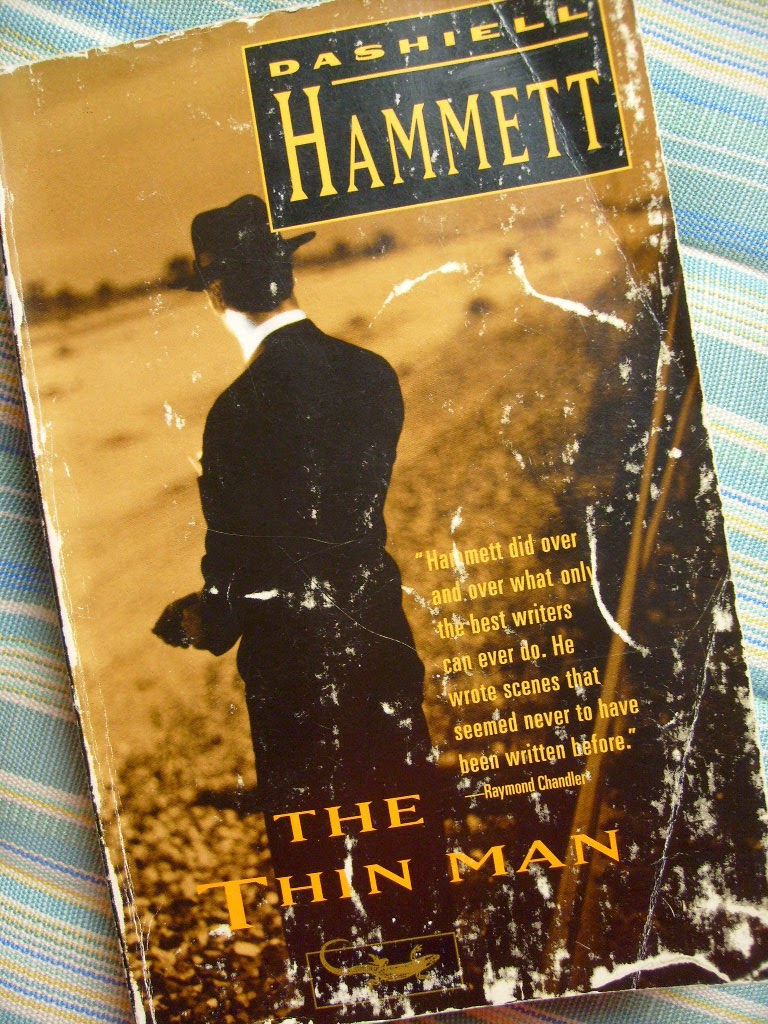
The Thin Man

I have had Dashiell Hammett in mind for a long time. He is a fictional character in one of Laurie R King´s novels, "Locked Rooms", which I recently re-read. When blogger Divers and Sundry blogged about suitable reading for Christmas, I decided to try and find "The Thin Man" by Hammett and this rather well-read copy was waiting for me at the library in Kalix.

I enjoyed this read; Hammett has a fast-paced writing style, he doesn´t linger at anything that doesn´t drive the story forward. I confess some of the slang was a bit hard to get, and sometimes I just didn´t get the banter. Likely, I missed the best jokes, but what can you do? I enjoyed it well enough, but not so much that I will be looking for the rest of them; I understand Hammett also wrote some short stories about the main characters, Nick and Nora Charles.

However, I checked out some of the films that was made in the 30´s and 40´s with William Powell and Myrna Loy, and became so infatuated with them that I ordered a four-film-box. A good detective story with a bit of humour is never wrong on a Friday night.

2014-12-12

Kallocain

Have I whined yet about the new order of the e-book library? Because of the expense of it - the libraries and the publishers seem unable to reach a sensible decision about this - the libraries have had to severely limit the number of e-books one is allowed to borrow, and the new limit is, unbelievably, two books per month! It used to be five or seven a week, more than one could read, really, but this is ridiculous! My reading friend and I lamented this but decided that perhaps it was time to turn towards the classics. The Swedish Academy has a good, open library with literature they consider part of the Swedish cultural heritage, Litteraturbanken (= the literature bank). I had been considering Karin Boye´s "Kallocain" for years, and my friend was up for it.

From Wikipedia.
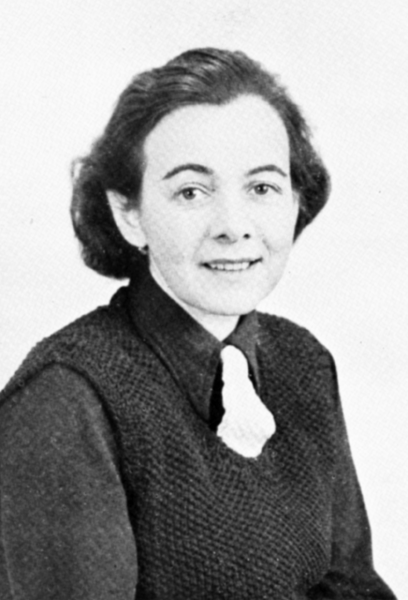
Karin Boye was born in 1900, and is mostly known for her poetry, but also wrote novels and worked as a journalist. She also painted, and you can see some of her watercolours here, at the website of the Karin Boye Society. Several of them have been exhibited at Waldemarsudde, the art museum founded by Prince Eugen, who was not just a royal, but one of Sweden´s most prominent painters. After her death, by suicide in 1941, her friends published a book in remembrance of her, and for it Hjalmar Gullberg (who wrote the poem "God in Disguise") wrote a poem called "Död amazon" (= dead amazon), which is still quite well known: "for the Thermopyle of our hearts, some must still give their lives" (my translation).

"Kallocain", from 1940, is probably her best known work internationally, and can be viewed as a precursor to Orwell´s "1984", which was published about a decade later. The narrator of the novel is Leo Kall, inventor of the truth-drug Kallocain. He is a citizen of the World-state, lives in Chemistry City Number 4, which is more or less an underground factory, with his wife Linda and their two youngest children. Their oldest, at eight years old, has already been moved into a reformatory of sorts, where all children go to be shaped into good "fellow-soldiers". The World-state is a severely supervised society, where every home has an "eye" and an "ear" on the wall, behind which supervisors may at any time look in on family life (such as it is: most of their spare time, family members are assigned some kind of policing/supervising duty), and informing on anyone, even family members, not seemingly devoted to the state, is a proud duty, not a dirty secret.

Leo Kall is a fanatic, but about to crack. His supervisor is Edo Rissen, an introverted, thoughtful man and Kall projects all his insecurities on him; he even imagines that Rissen has an affair with Linda. As they start to test the Kallocain drug, Rissen sceptically says that every man over 40 has a guilty conscience, which Kall takes as admission of crimes against the state. The confessions they get from their volunteers are not about crimes as such, but rather "emotional infidelity" to the state, a disturbing longing for human affection and trust, a natural faith in one´s fellow. The police authorities order Kall and Rissen to start training Kallocain interrogators, but it turns out that now, anyone can be convicted. As is Rissen, when Kall finally turns him in. He also steals some of the drug and uses it on his wife, with surprising results.

I found it a captivating read, and fast, at only 130 or so pages. I got quite spooked for a while, as I think anyone with some degree of maturity - as Rissen says, with reasons for a guilty conscience - will recognize that state of awakening from truths earlier taken for granted. I think most teenagers feel what Kall does, as they realize that all families and societies are not alikel, but that there are several ways of doing things and looking at the world, not necessarily on a scale from good to bad, just different. I suspect being a lesbian at the beginning of the century, coming from a middle-class family, would have given Boye a profound insight into being at odds with ideas of what is normal and natural.

You can read "Kallocain" for free on-line, at the University of Wisconsin digital collections, but it is also available through amazon, as is her "Complete Poems". Her most famous poem goes "Javisst gör det ont när knoppar brister, varför skulle annars våren tveka?" (= of course it hurts when buds burst, otherwise, why would spring hesitate? the entire poem can be read in English here) and I think most Swedes with an interest in literature recognize it, even if they are not poetry readers; references abound. The Karin Boye Society even have short recordings of her voice, reading her own poems. (Although, for them to work I had to download them first, could be my browser acting funnily.) She has that very clear enounciation they had in those days.

All in all, a good read. I am quite keen on reading more of her in the future.

2014-11-27

Obsessive Passions

I thought for sure I had blogged about Lena Andersson´s novel "Egenmäktigt förfarande - en roman om kärlek" (being translated to English as we speak: "Wilful Disregard: a novel about love" will be released next summer, according to British amazon) but I can´t find the post, so probably I read it while I was on blogging hiatus, in the spring. Well, now I have read her second book about Ester Nilsson, her passionate and not just slightly disturbed heroine, a novel called "Utan personligt ansvar" (= without personal responsibility). I read both in tandem with my reading friend, but I probably wouldn´t have considered it - a novel about love sounded a bit tiresome - if the husband, of all people, hadn´t heard it being read on the radio on his way home from work (he has a 40 minute commute, one-way, most days) and became so engrossed with it that he was quoting from it for weeks! He is not normally a reader of fiction, so of course I had to see what the fuss was about, and my friend jumped aboard.

It makes sense to write about both novels in one single post, as they have a similar topic. Ester Nilsson is a middle-aged academic, poet, student of the world through language, forever searching for the exact words, which to her equals the truth; she is uncompromising in her rock-hard integrity, but also blinded by her passions and able to decieve herself in considerable measures. Her command of language and logic and her ability to convince herself as well as others leads her so far astray that she crosses the line into severe self-delusion and madness not just once, but over and over again. She falls in love.

The first object of her affection is artist Hugo Rask. He is much older than she, he is flattered, both by her youth and the applauding articles she writes about his art. He is single, sort of (there is a woman in another town that he seems to have some kind of long-standing relationship to, but sexually he seems free to stray), he surrounds himself with a team of young artists in his studio, and Ester´s life very soon focuses entirely on how far she can push herself into his circle. She dumps her old boyfriend without a second thought or any feeling of regret, and becomes what can only be described as Hugo Rask´s stalker. He does go to bed with her once or twice, but they are never in a "relationship" (though Ester tries to convince herself that they are); most of the time, he seems unaware of her. She is like an ant in his elephant´s life.

The whole story focuses on what goes on inside Ester, her feelings, her thoughts, her efforts to come closer, to break it off (after having epiphanies of clarity that are muddle every time Rask is kind or just polite to her). It is cringe-making, to say the least. However, it´s not a long novel, and the pain is over fairly soon. I think Andersson has measured out the size of dose of Ester Nilsson one can take fairly accurately.

In the second novel, Ester Nilsson is at it again. This time, she falls for Olof Sten, another older, this time married, man, actor in a play she has written (and later director of other plays she writes). I feel more sorry for her this time, as she is clearly falling into the claws of someone a lot more vicious than Hugo Rask. She buys a car so that she can drive her lover from playhouse to playhouse, from town to town, all the while battling him for the truth of what is going on. It sounds something like this:
Ester: I want to live with you. I will not be your lover. (But of course, she jumps into bed with him every time.)
Olof: We are not in a relationship. I will not leave my wife or be unfaithful to her. (See brackets above.)

It´s very, very tiring. Ester´s girlfriends thinks so too, and after a few years of obsessively discussing Olof Sten with everyone, some of them begin to withdraw from her. If the book had been any longer (220 pages, slightly longer than the first), the reader might have given up as well, but as before, Andersson knows when to quit.

The first of the novels was awarded the prestigious Swedish August Prize last year, and Ester Nilsson has been discussed by everyone. Really, when people like the husband, who normally don´t have time to pick up a novel, throw themselves over the next chapter in the saga of Ester Nilsson, you know that this is something special. It is probably Andersson´s tone of voice: the exact, dissecting manner in which she slices Ester and her lovers open for us to see; this is the opposite of "show-don´t-tell"-writing. And, as tiresome as we find her, we have all been there, to some extent: hopefully self-delusional. Not that everyone interprets the novel the same way. Many seem to find Hugo Rask a predatory a***ole, but I don´t agree. Probably Roy Andersson doesn´t either, as he declared himself to be the real Hugo Rask some weeks ago, only to be ridiculed on the cultural pages of the papers (not that I think he cares in the least). Andersson insists that what she writes is fiction, but the debates have kept up the interest, and perhaps Andersson has written herself into the Swedish literary canon. Time will tell.

There is a very nice interview with Lena Andersson, in Swedish, but I guess Google translate can do something with it. I find I like her. I have always liked what she writes in the paper (she is a regular in Dagens Nyheter, on the editorial page), she is always analyzing those phenomenons that we seem to take for granted, turning the perspective around. She is a true intellectual and reading her will expand your horizon; authors like that are thin on the ground.

2014-11-23

Bertila

Some weeks ago, I got an email from Marta, a lover of Barna Hedenhös, of which I blogged - oh my! - exactly one year ago! Must be some kind of benign sign... Anyway, this led to my discovery of a recent publication on the collected works of Barna Hedenhös´ creator, "Boken om Bertila", or Bertil Almqvist as was his full name, by Nisse Larsson. I immediately walked over to the library and got it, and what a revelation!

I was completely unaware that Bertila was the man behind one of the most iconic images in Swedish history: En Svensk Tiger. These words mean two things: A Swedish Tiger, and A Swede Keeps Silent. It was a variation on those many posters the Brits had, like this one. But because of the word play, it was also an affirmation of the strength of both the nation and its individuals during a time when they needed reassurance. A brilliant image, really, and the words that was part of it made it go beyond the visual. It is so ingrained in the nation´s conscience that it has been re-used for other purposes, like selling Swedish milk and Swedish magazines.

 A high ranking military man didn´t like the tiger, he thought it should have been a lion instead,
completely missing the point - a story Bertila enjoyed telling. 


Bertila´s column, with tall Prime Minister
Erlander as the father of the Swedish "folkhem"
(the Swedish Welfare State) with the leader of
the Farmer´s Party, Gunnar Hedlund, as his
supportive wife.
 You can see more columns here.
Bertil Almqvist was born in 1902, to a middle-class family in Stockholm. He got into drawing and writing funny verse already in school, and pretty much continued to do that for the rest of his life. He was perhaps not the most gifted visual artist of his time, but in combination with his word play, his output was unique. For many, many years, he published a weekly drawn and written column that commented on anything that was happening, from politics to sports and culture. It was called "På tapeten", which means literally "on the wallpaper" and means "the topic of the day". He made a sport of drawing the headline differently each week and in accordance with the topic.

He made all kinds of illustrations: theatre posters, children´s books, campaigns. And, of course, he wrote and drew "Barna Hedenhös": the books, the comics, the films. He died in 1972, while working hard on a film for Swedish Television about the Hedenhös children (he wasn´t just overworked, he was fond of his drink and his cigarettes, too, there is hardly a photo of him without a fag between his lips). He had by then been retired - quite forcibly - from his newspaper column, something that had made him so upset he even complained to the Prime Minister of Sweden! Perhaps he had lost touch with the times. When you look at his works they have very much that 50´s positivity, a stout belief in progress.

Mother Svea (Sweden) gives Bertila his uniform.
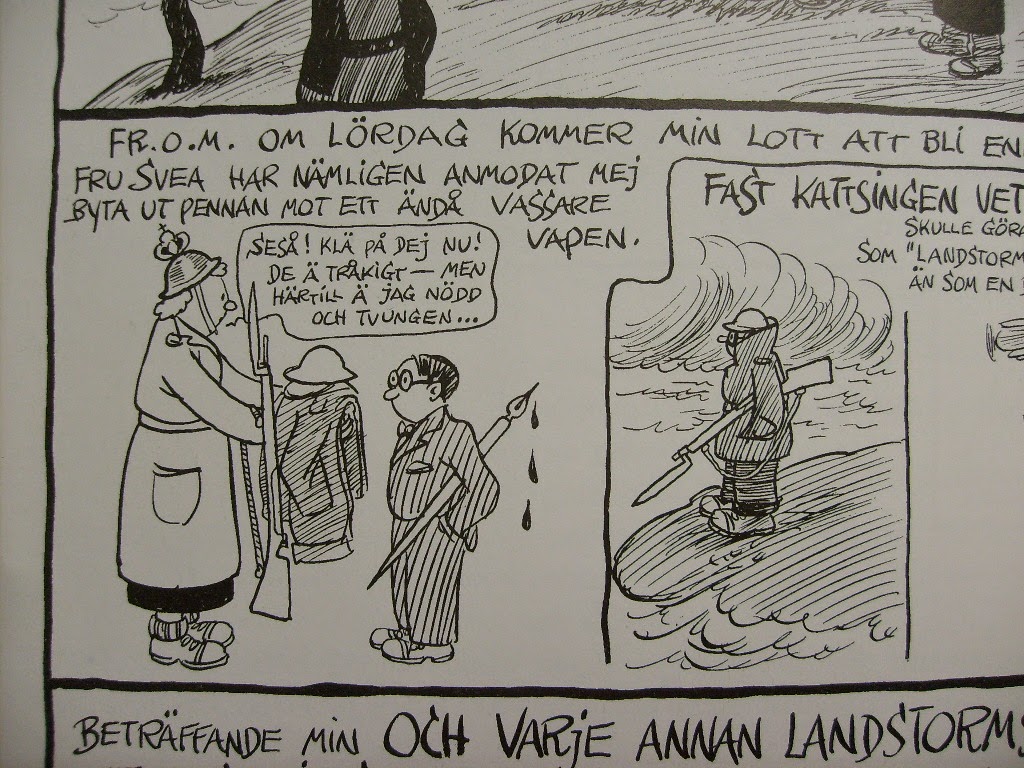
Word play was part of his game and the Swedish language started to change in the 70´s, as a new political and social awareness developed, as Swedes became more internationally aware, and society was being reshaped by immigration and the developement of modern media. Some of the Hedenhös books are no longer reproduced, considered racist and misogynist - which would have offended Bertila, who was a pacifist and a very outspoken advocate of equality and progress, both social, cultural, and technological. For example, he was a keen driver and fiercely lobbied for right-hand traffic for more than 30 years before it became a reality, in 1967. He also had strong convictions about spelling reforms. He did go into the army during the war, but reluctantly so, as he explained in comic form. He thought he could do more for the nation with his pen, and he did that as well, as you already know.

He also composed, which was a surprise to me. He wrote one of the most loved children´s songs in Swedish history, "Droppen Dripp och Droppen Drapp" (performed below by Alice Babs and her daughter Titti), and even recorded songs and put up a revue in 1934, where he sang his own songs in front of fifteen large drawings.

I only knew him for Barna Hedenhös, but I think now that his most lasting work will be "En svensk tiger" - even though perhaps that work has outgrown the memory of the man who created it.

(on Youtube by Tosukep)

Lyrics:

Droppen Dripp och Droppen Drapp    (the drop Drip and the drop Drap)
satt på varsin isetapp                         (sat each on his own icicle)
ovanför vår förstutrapp                      (above our landing)
Droppen Dripp och Droppen Drapp!   (the drop Drip and the drop Drap)

- Hej, sa Dripp till Droppen Drapp       (- Hi, said Drip to the drop Drap)
trivs du bra uppå din tapp?                 (are you happy on your icicle?)
- Åjavars, sa Droppen Drapp              (- Oh, allright I guess, said the drop Drap)
fast min sittplats är rätt knapp!            (although my seat is rather small.)

- Hördudu, sa Dripp till Drapp,            (- Hey listen, said Drip to Drap)
ska vi hoppa ner ikapp,                       (shall we race each other down,)
ner på våran förstutrapp?                    (on to our landing?)
Så sa Dripp till Droppen Drapp.           (That´s what Drip said to Drap the drop.)

- Hu, så högt! sa Droppen Drapp,         (- My, that´s high! said Drap the drop,)
såge helst jag hoppa slapp.                   (I wish I didn´t have to jump.)
- men det gör väl hipp som happ,          (but I guess it´s neither here nor there,)
låt oss hoppa ner i kapp!                      (let us race each other down.)

Och så hoppa Dripp och Drapp            (And then Drip and Drap jumped)
från sin isetapp ikapp,                          (from their icicles together)
ner på våran förstutrapp                      (down onto our landing)
- och blev platta som en knapp!            (and became flat like a button!)

(my own translation - quick and dirty)

Bertila with his daughter Monne Kristina, to whom he wrote the first Hedenhös book. 


2014-08-17

The Shining

I have just finished reading Stephen King´s "The Shining". The only other thing I have read by King apart from "Cujo" in the 80´s, is his excellent book "On Writing" which I have read twice, with a few years of experience in the meantime. Ok, everyone´s process is different, but King seems to be fairly accurate about how I function, at least - although I didn´t know it the first time I read him. He has some good advice, if you are bent on writing a book yourself. (And why shouldn´t you? Everyone has a story.)

In the mountains, no one can hear you scream...
I decided on "The Shining" in particular because I had read rave reviews about the sequel, "Doctor Sleep", and because Priya seems to think it´s one of the best books ever. I have not seen Stanley Kubrik´s film with Jack Nicholson and I understand it differs quite a bit from the book. 

It took me more than two months to finish "The Shining", which must be some kind of record with a novel, for me. It wasn´t that I didn´t like it. It wasn´t that it was badly written - gosh no, King knows his stuff and he has a lesson for you on every page if you are a student of his. It was partly because I had a pretty busy summer, and partly that the main character, Jack Torrance, was a bit predictable. Crap childhood, history of abuse, mood swings, temper control issues - perhaps characters like these were not regulars of crime and other fiction in the 70´s, but Torrance has certainly had many, many followers in books, on film, and television. The chemistry between Torrance and his wife Wendy and their psychic son Danny, is also pretty familiar. Fear and love is a bitter brew; many of us can relate, and not just through fiction either. These character feels real because they are, there are versions of Jack Torrance in every village, on every block, in every extended family - I hope you are lucky enough not to have one in yours. 
...his father´s attitude was strange. It was a feeling that he had done something that was very hard and had done it right. But Danny could not seem to see exactly what the something was. His father was guarding that carefully, even in his own mind. Was it possible, Danny wondered, to be glad you had done something and still be so ashamed of that something that you tried not to think of it? The quesiton was a disturbing one. He didn´t think such a thing was possible... in a normal mind. His hardest probings at his father had only brought him a dim picture of something like an octopus, whirling up into the hard blue sky.
In short, what happens is that Jack takes a job as a winter caretaker of the summer mountain resort The Overlook. The family gets snowed in for months in the Colorado mountains, in a house brimming with tragic history and the dangerous shadows these events are casting. As they settle in, King tells the background story in flashbacks. Like I said: well written and realistic, but familiar. Then the spooky stuff starts, and that cheered me up a bit; I finished the last half of the novel within a week. King is really good at making the most improbable things absolutely believable. Also, I fell head over heals for the wonderful Mr Hallorann, who comes to the rescue in the end. 
Jack wasn´t out there anymore. She was hearing the lunatic, raving voice of the Overlook itself.
For me, this is a story about rage, and by rage I mean anger that grows bigger than what you were initially angry about, until it is out of control or even controls you. Wendy and Danny keep repeating that it wasn´t Jack doing those things he did, it was the house, the Overlook, the ghosts that made him do it. But I keep thinking that Jack had all that rage in him when he came. The Overlook didn´t make Jack Torrance any different, it just worked with what was already there. And of course, that is King´s point (or so I imagine): that the people who love us are capable of infinite indulgence, forgiveness, and hold hope for us even when we are hopeless. To the point of self-sacrifice; Wendy and Danny see what´s coming, and yet choose to stay.  

I kind of wish I had read this when I was a bit younger. Perhaps it would have taught me something that could have been useful to me. But that´s easy to say in retrospect. Now, I am much eager to go on with "Doctor Sleep", which, I imagine is about the grown-up Danny and how he (hopefully) breaks his father´s curse. 

2014-06-17

Love in a Cold Climate

Yesterday I finished "Love in a Cold Climate" by Nancy Mitford. I enjoyed it very much, I really like the way she writes, without frills, much dialogue, great characters, good action. It ended a bit abruptly, but I suppose she felt the story was over, so she finished it.

Castle Howard, 2009.
This story is again narrated by Fanny, the Bolter´s daughter, raised by her aunt Emily and uncle Davey, cousin of the Radlett children, among them Linda, who was the protagonist of "The Pursuit of Love". Linda does not appear here at all, though the story takes place at about the same time as Linda´s story did. This time Fanny becomes involved with the Radlett´s neighbours, the Montdores, and particularly the mother, lady Montdore, and her daughter Polly, who is the same age as Fanny and Linda (though not on friendly terms with Linda, which is why their stories do not intersect).

Lady Montdore and Polly is at odds over marriage. Polly is "out", and is almost twenty, but shows absolutely no interest in men at all (or in anything else, for that matter), which frustrates her mother. Fanny, recently married to a junior Oxford don and staying with the Radletts at Alconleigh while her new house is being done up, is brought in by both of them to act as a kind of buffer between them. Lady Montdore is bossy and overbearing, but can also be very charming and Fanny likes her a lot. Polly, also loved by Fanny, is a rather vapid, boring and unattractive personality - even though she is the most beautiful debutante in London society, a fact that is repeated over and over. Perhaps it is hard for a reader to like her, since we can not see her - beauty seems to be her only asset and she has such an abundance of it that it makes up for her lack of character. It´s hard to get particularly upset when she, upon her aunt´s death, confesses that she has been in love with her uncle-in-law Boy, a middle-aged historian, since the age of fourteen and is now intending to marry him. The matter is made even worse by the fact that this uncle has been her mother´s lover for years, is bisexual, and has paedophile tendencies (the Radletts call him "the lecherous lecturer").

So, things go spectacularly bad, but in the end everything turns out all right, in a rather amusing way, as one would expect from a story like this. My favourite passage in this book is about Uncle Matthew, who is aging and softening (and Fanny is also maturing, which perhaps mellows her view of him), and this is what happens when his younger daughter Jassy insists on being buried at a particular spot in the churchyard:
"'Write it down,' said Uncle Matthew, producing a piece of paper and a fountain-pen, 'if these things don´t get written down they are forgotten. And I´d like a deposit of ten bob please.' 'You can take it out of my birthday present,' said Jassy, who was scribbling away with great concentration, ' I´ve made a map like in Treasure Island,' she said. 'See?' 'Yes, thank you, that´s quite clear,' said Uncle Matthew. He went to the wall, took his master-key from his pocket, opened a safe, and put in the piece of paper. Every room at Alconleigh had one of these wall-safes, whose contents would have amazed and discomfited the burglar who managed to open them. Aunt Sadie´s jewels, which had some very good stones, were never kept in them, but lay glittering about all over the house and garden, in any place where she might have taken them off and forgotten to put them on again, on the downstairs wash-basin, by the flower-bed she had been weeding, sent to the laundry pinning up a suspender. Her big party pieces were kept in the bank. Uncle Matthew himself possessed no jewels and despised all men who did. (Boy´s signet ring and platinum and pearl evening watch-chain were great causes for tooth-grinding.) His own watch was a large loudly ticking object in gun-metal, tested twice a day by Greenwich mean time on a chronometer in the business-room, and said to gain three seconds a week. This was attached to his key-ring across his moleskin waistcoat by an ordinary leather bootlace, in which Aunt Sadie often tied knots to remind herself of things. The safes, nevertheless, were full of treasures, if not of valuables, for Uncle Matthew´s treasures were objects of esoteric worth, such as a stone quarried on the estate and said to have imprisoned for two thousand years a living toad; Linda´s first shoe; the skeleton of a mouse regurgitated by an owl; a tiny gun for shooting bluebottles; the hair of all his children made into a bracelet; a silhouette of Aunt Sadie done at a fair; a carved nut; a ship in a bottle; altogether a strange mixture of sentiment, natural history, and little objects which from time to time had taken his fancy."
This is probably the most endearing description of a man´s character I have ever read (don´t you love how the wife ties knots in her husband´s key"chain" to remind herself of things?). And it is a good example of Nancy Mitford´s skill. If you like Austen-style stories with British excentric aristocracy in great houses, this is for you.

2014-06-09

The Pursuit of Love

After I failed Proust and then finished three Klas Östergren novels in a row, I really felt that I had been reading much too seriously for far too long. Reading should be more joyful than this. So I decided to go on with the Nancy Mitford series, and started with "Pigeon Pie" from 1940, which began with an apology from the author, calling it "an early and unimportant casualty of the real war which was then beginning". I only lasted a few pages into it, and I can see why she would have been reluctant to re-publish it. So I just moved on to "The Pursuit of Love", which is, along with "Love in a Cold Climate" her best known work.

Compared with her early comedies, "Highland Fling", "Christmas Pudding", and "Whigs on the Green", there is more depth in this novel, and even though she is very funny, as usual, it is a tragedy, really. It revolves around an aristocratic family, the Radletts, who live at the Cotswold estate Alconleigh. The narrator, Fanny, is raised by her aunt Emily after her mother, called "the Bolter" (we never learn her real name), has left her baby on her sisters´ doorstep and gone on to an adventurous life abroad with a string of husbands. Her other aunt, Sadie Radlett, wants to raise Fanny with her cousin Linda, who is the same age, but her uncle Matthew refuses, as Fanny´s father is one of his old enemies. In spite of this, Fanny spends most of her holidays at Alconleigh with her cousins and the rest of the time lives with her aunt Emily and her husband Davey, which is probably lucky for Fanny, as uncle Matthew must be one of the most irascible characters in fiction and Davey the dad everyone would want. Uncle Matthew´s idea of fun is arranging an annual Christmas hunt - with the children as prey - mounting the horses and setting the dogs after them. Aunt Sadie is a rather distant and cold mother, and it is no secret that this eccentric couple, this family, was moulded on Mitford´s own, childhunt and all. It is funny, for sure, but horrible as well. One of the sisters starts saving her pennies for a runaway fund aged seven, and eventually also runs away to America. Which is more or less exactly what Decca Mitford did.

As they grow up the story focuses on Linda, who marries after her first season "out", and has a child  with a man who turns out to be a bore. She goes in the footsteps, to some extent, of Fanny´s mother, and the rest of the novel is all about what becomes of her. Mitford pushes her writing style and I jumped a bit at these lines about what it was like to attend one´s first ball:
"This then is a ball. This is life, what we have been waiting for all these years, here we are and here it is, a ball, actually going on now, actually in progress around us. How extraordinary it feels, such unreality, like a dream. But, alas, so utterly different from what one had imagined and expected; it must be admitted, not a good dream. The men so small and ugly, the women so frowsty, their clothes so messy and their faces so red, the oil-stoves so smelly, and not really very warm, but, above all, the men, either so old or so ugly. And when they ask one to dance (pushed to it, one cannot but suspect, by kind Davey, who is trying to see that we have a good time at our first party), it is not at all like floating away into a delicious cloud, pressed by a manly arm to a manly bosom, but stumble, stumble, kick, kick. They balance, like King Stork, on one leg, while, with the other, they come down, like King Log, on one´s toe. As for witty conversation, it is wonderful if any conversation, even of the most banal and jerky description, lasts through a whole dance and the sitting out. It is mostly: 'Oh, sorry - oh, my fault,' though Linda did get as far as taking one of her partners to see the diseased stones."
Not unlike going to one´s first disco dance, as I recall...

The garden feature at which Churchill proposed to his Clementine.
I like Mitford´s style, she is unapologetically unsentimental, and even though some modern readers may find some of the family relationships a bit exaggerated, particularly between parents and children, I think she is spot on; even though she turns it into good comedy, there is a complex double edge here, and quite a bit of real pain - but also a good deal of love - poured into it.

I think Linda in this story has some likeness to Diana Mitford, the beautiful sister who ran away from her Guinness husband to marry the British fascist leader Oswald Mosley, but most of all, I think she is modeled on Nancy herself, who dedicated the novel to her French lover Gaston Palewski. 

With this fifth novel Mitford really matures into a good storyteller, and the BBC made an adaptation for television in 2001 with Rosamund Pike as Fanny. There was another adaptation in 1980 with Judi Dench as Aunt Sadie. Both adaptations are titled "Love in a Cold Climate", which is the name of Mitford´s next novel, another tale of Fanny´s which takes place during the same time frame. I am reading that one now, so that will be the topic of the next post.

2014-05-28

Gangsters

I eagerly threw myself over Klas Östergren´s follow-up to "Gentlemen", "Gangsters", which was published in 2005, 25 years after the first novel. Mostly, I wanted to know what had really happened to Henry and Leo Morgan. Did I find out? Well, not exactly.

We meet a much more mature Klas in this novel, and Klas the Narrator from Gentlemen is now one step closer to Klas the Author of both novels. What he does, actually, is betray the fiction: only a few pages into this story, he reveals that the brothers, Henry and Leo, are actually one and the same person. Maud the Mistress - who is pregnant with Henry´s child and has dumped the mysterious financier W.S. - reads Klas´s manuscript and then tells him her story, a corrective of which the details remain hidden to us readers. When the second manuscript is finished, suddenly there is a message from Henry, for Maud to meet him in Vienna. She, heavily pregnant and unable to go anywhere, sends Klas instead. He does not, however, find Henry there, but a man they call The Envoy, who is described as a kind of state-employed cleaning man, who plugs leaks, gets rid of awkward and inconvenient people, and what not. You could say he is the mobster henchman of the Swedish Welfare State. I see before me the equivalent of Harvey Keitel´s cleaner in "Pulp Fiction", powerful, dangerous, but much more beige.

Klas spends a night in the company of The Envoy, and only towards the end of the story do we find out some of what he learned in those hours. We do get some idea of what happened to Henry Morgan, but much remains foggy. Klas stays in touch with, but not close to, Maud and her son Gustaf, and years later is drawn back into the plot involving Henry´s disappearance, through his son. We also learn that the second draft of "Gentlemen" was completely re-written after the meeting with The Envoy, and that Maud was very put off when the book was finally published. What was left out, we never find out.

The style of writing is so much more mature and a real joy to read. You can really see how much better an author Östergren has become in the years that have passed: he is a master at character study and absolutely nails those awkward scenes with family and people that used to be our friends, situations that we all can relate to. He lets the characters be both complex and paradoxal at times, and all of them are as mysterious when the novel is finished as they were to start with. He also flavours the text with small nuggets of wisdom, of lessons learned, without ever touching a cliché. I loved these lines (in my own quick and dirty translation):
"...real pride is an evening-feeling, something that comes when the machines are cooling down, tools and equipment has been put away for the night, when one´s daywork is done and has been done well, just like all other days, weeks, months, and years."
The moral of this story is, I suppose, that we never can know, and for the most part don´t want to know, the truth about our friends or our country, those we love and trust. Klas is offered more insight than he is willing to recieve, and as a reader, I am all with him, not at all eager to open those doors to which he has a key that he prefers not to use, which is extremely skilfully done by Östergren the Author.

There is a gangster in every gentleman, and every gangster has a gentle side to him; this is certainly true of Henry Morgan, but also of W.S., of The Envoy, and even of Klas Östergren himself.

2014-05-21

Gentlemen

It´s been a tough week in one regard, with the mum-in-law in hospital and myself contracting stomach flu, probably from the emergency room where there were signs about this contagion being around. Luckily, she didn´t get it, but I had to be in quarantine for four days in total, which was depressing and frustrating, but on the other hand, it gave me a lot of time to read.

The reading project I had started was another tandem read with my friend (who did finish "Swann´s Way), and this time we had decided to go for a Swedish author, Klas Östergren, who is well known, has been around for a while, but for some reason, none of us had read. He has recently been invited to join the Swedish Academy, on chair 11 after Ulf Linde, who was one of my favourite eccentrics on the Swedish art scene. Östergren was Pernilla August´s first husband, and she is, as you may know, Anakin Skywalker´s mum. Not that this has anything whatsoever to do with Östergren´s authorship...

In 1980, Östergren got his big break with "Gentlemen", and I remember it, as I was 14 at the time and had just started to get interested in literature for real, realizing it was more than Nancy Drew mysteries and sci-fi paperbacks. He was 25, cute and gifted, and I should have read him then but didn´t and today, I´m kind of glad I didn´t. Because I really enjoyed this novel now, and also, he wrote a sequel in 2005. It is a tale about a young author, Klas Östergren, who befriends two brothers, Henry and Leo Morgan, and gets himself drawn into some very dangerous machinations.

Östergren, the narrator (not the author), gets his flat plundered of almost everything and decides to take an offer made to him by a new friend from the boxing gym, Henry Morgan, to move into the grand flat Henry has inherited from his grandfather, the nobleman Morgonstjärna (which literally means morning star). Henry´s late father had been a jazz pianist, a bit of a black sheep of the family, and changed his name to Morgan. Klas is working on a commission, a pastishe of August Strindberg´s classical novel "The Red Room", to celebrate its 100th anniversary.

Henry Morgan is a grand character with gentlemanly habits, dresses stylishly but out of date, is always cleanshaven, an excellent cook, likes to woe the ladies; a real charmer. On the other hand, he lives on almost nothing: a small allowance inherited from his grandfather, the odd job as a film extra, and small schemes that are more or less criminal. He has also inherited a treasure hunt from his grandfather, a dig into the "Bellman tunnels" under the house, where a 17th Century king is rumoured to have disposed of some gold for just-in-case he is overthrown. Henry is helped by a few of his neighbours, a gang of colourful characters who all seem more or less alcoholic, and Klas fits in nicely among them. Henry has also spent five years on the continent after deserting from the Swedish army, a tale which reads almost like a picaresque novel: a string of unlikely adventures. Henry is a jazz pianist like his father, and has been at work for ten years with a concert he is calling "Europe - crumbling fragments", but no one has ever heard any of it.

The home of the Morgans, borrowed from Wikipedia
Henry´s  brother Leo isn´t around when Klas moves in. "He is in the States," Henry says, but when Leo finally shows up, it turns out he has been in a mental hospital. Leo is a poet, an infant prodigy who got his first collection published when he was 14 and who is now, at thirty, a burned out junkie. He also has a great work which he never seems to finish, a poetry collection of great promise.

Henry has a mistress which he shares with a financier, a man who is only a shadow in the story, but of whose existence Klas is always reminded as Henry is always wearing his shirts and using his cigarette cases, both with his initials on them. Shadowlike he may be, and Klas calls him evil, but he is more complex than that, among other things involved in trying to rescue defectors from East Berlin. Leo gets a commission from a magazine, to do a bit of investigative journalism. He finds evidence of goings-on during the war that could be embarrassing to the financier, who is getting ready to go into politics.

It took me a while to get into it, I have to say. The style is a bit anachronistic (not unlike Henry Morgan himself) and can feel a bit pretentious, and I´m not sure it is consciously done that way since I haven´t read anything else by Östergren. Particularly in the introductory part, where we get to know the narrator, and he comes off as a bit of a prat. The best bits are when he tells the tale of the Morgan brothers, that is delightfully entertaining. The present dangers are more hinted at than concrete; Östergren also skillfully sets the zeitgeist, with demonstrations in Stockholm, Cold War tensions, the Harrisburg incident, and so on. Like I said, these are times I lived through myself, this is the world I grew up in, and it feels both recent and very far away.

Towards the end I start to think of it as a novel about creativity. Each character is struggling with some great work, a vision of the magnum opus that is going to make their names, give them their break. They are constantly diverted, however. It is also about trying to function in a world that is changing all the time, when you have bought into the values of an old way of life. Who needs a gentleman in the 1980´s? Who needs it now? And is Henry Morgan a proper gentleman, anyway? Or is it just some grand self-delusion, a cover-up of the truth?

I also think that this is about a young man (the narrator) who realizes that so much about his life, so much about his destiny, is in the hands of people that are out of his reach: politicians, capitalists, the big movers and shakers that the man on the street are at the mercy of, so to speak. Klas and the Morgans, as artists, live at the fringe of society, and they become acutely aware of how much the rules can be bent. In this regard, the novel is more current than ever. Actually, it doesn´t feel dated at all, at least not to me.

It is a long novel with some 400 pages; it is very complex and open-ended. When it is finished you don´t really know what happened. A very unsatisfactory end indeed, and how lucky I was to read the book now, because in 2005, Östergren wrote a sequel, "Gangsters". It would have been very frustrating to have to wait for 25 years!

There is an English translation of "Gentlemen", and according to this, there should also be a translation of "Gangsters", but I can´t find out where to buy it. There seem to be a pending release of both books, but it doesn´t say what language. A film is being made right now, to be released later this year, both in cinemas and on television. I really look forward to that, but first I am going for the novel "Gangsters"!

2014-05-04

To Read Or Not To Read - Proust

I hardly have to comment on the merits of Marcel Proust´s "In Search of Lost Time" (or "Remembrance of Things Past" depending on the translation; Sw. "På spaning efter den tid som flytt") - countless books have been written on the subject, hundreds of academics have made a career of analysing the 3000 or so pages of this mega-novel. I´m not sure I know anyone who has read it in its entirety, most people are probably happy to get through the first part, "Swann´s Way". Personally, I got to about page 158. That´s when I realized I had effectively stopped, that I was seriously procrastinating my reading - a very strange experience for me.

Yes, I had developed a strong sense of unease about the whole thing, almost a kind of claustrophobia that made me either just shut down (and go to sleep) or want to open the window and howl.

I reached for support in the form of Olof Lagercrantz, my old favourite literary critic, who has written a whole book about his reading of Proust ("Att läsa Proust", 1992). It was a joy to read, as everything by him: he clearly and concisely laid out the main points of the novel - as he saw it, of course, his interpretation is his own. I realized this: to "get" Proust, I need to read all of it. I must also read a few biographies about him. This will probably take a decade of my life, if not more considering the pace I am keeping. Lagercrantz himself didn´t get to it until he was old and retired. Also, now having read Lagercrantz and knowing a bit more about the story, I am even less inclined to pursue the reading. The language is lovely, but pretty sentences is not enough for me.

Lagercrantz has written elsewhere ("Om konsten att läsa och skriva", 1985) that a good writer leaves room in his text for the reader to breathe, a poetic way of saying that the reader is invited to participate in the creative process; for example he does not give every little detail away, does not kill the story with descriptions, thereby letting the reader add his own flavour and make the story more familiar to him. (Or her, obviously.) We, as readers, engage in the text through our imaginations. There is, adds Lagercrantz, two exceptions: Proust and Joyce. This does not make them poor writers, he hurriedly continues, but rather the Mount Everest of literature. There is very little oxygen up on this literary Olympus, very little for the reader to do, and it is very hard to engage. I have tried Joyce as well, and came to somewhere around page eight, so I think Lagercrantz is probably right.

Well, I have a very active imagination. I like to "nest" within a story as I read it. To be frank, I found this beautiful, skilful, impressive, and very, very dull. I am not qualified to comment on anything beyond my own experience and there you have it. For a few days, I tried to convince myself that I might "save" it for my old age, but honestly, I will never go near it again. I will always have something better to do than reading Proust, even if it is just looking out the window, like his Aunt Leonie.

2013-11-23

The Stone Age Rocks

Every year, for as long as I have been around, Swedish Television has had an Advent calendar program for children every evening in December, leading up to Christmas Eve. (In Sweden, Christmas Eve is The Day of celebration, and Christmas Day is just for eating leftovers and playing with your toys while mum and dad does crossword puzzles or watch a film.) It´s some kind of story, often connected with Christmas, and you can buy a calendar and open it with the television host or perhaps even the characters of the story. This year, the advent story is based on a Swedish children´s book classic, "Barna Hedenhös" (= the children From-Time-Immemorial, but it´s really not translatable and the books are not, as far as I can figure, translated to English) by Bertil Almquist.

The family lives on the Stock (= tree log) Holme.
"Barna Hedenhös" was an early favourite of mine and the trauma experience of having my father read it to me may have fueled me with some extra motivation to learn how to read for myself. What he did during his first reading was to improvise: "And pappa Ben says:" and then he would ad-lib something really funny that went with the pictures. The next time I begged him to read it he was, however, not able to repeat the performance, and I was so confused and provoked, because to me, letters were absolute, books were reliable (and I had a very good memory - I still to this day remember one of those made-up lines...), and they didn´t change from reading to reading. A book did not forget the joke it told yesterday!

Much of the humour is based on wild, unrestrained punning and unabashed anachronisms; Almquist was particularly fond of making up words with the prefix ur- which means ancient or primordial. Like in the book where the family Hedenhös goes to America, they arrive at a town called Urjork, or Ur York, which is, naturally, the original New York. The indians who live there are not iroquois, but uroquois. And they go on an excursion to Urtroit and visit with uncle Urford, riding on his horsepowered wagons. It´s all delightfully recognizable, and the well-travelled Hedenhös family also goes adventuring to Egypt, England, Paris (where they are kitted out by Mr Diur), and they even go to the moon, and to Mars! They also organize the worlds first international olympiad, the urlympiad.

Pappa Ben builds the raft Ur-tiki that takes them to America. (Remember Heyerdal´s Kon-Tiki expidition in 1947?)

Arriving at Ur York.
The illustrations are glorious, there are things happening all over the place, and there is such vitality to every character. 

Bertil Almquist was born in 1902, and the first book came out in 1948. The stories are very much of their time and have that hyper-positive attitude to technology and progress. It is what fuels them, really. The family is an ideal nuclear family: pappa Ben (= bone), mamma Knota (= another Swedish word for bone), brother Sten (= stone), and sister Flisa (= splinter). Pappa Ben may only possess a flint knife and a stone axe, but that does not stop him from building a jet plan (driven by uranium, in case you wondered). Their animals are part of the family, as well as being useful household assets, and they all come on the adventures.


In yesterdays paper, it was announced that the America-album will not be published in future. It is perhaps my favourite, but I can really see why they had to make this decision. The attitude to the indigenous people of North America is, well... shall we say naive and patronizing? A tad colonial? Remember, this was a time when Swedes had not yet learned that a person of dark skin-colour could take offence to being called a negro. To us, it was just a noun, and to some very old people (like the mum-in-law) it still is. We had yet to see "Roots" on television (I was not old, but I remember how BIG that was). If the world seemed small in the Hedenhös universe, to a regular Swede in the 50´s, it was actually pretty large and unknown.

Uncle Urford´s factory in Urtroit.
In some cases, older books can be salvaged from having become un-politically correct by changing a word here or there (as I understand has been done to Mark Twain´s children´s books, and Astrid Lindgren´s Pippi-books). But in this case, the whole plot is based on the "fact" that bulls (as everyone knows from the bullfights, right? it couldn´t be the BARBED arrows they stick in their backs, could it?) become enraged when you wave something red in front of them, and that indians have red skins. Pappa Ben solves this problem by introducing face paint to mask the redness and thus makes the indians and the bisons best friends forever... It´s a story promoting peace, but the premise is too way off. It´s unsalvageable. And I don´t think Almquist was a racist, more like the opposite. But for all the things he knew, there was so much he didn´t. If he were alive today, he´d probably cringe, as I did when I read it a few days ago.

Still, the characters are alive and well, and changing with the times. I think I´ll tune in at least for the first episode, to see what´s been done to them.