Stunning photographs from New York´s Central Park. Niels Oesingmann is the photograper and it´s a good demonstration of the art of composition.
This goes very well with what we are watching (or rather, listening to) on television right now, which is "Last night of the Proms" from the Royal Albert Hall in London. Joyce DiDonato is just now performing something of Rossini´s, a real treat! We have just brought mum-in-law home from a week in hospital and I´m enjoying a well-deserved G&T.
Hope you are all having a great weekend!

Showing posts with label photography. Show all posts
Showing posts with label photography. Show all posts
2014-01-18


2014-01-16
Great Mentor
...one of the most important keys to the successful art life is to understand the nature of disappointment, and to recognize it as something that can provide either disincentive or encouragement. Disappointment is a disincentive if it leads to frustration and sense of failure. It’s possible, however, to recognize disappointment as a form of success: as has often been said, “Even the person who falls flat on their face is at least moving forward.”

As Jensen says:
A project does not need to take a long time. There is nothing wrong with a project that develops slowly, and there may even be some virtues. But, more “spontaneous” projects, conceived and completed quickly, have their place in creative photography, too....and I have taken this to heart. Whenever I bring the camera, I try to formulate an idea about what I want to do differently this time. Sometimes I do it, sometimes I don´t. I had this idea about doing some proper, old-fashioned group photos for Christmas, but for some reason I didn´t think the mood was right. Or perhaps my mood wasn´t right. I am planning to give it another go, though. I suppose what I´m after is involving my friends and family in my creative process, and perhaps I need to think some more about how to make that a fun thing to do - for all of us. You know, how to make use of their creativity and make it a real collaboration. It´s very much trying to go beyond my comfort zone.
Another quote that caught my attention was this:
Figuratively and scientifically, a photograph is a slice of time, frozen for us to look at and see more intently than is possible at the speed of life. It is a “now” that is removed from the flow of time. Such language brings to mind what the Buddhist meditators call the “eternal now” — but in photography we have the ability to capture that eternal now and freeze its image — at least for a while, at least as long as the medium remains coherent. Indeed, no other media does this as well as photography.I have observed for some time that for me, the process of photography seem to anchor me to the present and give me more energy rather than tire me. I often hear the complaint about amateur photographers that they "hide" behind the lens, or that they are somehow not "there" in the moment, but just recording it or collecting it. It is true that some people can be said to photograph like scalp-hunters; I had an uncle once who would put my aunt in front of the Thing of Interest, take a snap and then go back to sit in the car and wait for the rest of us. But sometimes, this complaint means something else; it means: I want you to talk to me, be with me, instead of taking your photographs. This can be a valid complaint if you are often inaccessible to your loved ones, but more often than not, the conversation offered is more about other moments than the one we´re in right now, so conversation can be just another form of escaping the present moment.
Having Jensen as a kind of mentor is doing me good, I feel, both in my photography and in my writing. In my living, probably, as well. I am so happy about him that I have subscribed to Lenswork this year. I hope that will give me even more insight and inspiration!

2014-01-11
Landscape photography
I grew up in the woods, often taking long walks by myself, hunting for mushrooms or skiing in winter. I just happened to find Kilian Schönberger´s photographs of woods, and they evoke so many memories and feelings. Enjoy!
2014-01-02
On-line Gallery To Check Out
Look at these photos from Prague - aren´t they amazing? Michael Kenna is a magician, it seems to me, particularly if you compare all the studies of the Charles Bridge. A very good example of what one can accomplish when returning to the same object again and again.
Extraordinary.
Extraordinary.
2013-12-11
Old Images Brought To Life
I just read an article in a ladies magazine about artist Sanna Dullaway, who does colour work on old photos. She is amazing, and has worked for Times Magazine, among others. Do check out her website, and be impressed!
.jpg)
2013-10-08
A Squirrel in a Fir Tree
When I was out photographing foliage, I took a lot of shots up in the trees, some of which didn´t turn out so well. When I came across this one, I thought, what is that thing?
.jpg)
.jpg)
There have been verses added later, that can not be attributed to Tegnér. According to them, the squirrel then goes home to mummy (who lives in a green field, which doesn´t sound very natural to a squirrel, but rhymes well in Swedish), is put to bed with a stiff drink, a plaster on his toe and a bandage on his tail.
PS: Some great advice, via Humans of New York.

I wish I had seen him when I was there, I had so much more zoom in the lens! But I am rather myopic (autofocus is a godsend). Anyway, the photo reminded me of an old nursery rhyme by Alice Tegnér I am sure the kids still sing.
The squirrel was sitting in the fir tree
about to peel his cones.
When he heard the children coming
he hurried away.
He jumped onto the pine branch
but bruised his little leg
and his long shaggy tail.
(Awkward & unmusical translation by me. Video by Mrs Bean. Song by Alice Babs.)
There have been verses added later, that can not be attributed to Tegnér. According to them, the squirrel then goes home to mummy (who lives in a green field, which doesn´t sound very natural to a squirrel, but rhymes well in Swedish), is put to bed with a stiff drink, a plaster on his toe and a bandage on his tail.
PS: Some great advice, via Humans of New York.
2013-10-07
Norwegian Wood - Part I
Saturday, I did as I had intended and popped in at Studio 31 to check out the place and the vernissage of Natalie Avigdor. The artist was there of course, a very nice young woman with a very interesting project. Unfortunately, I was in a bit of a rush, and didn´t really have time to look properly, but I will return next week. (She has said it´s ok to take photographs so I will be able to show you more later.) In fact, I have decided to make a kind of parallell project to Avigdor´s. I will return to that later.
Avigdor has spent part of her youth in Luleå and Boden, and studied at the aesthetic programme at Luleå´s gymnasium (equivalent to high school in the US). She has then studied one year at Munka Folkhögskola in Skåne, the south of Sweden. Now she is at the Academy of Arts and Design, Bezalel, in Jerusalem.
She explained to me that this project is about three months of her life: August, September, and October of this year, that suddenly (a quote from her diary suggests a break-up in Oslo) was empty, without any plans. She decided to build a new life, make new friends, and create an alternative life to - I suppose - her life in Israel. During this time she has also travelled to Japan. The title of her project, and one of the paintings, is "Norwegian Wood", and this immediately made me think of Haruki Murakami´s novel of that name, which was also filmed a few years ago.
Avigdor is also participating in a performance with the art collective PAiN (Performance Art i Norr) at Galleri Syster the 16th of October. On PAiN´s website she says:
On a side note: If you have access to Swedish television and are interested in clothes as communication, you may want to watch a new series called "von Svenssons kläder" (= von Svensson´s clothes) about how we dress and why. The first episode was promising.
 I am attracted by many things in Avigdor´s project: the diary, the paintings of trees and woods, the photographs from Tokyo, drawings by ballpoint pen (which is an instrument associated with writing and not so much the visual arts), the references to literature that I haven´t read but is on my reading list (the long list...), and also the way she has limited her project in a rather strict time frame. I mean, seriously, this girl is getting a lot done in just three months! I want some of that energy, I suppose, and I have also been thinking a lot this last year about what art means to me and how I let it work for me, with me, and through me. There is no doubt that really engaging with art in a deliberate way is good for my overall well-being, creativity, and not least, my writing.
So - how far can I take this? I toyed with the idea in my own diary and decided that there are several doors I can take in, out, or through Avigdor´s project. I will work on this for three weeks, and I have an idea that it would be interesting if it would end in a story of some sort. However, I´m trying to not have any expectations, not to make any plans, just to follow inquiries. Ask questions and see where they take me. It will not be anything like a three-month parallell life, but a three-week adventure, that´ll do me nicely.
 |
| Natalie Avigdor and painting "Norwegian wood". |
She explained to me that this project is about three months of her life: August, September, and October of this year, that suddenly (a quote from her diary suggests a break-up in Oslo) was empty, without any plans. She decided to build a new life, make new friends, and create an alternative life to - I suppose - her life in Israel. During this time she has also travelled to Japan. The title of her project, and one of the paintings, is "Norwegian Wood", and this immediately made me think of Haruki Murakami´s novel of that name, which was also filmed a few years ago.
Avigdor is also participating in a performance with the art collective PAiN (Performance Art i Norr) at Galleri Syster the 16th of October. On PAiN´s website she says:
"I am fascinated by performance art and think the boundries between real life and performance can be very diffuse." (my translation)She has done more performance art and one piece (is that the right word?) I found interesting is called "Projector", where she projects images on her body. Being interested in clothes and fashion (the media has been full of fashion weeks lately, as you may have noticed) it makes me reflect on how blurry the line between dressed and bare can be when one dresses with real intent. What I mean is, naked bodies are all the same - more or less. But choice of dress can be very individual and expressive. So in a sense, the intentional dresser can bare herself while putting clothes on, as well as hide herself. (And I suppose the same goes for the unintentional dresser...) Clothing can be a form of carapace, particularly perhaps for those who are in jobs where one is very vulnerable and sometimes has to be brave, like policemen, doctors, nurses, soldiers. Of course, I refer only to the aesthetic side of the garment in this line of argument; clothes naturally have functional aspects, as well as being tools of communication.
On a side note: If you have access to Swedish television and are interested in clothes as communication, you may want to watch a new series called "von Svenssons kläder" (= von Svensson´s clothes) about how we dress and why. The first episode was promising.
So - how far can I take this? I toyed with the idea in my own diary and decided that there are several doors I can take in, out, or through Avigdor´s project. I will work on this for three weeks, and I have an idea that it would be interesting if it would end in a story of some sort. However, I´m trying to not have any expectations, not to make any plans, just to follow inquiries. Ask questions and see where they take me. It will not be anything like a three-month parallell life, but a three-week adventure, that´ll do me nicely.
2013-10-05
Playing Hookey
A few days ago, I decided to ignore all my duties (cleaning, phone calls, writing) and take my camera for a walk in a direction where I normally have no errands. I have probably walked that route twice in my life. I remembered when I was in pre-school and the teacher took us out to collect colourful leaves to make collages from, that we would then tape to the windows for all passers-by to see. I tried to find images like that and this is what I came up with. And I guess you are my passers-by.
Oh, and the very short film is from a back-garden I passed. Couldn´t really catch all that movement with a snap, could I?


2013-09-29
A Royal Photographer
.jpg)
Spelling conventions have changed over the years. I´m pretty sure I have always seen Queen Viktoria spelled with a k, and the Swedish Wikipedia article has the k-spelling in brackets. The English article does not. According to the Swedish news agency, Tidningarnas Telegrambyrå, older Swedish royals are now spelled according to Swedish customs, up until Oscar I, when they are adressed the way they spell(ed) their names themselves. From this, I gather that Viktoria herself used the c, even though the German spelling is with a k (and she was German, so who would have thought?). So that´s what I will use from now on. (Check out the way Icelanders adress Prince Charles...)
.jpg) |
| Victoria´s studio |
 At 25, she became seriously interested in photography and always used the best, most modern equipment. To help her, there were the court photographers, but she also frequently visited photoshops in Stockholm, Vienna, Paris, Berlin, and Karlsruhe.
 She brought two travel cameras with her, and this is the smaller one. I imagined that most photography in those days were done with large wooden cameras on sturdy tripods, with the photographer hunched under a black sheet, forcing the poor folk in front of it to stand absolutely still for minutes at a time. But look at this: she was into street photography! She liked to take snaps during transport and while walking.
.jpg)
.jpg)
.jpg)
She would have had a lot of help, of course, and it´s unlikely that she did much work in the darkroom. The Crown Prince couple travelled with a party of courtiers and friends, and the Khedive of Egypt (kind of like a viceroy in the Ottoman Empire) was a generous host. They stayed in Egypt most of the winter due to her bad health (she had lung problems) and then came to Capri in Italy, where she met and consulted dr Axel Munthe for the first time. They then returned to Sweden, where she fell ill again, and late in 1891 she returned to Egypt without her husband.
.jpg) |
| Gustaf, Victoria, and Blixen-Finecke on the Nile. |
.jpg)
She continued to photograph during her travels, which were extensive, and exhibited until 1906, but stopped due to eye problems. In 1907 she became Queen of Sweden. She kept taking snaps of the family, though, but these are private and have not been published.
When she returned to Egypt in November 1891, without Gustaf, she didn´t do much photography. Instead, she focused on doing watercolours, and look how talented she was! When she came home, she coloured some of her photos, as they did in those days, like the one below with the beduin on a camel in front of the pyramids, which was much published.
.jpg)
.jpg)
Before she died, Victoria arranged to have much of her private archive destroyed, like all the letters she and her husband had written to each other and all her glass plates, including those from Egypt. The janitor at Tullgarn (one of the summer palaces) dumped most of her photographic legacy in the sea, and when there was talk of salvaging them a few decades later, the one person who knew where they were refused to help, respecting her wishes.
 She seems to have had a rather miserable life, poor Victoria, longing for divorce and freedom and love. Only a few letters remain, and it´s clear from them that she and Gustaf were estranged for most of their marriage, and that her closest friend (and perhaps lover) was dr Axel Munthe. However, Munthe did marry an English lady in 1907, and the First World War caused a rift between him and Victoria as he sided passionately with the English, serving as a field surgeon at the French front. He wrote a book about it (which you can still buy) after the war that was a fierce attack on the Germans (it was published anonymously at the time to save Victoria from embarassment). Munthe was a prolific writer and many of his books are still in print, both in Swedish, English, and other languages. You can even get them on Kindle. I have read "The Story of San Michele", but it was a while ago.
 I want to like her, but I think - from what I have read about her before - that she wasn´t always that easy to get along with. Being unhappy probably didn´t help. But I think she looks pretty happy in the photos with her husband and her children before that journey to Egypt. Whatever happened there - and no one is likely to find out what it was - ruined her life and her happiness.
.jpg)

All photos are snapped from "Resan till Egypten. Drottning Victorias fotografiska liv". It´s a grand volume, with much more lovely photos in it, and much to read as well, if you are curious and read Swedish.
2013-09-14
A Reflection on Seeing
Much of what I have read lately seems to make the point that art is all about seeing. Several authors have made the point that it´s a good idea to start where you´re at. On a similar note, in the 70´s there was a slogan here in Sweden that said "write as you speak". Some say "write about what you know". However, there are complications.
I find that it´s really hard to see what you know intimately. When I was in an art class in the 80´s, we were taught to draw with the right side of our brain. What the teacher did, was to put a picture on an overhead projector upside down, and tell us to draw exactly what we saw. When we then turned our drawing around, most of us found that we had made the best drawing of our lives. Small children draw what they know. If they know (and they do) that a car has four wheels, the car in their drawing will have four wheels, even if that isn´t what they actually see when they look at the car. If a mature artist does this, we call his style naïvist.
Another tool I learned to use during a watercolour course, was a cardboard frame. We were supposed to use it to frame the landscape in front of us, to find our motif. You can´t get it all on the paper, the teacher said. It doesn´t work with a camera either, as anyone who ever tried to take a photo of New York from atop the Empire State Building knows. You come home with a bunch of very unsatisfying snaps.
It hard to capture the feeling of standing on top of the world, and that´s another complication, we often confuse what we see with what we feel. Sometimes I see photo blogs, particularly by female photograpers, where they share photos from their personal lives, and I think "no way it looks like that". It´s like they live in a white, fuzzy cloud of happiness or something. But what do I know, perhaps they actually see that? I tend to add contrast to my photos, to get them to look like what I see. Perhaps it´s just our brains working differently.
A lot of people, and a lot of artists, find that going away, travelling, helps them to see. It´s easier to look with interest and curiousity on things and places you are not familiar with. Meeting the exotic sharpens our eye, and there is also a sense of urgency, as time is often limited. When we return home, for a short time we also see the familiar with a fresh gaze. It rarely lasts very long, though. We´re talking about minutes.
Where am I going with this? Not sure, actually. Perhaps I´m trying to find a way of saying that there is no such thing as an objective photograph, or an objective depiction of any kind. There is always a point of view, and that is about where we stand, what we know, and how we feel. Any picture we take, any text we write, will be influenced by those factors.

I find that it´s really hard to see what you know intimately. When I was in an art class in the 80´s, we were taught to draw with the right side of our brain. What the teacher did, was to put a picture on an overhead projector upside down, and tell us to draw exactly what we saw. When we then turned our drawing around, most of us found that we had made the best drawing of our lives. Small children draw what they know. If they know (and they do) that a car has four wheels, the car in their drawing will have four wheels, even if that isn´t what they actually see when they look at the car. If a mature artist does this, we call his style naïvist.
Another tool I learned to use during a watercolour course, was a cardboard frame. We were supposed to use it to frame the landscape in front of us, to find our motif. You can´t get it all on the paper, the teacher said. It doesn´t work with a camera either, as anyone who ever tried to take a photo of New York from atop the Empire State Building knows. You come home with a bunch of very unsatisfying snaps.
It hard to capture the feeling of standing on top of the world, and that´s another complication, we often confuse what we see with what we feel. Sometimes I see photo blogs, particularly by female photograpers, where they share photos from their personal lives, and I think "no way it looks like that". It´s like they live in a white, fuzzy cloud of happiness or something. But what do I know, perhaps they actually see that? I tend to add contrast to my photos, to get them to look like what I see. Perhaps it´s just our brains working differently.
A lot of people, and a lot of artists, find that going away, travelling, helps them to see. It´s easier to look with interest and curiousity on things and places you are not familiar with. Meeting the exotic sharpens our eye, and there is also a sense of urgency, as time is often limited. When we return home, for a short time we also see the familiar with a fresh gaze. It rarely lasts very long, though. We´re talking about minutes.
Where am I going with this? Not sure, actually. Perhaps I´m trying to find a way of saying that there is no such thing as an objective photograph, or an objective depiction of any kind. There is always a point of view, and that is about where we stand, what we know, and how we feel. Any picture we take, any text we write, will be influenced by those factors.
2013-09-08
Autumn Walk
.jpg)
 I took the new lens for a walk, and realized that it´s autumn already. Can´t believe how fast summer went by. We have been lucky with some very nice and warm days late in August. They say it was the coldest July since 1996, but it didn´t feel that way. For me, this summer was probably the best in years. I suppose the weather is only half of it.
 I have been meaning to take a few nice photos of the slag buckets (I´m not sure about the translation here, I had to pick the word apart and make a guess) from the steel works that have been used as gigant flower pots in the Flora park. They hold 6 tons or 4,3 cubic meters of slag, often so hot that the casks get deformed and have to be replaced. The steel works go through eight of these a day, apparently. Anyway, I always come by when the sun is already too low to get a really good picture, but I decided to take a snap anyway, as I´m not likely to ever get there before lunch.
.jpg)
The trees in the park are pine, and the gardeners usually choose plants with much variation in the foliage rather than a bunch of pretty flowers; they are a bit coarser and rougher, with many shades of green that harmonize so well with the pine trunks. I think they also harmonize well with the rusty buckets.

I really like this view much better since they started building those big apartment houses on the left. For me, "nature and culture in harmony, you see Lizzy, wildness and artifice, and all in the one perfect county" (Mr Gardiner-quote from Pride & Prejudice, BBC-version 1995 - not the book, I have searched and searched...) is a sentiment I will always agree with, whether we are talking about Derbyshire or Lapland. Unspoilt nature has its worth, for sure, but I suppose that aesthetically I prefer the contrasts of the wild versus the man-made.
2013-08-27
Photographing Victoria

Mum-in-law and I set out an hour before the ship was about to reach the quay, and there was already quite a crowd assembled. The only spot left was just behind the big scoop thingy attached to the old museum harbour crane. We figured we would at least get a good view of the ship once it got to its designated mooring spot, to the left of us, where a red carpet had been laid out for the royal guest of honour.


By the time I got back to mum-in-law, more people had pressed on, and she had started a party with three or four other talkative ladies who just happened to stand there. She had also managed to aquire a flag to wave at the princess, I never found out from where.
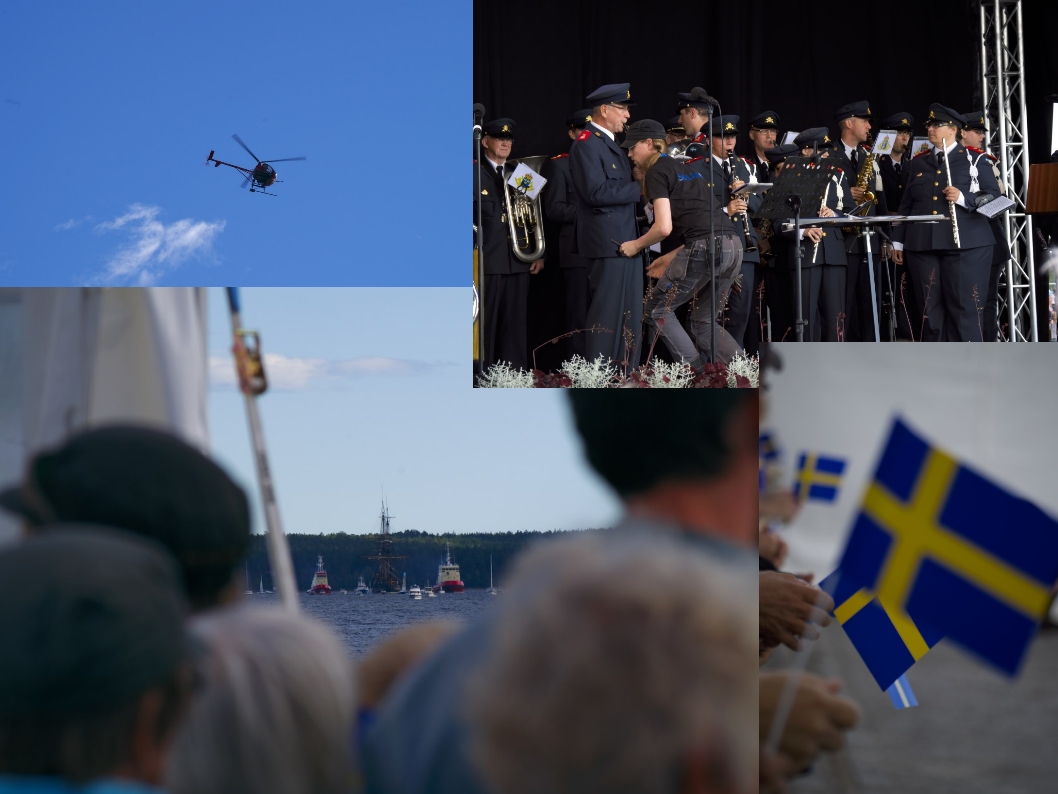

Then, bit by bit Götheborg came into view. Slowly though, because of the wind. The crew had quite a bit of work trying to moor it, according to the newspaper´s report.


I didn´t bring home a single remarkable picture, but I think I did all right, considering where we stood. Of course, if I had had a helicopter or a boat... But then, my photos have a very special point of view, and I really like that. We were there. These photos really reflect that, our own experience.
And then we decided to go home. Mum-in-law was tired, I wasn´t really up for any of the awkward speeches and whatever.
I returned with the husband on Saturday. It was possible to go onboard and have a look around, but we figured we had had enough of old boats in Portsmouth. The weather was nice, but there wasn´t much of a crowd - probably there had been more people there earlier in the day. Götheborg left on Sunday, with more salutes, and that was the end of that visit. A bit of a blast from the past.
 |
| Photographic exhibition about the past and visions of the future. |
.jpg)
 |
| A postcard from the southern harbour, a century ago. |


Subscribe to:
Posts (Atom)