Showing posts with label illustrations. Show all posts

2015-02-08

Lionhearts

Over the Christmas holidays, Swedish television broadcast a three-episode documentary about Astrid Lindgren, who is perhaps our most beloved author. She wrote several children´s books from the late 40´s until the 80´s, from "Pippi Longstocking", over "The Six Bullerby Children", "Karlsson-on-the-Roof", "Emil of Lönneberga", "Bill Bergson" ("Kalle Blomkvist" in Swedish), "Mio, my son", "The Brothers Lionheart", to "Ronia, the Robber´s Daughter". She also wrote the script to "Vi på Saltkråkan", a wonderful television series about a couple of families on an island in the Stockholm archipelago.

I didn´t know much about her life and it was really interesting to see what inspired all those stories. She said she remembered her childhood well, because she had been such a happy child, with happy parents, but that she had hardly any memories from her teens, when she was very unhappy. She was closest to her older brother, with whom she played the best, and he was the model for many of her characters, the older, kind brothers.

Little "Rusky" knows he is going to die and his older brother comforts him.
At eighteen, she became pregnant and involved in a great scandal, when the father of her child (with whom she was not in love, she said she was simply young and flattered that he was in love with her), a fifty-something newspaper man, was sued by his wife and mother of his seven children. Astrid fled to Denmark to have her son Lars and he was put in fostercare there for three years, until his fostermother became ill and Astrid, who was struggling to make a living as a typist in Stockholm, took him to her. After a few months of barely making it work, her parents decided to take the boy in, and when Astrid married soon after that, he could finally live permanently with her. This was her life trauma, and many of her books are about abandoned, lonely little boys, as well as about strong but equally alone little girls.

Happily re-united in the Cherry Valley.
She worked for Swedish intelligence during the Second World War, and spent a few years working for an internationally renowned criminologist. These experienced inspired her books about Bill Bergson, the master detective, and the Lionheart brothers, who fight in the resistance movement against the evil knight Tengil.

She had a daughter in her marriage, and was widowed in 1952. She never married again, but worked as an editor while also writing her books. She spoke English and German equally well, has readers in most countries in the world, and received sackfuls of letters every day. She even took the time to properly correspond with some of her readers, like one troubled little girl (interviewed in the documentary) to whom she wrote for almost 30 years (they never met).

After having seen the documentary yesterday, I decided to re-read "The Brothers Lionheart". I probably haven´t read it since the early 80´s, late 70´s perhaps. It´s a well-read book though, it took me a while to find it since the back is missing. It´s a sad story about leaving home and having to do brave things even though one is scared, and I see how this would have appealed to me. Unlike Astrid, I was not a happy child and can remember very little about childhood. Thanks to women like her, I could grow up to be a free (relatively) adult, and that suited me better than being a child. She wrote this book for her brother, who had a heart disease and knew he was soon going to die. It was a "consolation book" for them both. It was also a book which was inspired by her work in the Second World War and how she experienced the struggle for freedom from Nazi rule. The wonderful illustrations are by Ilon Wikland, who came to Sweden as a fourteen year-old refugee from Estonia.

Jonathan, who is all good, even rescues one of Tengil´s soldiers, when he nearly drowns. 
The story is about little Karl Lejon (Lion), called Skorpan (Rusky in English translation) by his brother (after the little biscuits he loves), almost ten years old, who is dying from tuberculosis. His thirteen-year-old brother Jonathan comforts him and tells him that they will meet again in Nangijala, the land beyond the stars that is still in the age of fairytales. After the house catches fire, Jonathan bravely saves Rusky´s life, taking him on his back and jumping from the third floor, dying from the fall. In an obituary, Jonathan´s teacher writes that he deserves the name Lionheart.

Not long after, Rusky succumbs to his coughs and suddenly finds himself standing in front of a small farmhouse with a sign on the gate: "The Brothers Lionheart". The brothers are united in the Cherry Valley in Nangijala and Rusky - who is now healthy and strong - is deliriously happy for a while, but not all is well in Nangijala. Their neighbouring valley, the Thorn Rose Valley, is enslaved by the evil knight Tengil, who has a terrible weapon called Katla, which no one wants to talk about, but the name makes Rusky shudder. Jonathan is in league with the leader of the resistance, Sofia, and he leaves on a mission for Thorn Rose Valley.

The evil Tengil terrorizes the Thorn Rose Valley folk.

After a bad dream, in which he hears Jonathan call for help, Rusky goes after him, and I am not going to spoil the story by telling you about it any further. It is sad and dark, people die in it, and Lindgren was much criticized for having written such a dark and sad children´s book. Still, it is also a very hopeful story and good prevails, even though the price is high. It is one of the most loved and important books ever written, I think. It is often quoted in obituary notices for children, and adults too: "Don´t cry mummy, we´ll see each other again in Nangijala", which is on a note Rusky leaves for his mother the night he feels he is going to die.

I cried so much reading this book - I don´t remember crying so much when I read it as a child. I guess if you are happy, you´ll read it as a tragedy, but if you are unhappy, you´ll read it as hopeful and comforting. Yes, this is a truth: happy people have no idea what unhappy people need. Happy people can be cruel, with the best intentions. We should never forget that. Astrid Lindgren certainly never did.

2015-02-03

Carl Larsson - Family Comics


Lisbeth, my child, do not poke my paining, it is wet!


Lisbeth immediately stops and turns her back to the easel.


Lisbeth, if you touch my sketch, you will be spanked!


Lisbeth is a bit perplexed, still, she lifts her index-. 


Lisbeth, don´t you dare!


Lisbeth changes her mind, but can´t get the idea from her head.


Now mum and dad can´t take it any more (they burst out laughing) - Lisbeth had to poke!


As you can see from the above, Lisbeth is a real character!

This charming and loving little comic was drawn by Swedish artist Carl Larsson for his book "De Mina" (= my family) from 1895. I found it when I was browsing "Svenska teckningar - 1800-talet" (= Swedish drawings from the 19th century).  He is most famous for his paintings of his home in Sundborn, which was created by his wife, Karin (who was a very talented artist and gave up a promising career when she married), in a style very much inspired by the Arts & Crafts movement. Thanks to the Swedish Academy, you can enjoy his book "Ett Hem" (= a home) on their website. Perhaps not so much the introductory text, but the paintings that start on page ten (X). This was the first of the books that established the Larsson home as one to be admired and copied. You can also read "De Mina", "Larssons", and "Åt solsidan" (= on the sunny side). These books make even me want to re-paint my furniture in warm red shades!

If Larsson´s style of painting sometimes reminds you of comic books it´s no wonder - some are more or less coloured drawings with very bold linework. These images in particular are perennially popular in the form of postcards, wallhangings (prints or embroidery), trays, cups, plates - anything! In the 70´s those little girl´s dresses and ladies aprons were so popular; I remember them on my cousins. Also, Rörstrand porcelain factory has a service called "Sundborn", its design inspired by the Larsson home. (They also do Ostindia, a classic Swedish pattern that I grew up with and still use.)

This is very much how the Swedes see themselves. Larsson´s images define a typically Swedish aesthetic that probably includes you whether you grew up in a suburb of Stockholm or in a red house with white trimmings in the country.

Funnily enough, one of Karin Larsson´s paintings from her time at artschool pokes a nice big hole in the idea of a blond, blue-eyed and homogenous and (therefore, if you listen to the Sweden Democrats) happy past. This is "The negro Pettersson", a very popular model who also worked at the Stockholm harbour, was married twice to Swedish women and raised several children with them. He lived his life in Stockholm in the 19th century, without as many raised eyebrows as one might have thought, although I think he would have been a fairly exotic character at the time. I have seen several paintings of him, and Karin Larsson´s is one of the very best. It was featured not long ago on the "Antiques Roadshow" (on Swedish television).

2014-11-23

Bertila

Some weeks ago, I got an email from Marta, a lover of Barna Hedenhös, of which I blogged - oh my! - exactly one year ago! Must be some kind of benign sign... Anyway, this led to my discovery of a recent publication on the collected works of Barna Hedenhös´ creator, "Boken om Bertila", or Bertil Almqvist as was his full name, by Nisse Larsson. I immediately walked over to the library and got it, and what a revelation!

I was completely unaware that Bertila was the man behind one of the most iconic images in Swedish history: En Svensk Tiger. These words mean two things: A Swedish Tiger, and A Swede Keeps Silent. It was a variation on those many posters the Brits had, like this one. But because of the word play, it was also an affirmation of the strength of both the nation and its individuals during a time when they needed reassurance. A brilliant image, really, and the words that was part of it made it go beyond the visual. It is so ingrained in the nation´s conscience that it has been re-used for other purposes, like selling Swedish milk and Swedish magazines.

 A high ranking military man didn´t like the tiger, he thought it should have been a lion instead,
completely missing the point - a story Bertila enjoyed telling. 


Bertila´s column, with tall Prime Minister
Erlander as the father of the Swedish "folkhem"
(the Swedish Welfare State) with the leader of
the Farmer´s Party, Gunnar Hedlund, as his
supportive wife.
 You can see more columns here.
Bertil Almqvist was born in 1902, to a middle-class family in Stockholm. He got into drawing and writing funny verse already in school, and pretty much continued to do that for the rest of his life. He was perhaps not the most gifted visual artist of his time, but in combination with his word play, his output was unique. For many, many years, he published a weekly drawn and written column that commented on anything that was happening, from politics to sports and culture. It was called "På tapeten", which means literally "on the wallpaper" and means "the topic of the day". He made a sport of drawing the headline differently each week and in accordance with the topic.

He made all kinds of illustrations: theatre posters, children´s books, campaigns. And, of course, he wrote and drew "Barna Hedenhös": the books, the comics, the films. He died in 1972, while working hard on a film for Swedish Television about the Hedenhös children (he wasn´t just overworked, he was fond of his drink and his cigarettes, too, there is hardly a photo of him without a fag between his lips). He had by then been retired - quite forcibly - from his newspaper column, something that had made him so upset he even complained to the Prime Minister of Sweden! Perhaps he had lost touch with the times. When you look at his works they have very much that 50´s positivity, a stout belief in progress.

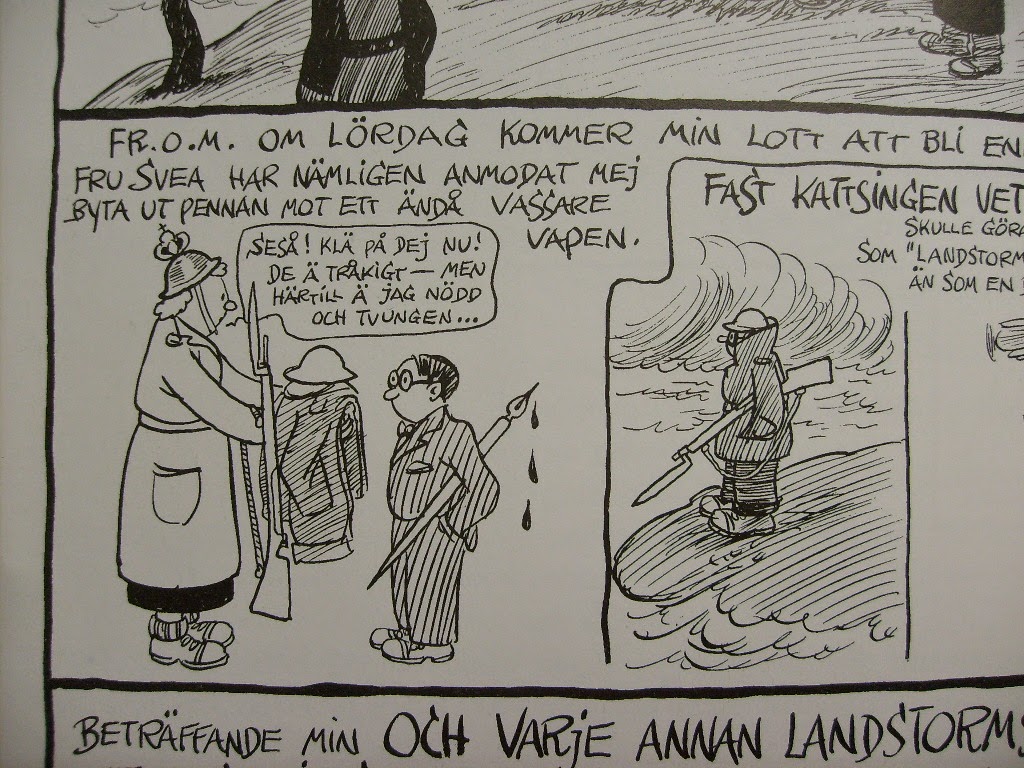
Mother Svea (Sweden) gives Bertila his uniform.
Word play was part of his game and the Swedish language started to change in the 70´s, as a new political and social awareness developed, as Swedes became more internationally aware, and society was being reshaped by immigration and the developement of modern media. Some of the Hedenhös books are no longer reproduced, considered racist and misogynist - which would have offended Bertila, who was a pacifist and a very outspoken advocate of equality and progress, both social, cultural, and technological. For example, he was a keen driver and fiercely lobbied for right-hand traffic for more than 30 years before it became a reality, in 1967. He also had strong convictions about spelling reforms. He did go into the army during the war, but reluctantly so, as he explained in comic form. He thought he could do more for the nation with his pen, and he did that as well, as you already know.

He also composed, which was a surprise to me. He wrote one of the most loved children´s songs in Swedish history, "Droppen Dripp och Droppen Drapp" (performed below by Alice Babs and her daughter Titti), and even recorded songs and put up a revue in 1934, where he sang his own songs in front of fifteen large drawings.

I only knew him for Barna Hedenhös, but I think now that his most lasting work will be "En svensk tiger" - even though perhaps that work has outgrown the memory of the man who created it.

(on Youtube by Tosukep)

Lyrics:

Droppen Dripp och Droppen Drapp    (the drop Drip and the drop Drap)
satt på varsin isetapp                         (sat each on his own icicle)
ovanför vår förstutrapp                      (above our landing)
Droppen Dripp och Droppen Drapp!   (the drop Drip and the drop Drap)

- Hej, sa Dripp till Droppen Drapp       (- Hi, said Drip to the drop Drap)
trivs du bra uppå din tapp?                 (are you happy on your icicle?)
- Åjavars, sa Droppen Drapp              (- Oh, allright I guess, said the drop Drap)
fast min sittplats är rätt knapp!            (although my seat is rather small.)

- Hördudu, sa Dripp till Drapp,            (- Hey listen, said Drip to Drap)
ska vi hoppa ner ikapp,                       (shall we race each other down,)
ner på våran förstutrapp?                    (on to our landing?)
Så sa Dripp till Droppen Drapp.           (That´s what Drip said to Drap the drop.)

- Hu, så högt! sa Droppen Drapp,         (- My, that´s high! said Drap the drop,)
såge helst jag hoppa slapp.                   (I wish I didn´t have to jump.)
- men det gör väl hipp som happ,          (but I guess it´s neither here nor there,)
låt oss hoppa ner i kapp!                      (let us race each other down.)

Och så hoppa Dripp och Drapp            (And then Drip and Drap jumped)
från sin isetapp ikapp,                          (from their icicles together)
ner på våran förstutrapp                      (down onto our landing)
- och blev platta som en knapp!            (and became flat like a button!)

(my own translation - quick and dirty)

Bertila with his daughter Monne Kristina, to whom he wrote the first Hedenhös book. 


2014-01-14

Amazing Notebook Pages

Just came across this at Pinterest. Such amazing pages! I have been wanting to rejuvenate my diary for a long time, almost giving it up; this is really inspirational. I feel the urge to explore new expressions!

2013-11-23

The Stone Age Rocks

Every year, for as long as I have been around, Swedish Television has had an Advent calendar program for children every evening in December, leading up to Christmas Eve. (In Sweden, Christmas Eve is The Day of celebration, and Christmas Day is just for eating leftovers and playing with your toys while mum and dad does crossword puzzles or watch a film.) It´s some kind of story, often connected with Christmas, and you can buy a calendar and open it with the television host or perhaps even the characters of the story. This year, the advent story is based on a Swedish children´s book classic, "Barna Hedenhös" (= the children From-Time-Immemorial, but it´s really not translatable and the books are not, as far as I can figure, translated to English) by Bertil Almquist.

The family lives on the Stock (= tree log) Holme.
"Barna Hedenhös" was an early favourite of mine and the trauma experience of having my father read it to me may have fueled me with some extra motivation to learn how to read for myself. What he did during his first reading was to improvise: "And pappa Ben says:" and then he would ad-lib something really funny that went with the pictures. The next time I begged him to read it he was, however, not able to repeat the performance, and I was so confused and provoked, because to me, letters were absolute, books were reliable (and I had a very good memory - I still to this day remember one of those made-up lines...), and they didn´t change from reading to reading. A book did not forget the joke it told yesterday!

Much of the humour is based on wild, unrestrained punning and unabashed anachronisms; Almquist was particularly fond of making up words with the prefix ur- which means ancient or primordial. Like in the book where the family Hedenhös goes to America, they arrive at a town called Urjork, or Ur York, which is, naturally, the original New York. The indians who live there are not iroquois, but uroquois. And they go on an excursion to Urtroit and visit with uncle Urford, riding on his horsepowered wagons. It´s all delightfully recognizable, and the well-travelled Hedenhös family also goes adventuring to Egypt, England, Paris (where they are kitted out by Mr Diur), and they even go to the moon, and to Mars! They also organize the worlds first international olympiad, the urlympiad.

Pappa Ben builds the raft Ur-tiki that takes them to America. (Remember Heyerdal´s Kon-Tiki expidition in 1947?)

Arriving at Ur York.
The illustrations are glorious, there are things happening all over the place, and there is such vitality to every character. 

Bertil Almquist was born in 1902, and the first book came out in 1948. The stories are very much of their time and have that hyper-positive attitude to technology and progress. It is what fuels them, really. The family is an ideal nuclear family: pappa Ben (= bone), mamma Knota (= another Swedish word for bone), brother Sten (= stone), and sister Flisa (= splinter). Pappa Ben may only possess a flint knife and a stone axe, but that does not stop him from building a jet plan (driven by uranium, in case you wondered). Their animals are part of the family, as well as being useful household assets, and they all come on the adventures.


In yesterdays paper, it was announced that the America-album will not be published in future. It is perhaps my favourite, but I can really see why they had to make this decision. The attitude to the indigenous people of North America is, well... shall we say naive and patronizing? A tad colonial? Remember, this was a time when Swedes had not yet learned that a person of dark skin-colour could take offence to being called a negro. To us, it was just a noun, and to some very old people (like the mum-in-law) it still is. We had yet to see "Roots" on television (I was not old, but I remember how BIG that was). If the world seemed small in the Hedenhös universe, to a regular Swede in the 50´s, it was actually pretty large and unknown.

Uncle Urford´s factory in Urtroit.
In some cases, older books can be salvaged from having become un-politically correct by changing a word here or there (as I understand has been done to Mark Twain´s children´s books, and Astrid Lindgren´s Pippi-books). But in this case, the whole plot is based on the "fact" that bulls (as everyone knows from the bullfights, right? it couldn´t be the BARBED arrows they stick in their backs, could it?) become enraged when you wave something red in front of them, and that indians have red skins. Pappa Ben solves this problem by introducing face paint to mask the redness and thus makes the indians and the bisons best friends forever... It´s a story promoting peace, but the premise is too way off. It´s unsalvageable. And I don´t think Almquist was a racist, more like the opposite. But for all the things he knew, there was so much he didn´t. If he were alive today, he´d probably cringe, as I did when I read it a few days ago.

Still, the characters are alive and well, and changing with the times. I think I´ll tune in at least for the first episode, to see what´s been done to them.

2013-08-09

Moodboards for Books

Did you know that Laurie R King does so called moodboards for her novels (some of them) on Pinterest? Look at this, her board for "Garment of Shadows". And this is for "Touchstone" which I haven´t yet read, but probably must, because it seems to be set in Cornwall, which I love. And then there is one for "The Bones of Paris", the follow-up to "Touchstone".

Such a great idea!