I am not getting a whole lot of reading done, and considering how much I anticipated the new Russell&Holmes adventure, "Dreaming Spies", by Laurie R King, it has taken me an uncharacteristically long time to get through it. The last quarter, however, was so exciting I sacrificed a few hours of sleep for it.
Our detective partners are just come home from their latest adventure in Marocko ("Garment of Shadows") and finds Mrs Hudson puzzled about a rock that has been delivered and carefully placed in their garden. The Holmeses do not take this as a puzzle to be solved, so we understand that they know what this rock is and why it has been given to them. Russell goes up to her house in Oxford, where she is met by an intruder, asking for her help. And so starts a lengthy flashback of their round-the-world trip and visit to Japan, one year earlier. (This would have taken place between "The Game" and "Locked Doors".)
One of the things I really like about King is how well she seems to understand the context in which she places her protagonists. Japanese culture - that whole thing about loosing face - is usually incomprehensible to me (I recently read an article in the paper about a Swedish exchange student in China who got into trouble with the police when trying to stop a fight in a nightclub, and how his attitude - perfectly understandable to a European - caused him a year of grief with the justice system, until he swallowed his pride and was promptly released after having begged forgiveness for something he hadn´t done) but King explains it well through the situations she puts the husband/wife team in.
This is the first of the novels where Russell and Holmes are really one hundred percent comfortable with each other as working partners - there is a higher level of trust and confidence, and a natural and easy division of labour - and I like how King has let her characters evolve through the series. She is, as always, very humouristic, sometimes slapstick funny. And again, she gives the most interesting and complex roles to the women of her cast; not that one really notices, as she is never overtly feminist.
Well, you can tell, I find it hard indeed to find fault with King´s work. I have realized that this series is not to everyone´s taste, although I can´t really understand why, but there it is. I do wish, however, that every reader finds a few series that he or she can relish as much as I do this!
Showing posts with label entertainment read. Show all posts
2015-03-21
2014-10-05
The Bones of Paris
I had finished the third novel in the Lord Peter Wimsey series and felt like I needed a change. Not a big change, but a little one. I decided to stay in the 1920´s and in the genre, and bought the second in what I imagine is becoming a longer series about former US agent Harris Stuyvesant, who was the hero of "Touchstone" by Laurie R King. This one is titled "The Bones of Paris", and Paris is where we find Harris now. It´s been three years since the last story took place, his friend Bennet Grey is back in his cottage at Land´s End, and Bennet´s sister Sarah, who was also Harris´s love interest, has disappeared, badly wounded from the ordeal they went through together and needing time to heal, alone. Harris is hurt, but also understanding and patiently waiting for her to get in touch again. Not that his emotional loyalty to Sarah stops him from having one or two flings...
After going in circles around Europe, stopping here and there, working both in bars and as a private investigator, Harris is in Berlin when he gets the assignment to locate a missing American heiress, Pip Crosby, with whom he had a short relationship at the south coast of France a few months earlier. He returns to Paris and goes in search of her, expecting to find her in some arts or political commune, doped up by drugs or ideals. He reaquaints himself with the Paris of the artists and American expats, the writers (like Hemingway and Fitzgerald), the visual artists (like Man Ray, Picasso, Matisse, Dali, Buñuel), the models (Kiki, Lee Miller), he sees films like "An Andalusian Dog", and strikes up an awkward friendship with a police officer, Doucet, who is troubled by what he sees as a cult of death in the art community and investigating a disturbingly long list of missing people who were connected to it. As were Pip Crosby.
Pip had also been the mistress of a Parisian count, Dominic Charmentier, the man behind a horror-burlesque type theatre which he claims provides a release to those tormented by the memories and losses of the war. As Harris goes investigating the man and his connections, to his surprise, he finds that the duke´s assistant is his own Sarah Grey. Though she is hardly his any more, but turns out to be engaged to the police officer Doucet!
By now, I did find that the number of coincidences were a bit too remarkable. Or was it that what Stuyvesant was uncovering seemed so disturbing? I try to avoid books with perverse murderers going after women and children, and found myself so eagerly distracted from the reading, that when one of Laurie R King´s newsletters came in my mailbox, I started re-reading old Mary Russell stories instead of going ahead with Harris´s search for Pip.
I realized during this reading how much I like the way King can turn a phrase. I´m not really capable of grading English prose on a scale of beauty, but she is to my taste, that´s for sure. Finally, I pulled myself together and read to the end. Which was happy enough, but pretty hairy just before the finishing line, just as you would expect. And now I am knee-deep in "The Beekeeper´s Apprentice", again...
![]() |
| Laurie R King has a great moodboard on Pinterest! |
Pip had also been the mistress of a Parisian count, Dominic Charmentier, the man behind a horror-burlesque type theatre which he claims provides a release to those tormented by the memories and losses of the war. As Harris goes investigating the man and his connections, to his surprise, he finds that the duke´s assistant is his own Sarah Grey. Though she is hardly his any more, but turns out to be engaged to the police officer Doucet!
By now, I did find that the number of coincidences were a bit too remarkable. Or was it that what Stuyvesant was uncovering seemed so disturbing? I try to avoid books with perverse murderers going after women and children, and found myself so eagerly distracted from the reading, that when one of Laurie R King´s newsletters came in my mailbox, I started re-reading old Mary Russell stories instead of going ahead with Harris´s search for Pip.
I realized during this reading how much I like the way King can turn a phrase. I´m not really capable of grading English prose on a scale of beauty, but she is to my taste, that´s for sure. Finally, I pulled myself together and read to the end. Which was happy enough, but pretty hairy just before the finishing line, just as you would expect. And now I am knee-deep in "The Beekeeper´s Apprentice", again...
2014-04-10
To Like or Not To Like?
I have been arguing with myself for some time if, and what, I should write about Ann Cleeves´s Shetland Island crime novels: "Raven Black", "White Nights", "Red Bones", and "Blue Lightning". I have read all the four first novels in one go (there is a fifth, and I expect there will be more) and I am conflicted about them. Most of all, I really like her main man, Detective Jimmy Perez. I dislike what she lets him go through in the fourth book, and judging by the reviews on amazon, I´m not the only one. Nor am I the only one to think that sometimes she crosses the boundary of what is believable in how people behave. It gets just a little too Midsumer Murder-crazy at times, if you know what I mean.
I suppose reading her has taught me something important about writing. I am still rather upset by what I thought was a violation of the writer-reader contract, particularly considering this is genre fiction, a pretty standard whodunit in all other regards. It is not wrong to test the hero and heroine, to bruise them a little, but there are limits to what I think you should do. And if you must let it all go absolutely pear-shaped, at least have a good reason for it. I could find no good reason for her to do what I can´t tell you she did without spoiling the reading for you, if you plan on taking her on. I am probably one leg over that line, anyway (talking about contracts, huh-hm).
The second thing I learned was how limited my imagination really is. She could write herself blue in the face about what it looks like on the Shetlands, but only after reading the last book did I google images of the islands, and realized that there really are no trees there. No trees at all. I could not imagine it. For me, there is always a tree in the background. Only when she described a character´s uneasiness about standing in what must have been a small, artifical grove, did I understand. I suppose it would be equally hard to imagine plodding through thigh-deep drifts of snow if you live in, say, Kenya. It really hammered into me how important it is to have good characters, and how I, the reader, focus on them, even skimming the descriptive parts (and barely noticing that I do).
Thing is, now that I find there is a fifth book out there, "Dead Water", I really want to read it. Damn. Totally against my will (for I want to punish the author for what she did to Perez, while at the same time I want to see him again). I suppose this is a kind of reluctant recommendation.
![]() |
| Land´s End - the most treeless landscape in my files. |
The second thing I learned was how limited my imagination really is. She could write herself blue in the face about what it looks like on the Shetlands, but only after reading the last book did I google images of the islands, and realized that there really are no trees there. No trees at all. I could not imagine it. For me, there is always a tree in the background. Only when she described a character´s uneasiness about standing in what must have been a small, artifical grove, did I understand. I suppose it would be equally hard to imagine plodding through thigh-deep drifts of snow if you live in, say, Kenya. It really hammered into me how important it is to have good characters, and how I, the reader, focus on them, even skimming the descriptive parts (and barely noticing that I do).
Thing is, now that I find there is a fifth book out there, "Dead Water", I really want to read it. Damn. Totally against my will (for I want to punish the author for what she did to Perez, while at the same time I want to see him again). I suppose this is a kind of reluctant recommendation.
2014-04-06
The Last Policeman
I did, when we had the post-Christmas health crisis, as one does: reach for a stack of detective stories. Just like they are the perfect vacation reads, they are also the perfect getting-away-from-ugly-reality reads. And the best of the bunch were a pair, part one and two in what is to be a trilogy, "The Last Policeman"-series, by Ben H Winters. If I remember correctly, I got the tip from blogger Divers&Sundry, and I´m glad I took note, since this is a really enjoyable read. The first is "The Last Policeman: A Novel" and the second "Countdown City: The Last Policeman Book II".
On one hand, it´s a traditional detective story, told in first-person by Detective Henry Palace of the Concord Police Department´s Criminal Investigations Division. He is young, having been quickly promoted since many colleagues have quit. This is happening a lot, not just in the Police Department, since a meteor is heading straight for Earth and the world as we know it is about to perish in just a few months. That is, I guess, what makes this novel stick out a bit from the rest of them.
So, it´s the end of the world, many people are going "Bucket List," which means that they suddenly, and often without telling anyone, leave their jobs and lives to do what they always dreamed of doing, whatever that is. Others stubbornly try to live their lives and do their jobs as best they can, and for Henry Palace, being a Detective is all he ever wanted. As we get to know him better, we realize that he has a lot more emotional baggage than just the pressure from the End of the world-thing. For him, doing the work is clearly a way of escaping his own worries, and whatever happens, he stays with the case. And things do happen. Society is breaking down all around him: hospitals, electricity, communications, food and water supplies, and finally he looses his job when the police- and justice system is replaced by a kind of military peace keeping force.
It´s been a few months since I read it, but I realize now how much this story affected me. I really like the main character, he is kind, good, obsessed with justice, and has little regard for his own safety - I suppose there is quite a bit of passive self-destructivness about him. He is, however, not the only good character in this story, and when he finally finds himself on the street, things do turn out all right for him. For now, that is. The meteor is still coming, after all.
It´s a well-written series, the whole breakdown of society scenario sounds plausible to me, and I really want to know what´s going to happen to my friend Palace. And to the Earth. The third book is on its way and will be along this summer, I think.
![]() |
| Not a meteor, obviously, but the closest I have of a fitting illustration. |
So, it´s the end of the world, many people are going "Bucket List," which means that they suddenly, and often without telling anyone, leave their jobs and lives to do what they always dreamed of doing, whatever that is. Others stubbornly try to live their lives and do their jobs as best they can, and for Henry Palace, being a Detective is all he ever wanted. As we get to know him better, we realize that he has a lot more emotional baggage than just the pressure from the End of the world-thing. For him, doing the work is clearly a way of escaping his own worries, and whatever happens, he stays with the case. And things do happen. Society is breaking down all around him: hospitals, electricity, communications, food and water supplies, and finally he looses his job when the police- and justice system is replaced by a kind of military peace keeping force.
It´s been a few months since I read it, but I realize now how much this story affected me. I really like the main character, he is kind, good, obsessed with justice, and has little regard for his own safety - I suppose there is quite a bit of passive self-destructivness about him. He is, however, not the only good character in this story, and when he finally finds himself on the street, things do turn out all right for him. For now, that is. The meteor is still coming, after all.
It´s a well-written series, the whole breakdown of society scenario sounds plausible to me, and I really want to know what´s going to happen to my friend Palace. And to the Earth. The third book is on its way and will be along this summer, I think.
2014-01-18
Laugh of the Day
I don´t know if there is such a thing as a national sense of humour. Probably there is, since what you find funny is tightly bound to your frame of reference and your values. This is why the young laugh at other things than their elders, and why the working classes laugh at other things than academics or the affluent.
Comic strip creators, and married couple, Jan and Maria Berglin must represent some of the best middle age, middle class humour in Sweden. They are expertly pointing their fingers at absurdities in the way we live and think. This week, I love this:
Translation: There is an abundance of coaches urging us to great achievements, but who is teaching us the fine art of giving up?
She says: Blabla... work... blabla...marriage hell...blabla...blood pressure...blabla...the trailer...blabla...nights sleep...blabla...aquarium fish...bla...roof tiles...bla...I´m trying and trying...
He says: But let go of the oars, silly! And have a chocolate. You didn´t ask for this... you were tricked into life just like the rest of us. Coffee?
And the hanging on the wall says: Teach me, you forest, to wither happily!
It´s that last bit that cracked me up. Perhaps this is particularly Swedish, having grown up with grandmother´s embroidered mottos.
Oh, and have a look at this! Hilarious! And creepy...
2014-01-07
An American In Lucerne
When I was browsing for a book on the history of Switzerland, I came across this thing: "The Lions of Lucerne" by someone called Brad Thor. Well, I don´t know the thriller genre very well, but it looked like fun. When we were recently in Lucerne, we visited the Löwendenkmal, which is a pretty impressive and poignant monument over the Swiss Guards who were massacred in Paris during the French revolution, defending Louis XVI. It was made by Danish sculptor Berthel Thorvaldsen, whom you might know from his sculpture of Christ, a well known popular image.
Anyway, the back cover of this book promised me a fight on the slopes of mount Pilatus and I imagined a tricky plot with a historical twist involving the Swiss Guards. It started well enough, with a prologue in which the Big Bad Guy invites a couple of Corrupt Senators into his hidden study. Thor makes a point of one of the senators making sure the place is not bugged, while the Big Bad Guy brags about a genuine owned-by-Louis XV-desk he has recently bought from under the nose of the French government and how he has been able to practically mind-read this Swiss mercenary he has hired. Aha! I thought smugly, this is important, I bet that desk is bugged after all and that Big Bad Guy actually sits in the pocket of Top-Lion of Lucerne.
But no. This is a standard form 1A thriller - that is, not particularly thrilling at all. It´s like one of those movies you find after midnight at obscure commercial television channels. You have never heard of the actors, who all look like models fitted out by stylists rather than a costume designer. The acting is wooden, the lines awkward, and the plot is simple yet impossible to understand.
Everyone in this novel is beautiful, superstrong, professional, expertly wields any kind of gun, climbs, skiis, does some kind of budo sport, and has the emotional depth of a plastic kiddie pool from Toys´r´us. The hero in particular acts like a 5-year-old´s notion of brave cowboy. And Top-Lion of Lucerne is what a villain must be: stupider than the hero. Which makes him pretty darned stupid indeed.
In spite of this, Thor seems to be an appreciated writer, doing well. Good for him. Perhaps he has written better books since this one, which I believe was his first try. I am not going to find out, though. It´s not really my genre, after all. Or no, I shouldn´t say that. I´ll enjoy any kind of book, well written. Surely it must be possible to write that thriller I was expecting to read. It should be right up Dan Brown´s alley.
I bought the book in paperback, thinking the husband might be interested. When I read this to him:
Anyway, the back cover of this book promised me a fight on the slopes of mount Pilatus and I imagined a tricky plot with a historical twist involving the Swiss Guards. It started well enough, with a prologue in which the Big Bad Guy invites a couple of Corrupt Senators into his hidden study. Thor makes a point of one of the senators making sure the place is not bugged, while the Big Bad Guy brags about a genuine owned-by-Louis XV-desk he has recently bought from under the nose of the French government and how he has been able to practically mind-read this Swiss mercenary he has hired. Aha! I thought smugly, this is important, I bet that desk is bugged after all and that Big Bad Guy actually sits in the pocket of Top-Lion of Lucerne.
![]() |
| The hero destroys part of 14th Century Kapellbrücke and lands in River Reuss. |
Everyone in this novel is beautiful, superstrong, professional, expertly wields any kind of gun, climbs, skiis, does some kind of budo sport, and has the emotional depth of a plastic kiddie pool from Toys´r´us. The hero in particular acts like a 5-year-old´s notion of brave cowboy. And Top-Lion of Lucerne is what a villain must be: stupider than the hero. Which makes him pretty darned stupid indeed.
![]() |
| Spectacular place for a fight. |
I bought the book in paperback, thinking the husband might be interested. When I read this to him:
As the man attacked again, Scot faked left, then spun around hard to his right and plunged the [ski] pole deep into the man´s chest. The knife fell from his hand, and in seconds, blood gurgled out of his mouth, painting his jacket a deep crimson.he passed. Oh well.
"It looks like you got my point," said Scot as he let go of the pole.
2013-12-14
Charming Comedy
You never know how a new author is going to enter your life. E F Benson (Edward Frederick) came to me like this:
Now, Rye is not a place from which the view is particularly spectacular; rather, Rye is a place people go to look at, as did we, on recommendation by a friend who had been there some months earlier. It is the quintessential English small town, and just what the English themselves seem to love the most. We only stayed for a few hours, strolled around (with our bags in tow, as we were in transit), had lunch, a long fika (as it began to rain rather heavily), took a few photos, and just generally roamed about. For some reason, probably the weather, all my photos from Rye are terrible and dreary, which is why most photos in this post are the husband´s. Also, a telephoto lens is crap when you want to photograph quaint alleys.
I had never heard of E F Benson, and nor had my friend (the one who had visited Rye before me and who has introduced me to some great British literature), so I investigated. Turned out, he wrote six novels about these characters and four of the books were set in a ficionalized version of Rye called Tilling. The first book, "Queen Lucia" is available for free at the gutenberg-project, or you can get it at amazon, also for free.
This is social comedy, or a comedy of manners, perhaps. Emmeline Lucas, or Lucia, as she wants to be called, dominates the social life of small town Riseholme by having set herself up as a paragon of culture and good taste. She hosts parties with musical entertainment and poetry readings (her husband Philip, whom she calls Peppino, is a retired lawyer and self-published poet), she has a penchant for tableaux, and has even invented her own dresscodes for parties. Her tastes go beyond the social and she has written a memorable essay on "Humour in Furniture", which she has read to the Riseholme Literary Society, advocating the use of brass milkcans as receptacles for sticks and umbrellas, displays of realistic stone fruit, and man-made insects crawling around the home.
Lucia´s right hand man is Georgie Pillson, a half-old bachelor, more girl than man, who adores Lucia in a most chaste manner. There are other wonderful characters as well, like Daisy Quantock, who likes to play first fiddle herself, and occasionally puts up a bit of a fight for the throne. The village green is referred to as the parliament, and gossip is what fuels the inhabitants of Riseholme. Everyone wants to know everything about everyone and everyone wants to be interesting and talked about by the others. Information is the most valuable currency.
The author Benson reminds me most of, that I have read, is Nancy Mitford, who published her first novel about ten years after "Queen Lucia". Both write amusingly about their social circle, which is upper class in Mitford´s case and solidly middle class in Benson´s. However, and I say this with the reservation that I have yet to read Mitford´s most praised, later novels, Benson has a lot more depth to his characters and the plots have more layers.
I don´t know if he planned a series when he wrote this book, or if the success of it demanded the sequels, but for sure, it feels very complete. Towards the end I realized that the story has a spiritual quality as well. You might say that it is a story of the enlightenment of Georgie Pillson, who are, I think, at the centre of the story. This is a delicious little paragraph towards the end, about a portrait Georgie is making of his new neighbour:
I started this book with curiosity, not expecting to get hooked or read another. Now, I am an ardent fan of Mr Benson, and will absolutely return to him at some time. "Queen Lucia" is an entertainment read, certainly, but it is so well written, has so much heart and depth to it, that it is also very satisfying. Benson seems to have a devoted following still, and this charming blog is dedicated to the Riseholme/Tilling universe. I also like this cute and nerdy little tribute on youtube, by Kevin Riley.
Highly recommendable!
Now, Rye is not a place from which the view is particularly spectacular; rather, Rye is a place people go to look at, as did we, on recommendation by a friend who had been there some months earlier. It is the quintessential English small town, and just what the English themselves seem to love the most. We only stayed for a few hours, strolled around (with our bags in tow, as we were in transit), had lunch, a long fika (as it began to rain rather heavily), took a few photos, and just generally roamed about. For some reason, probably the weather, all my photos from Rye are terrible and dreary, which is why most photos in this post are the husband´s. Also, a telephoto lens is crap when you want to photograph quaint alleys.
![]() |
| Referencing another, more famous author. |
This is social comedy, or a comedy of manners, perhaps. Emmeline Lucas, or Lucia, as she wants to be called, dominates the social life of small town Riseholme by having set herself up as a paragon of culture and good taste. She hosts parties with musical entertainment and poetry readings (her husband Philip, whom she calls Peppino, is a retired lawyer and self-published poet), she has a penchant for tableaux, and has even invented her own dresscodes for parties. Her tastes go beyond the social and she has written a memorable essay on "Humour in Furniture", which she has read to the Riseholme Literary Society, advocating the use of brass milkcans as receptacles for sticks and umbrellas, displays of realistic stone fruit, and man-made insects crawling around the home.
Lucia´s right hand man is Georgie Pillson, a half-old bachelor, more girl than man, who adores Lucia in a most chaste manner. There are other wonderful characters as well, like Daisy Quantock, who likes to play first fiddle herself, and occasionally puts up a bit of a fight for the throne. The village green is referred to as the parliament, and gossip is what fuels the inhabitants of Riseholme. Everyone wants to know everything about everyone and everyone wants to be interesting and talked about by the others. Information is the most valuable currency.
Georgie felt very much like a dog with a bone in his mouth, who only wants to get away from all the other dogs and discuss it quietly. It is safe to say that never in twenty-four hours had so many exciting things happened to him. He had ordered a toupet, he had been looked on with favour by a Guru, all Riseholme knew that he had had quite a long conversation with Lady Ambermere and nobody in Riseholme, except himself, knew that Olga Bracely was going to spend two nights here.Riseholme is, at the beginning of the story, a paradise to those who live there. As faulty as its inhabitants, perhaps, but paradise all the same. Then, the snake moves in. Or actually, a woman takes up residence in Riseholme, a woman who really is everything that Lucia pretends to be, and awkward and amusing things start to happen. And that´s really all I can say without spoiling your pleasure.
The author Benson reminds me most of, that I have read, is Nancy Mitford, who published her first novel about ten years after "Queen Lucia". Both write amusingly about their social circle, which is upper class in Mitford´s case and solidly middle class in Benson´s. However, and I say this with the reservation that I have yet to read Mitford´s most praised, later novels, Benson has a lot more depth to his characters and the plots have more layers.
I don´t know if he planned a series when he wrote this book, or if the success of it demanded the sequels, but for sure, it feels very complete. Towards the end I realized that the story has a spiritual quality as well. You might say that it is a story of the enlightenment of Georgie Pillson, who are, I think, at the centre of the story. This is a delicious little paragraph towards the end, about a portrait Georgie is making of his new neighbour:
Then Georgie had the other picture to finish, which he hoped to get ready in time to be a New Year's present, since Olga had insisted on Lucia's being done first. He had certainly secured an admirable likeness of her, and there was in it just all that his stippled, fussy representation of Lucia lacked. "Bleak December" and "Yellow Daffodils" and the rest of the series lacked it, too: for once he had done something in the doing of which he had forgotten himself. It was by no means a work of genius, for Georgie was not possessed of one grain of that, and the talent it displayed was by no means of a high order, but it had something of the naturalness of a flower that grew from the earth which nourished it.I have to say, the language is wonderful all through the book; it is pure joy to read Benson´s sentences. His characterisations are so funny (he is a master working with clichés), but he never portrays anyone without reason to sympathise with them and even like them. His most flawed characters are also his most amusing and dear, which is perhaps why Lucia lasted through six novels. You cringe when she makes an arse of herself, but can´t help liking her anyway, because no one can get away from the fact that there is a Lucia in all of us. There is also a television series from the 80´s, starring Nigel Hawthorne, Prunella Scales, and Geraldine McEwan as Lucia. I have bought the dvd from amazon and can´t wait to see it!
I started this book with curiosity, not expecting to get hooked or read another. Now, I am an ardent fan of Mr Benson, and will absolutely return to him at some time. "Queen Lucia" is an entertainment read, certainly, but it is so well written, has so much heart and depth to it, that it is also very satisfying. Benson seems to have a devoted following still, and this charming blog is dedicated to the Riseholme/Tilling universe. I also like this cute and nerdy little tribute on youtube, by Kevin Riley.
Highly recommendable!
2013-11-18
Too Many Gods
I have once been in the same room as Neil Gaiman. In 2000, I decided that a job is a job is a job, and that literature is the only thing worthwhile. To celebrate, I emptied my savings account and went to the Book Fair in Gothenburg, where, among others, I saw Gaiman and Terry Pratchett giving a presentation on how they had collaborated on "Good Omens", which was about to be released in Swedish. I enjoyed them a lot, and later read the book (in English).
The other day I saw that Gaiman had written something in the Guardian (I think it was a piece on Lou Reed). He is good, I thought, I should read one of his. I did read something of his not long ago (ok, ten years), "American Gods". That was good, I thought, but what was it about? I remembered a Mr Wednesday and a tree, and that was all. I was a bit puzzled about remembering so little about the book and decided to read it again.
The protagonist is a kind, honest, loyal, and not stupid man in his thirties who goes by the name Shadow. He has an unfortunate tendency to attach himself to Bad People, though, and has just served three years in prison. When he is released, he is hired by a Mr Wednesday, a one-eyed elderly man with a silver tie-pin in the shape of a tree. Shadow is now drawn in to a world of gods, magic, and other trickery. A war is starting, between the old gods: fertilitygods, wargods, deathgods, tricksters, leprechauns, djinns, trolls, brownies, anything you can think of; and the new gods: electrical gadgets, highways, shopping malls, media, "intangibles" (like hedgefunds), and so forth.
After I finished it, I tried for days to write something about it, kept going on and on, page after page, trying to understand why it wasn´t working for me. In the end, I came to the conclusion that I wasn´t being fair, I was judging it as something it was not. It is not a good read, it is an entertainment read. An excellent entertainment read, however, and a highly recommendable one. Perfect for the holidays, if you are looking for something that´s well written, cleverly plotted, and very funny. But it will not change your life.
But I expected more; I read it once already and I persuaded myself it was more. Why is that? It occured to me that I must still have the notes from Gothenburg, but where? These days, all my archives are digital, but I still keep a filing cabinet which my husband refers to as my "X-files". I don´t know what he thinks I keep in there, and honestly I hardly remember, but anything earlier than 2005 should be there. It took me less than 30 seconds to find them (to which I credit an anal-retentive streak). Disappointingly, all I wrote about Neil Gaiman at the time was that he had long, black, curly hair and looked like a stray member of Slade. So no clues there. And "Good Omens" certainly wasn´t very profound, it was a good romp about Armageddon.
As I leafed through my notes I saw that I had attended several seminars to do with the publication of the new Swedish Bible translation (which I also read later, cover-to-cover if you can belive it). There was a particularly interesting one about holy texts in all the world religions: Christianity, Judaism, Islam, Buddhism. I still remember clearly some of the things being said in that seminar, I occasionaly quote from it. Perhaps it´s the topic: gods, religion. Perhaps I made some links of association there, and messed up my idea of what Gaiman and his work is about. Perhaps, also, I have become a more discerning reader; I am not at all unappreciative of Gaiman and "American Gods", but I confess, three days after I finished it, it´s already beginning to fade.
The other day I saw that Gaiman had written something in the Guardian (I think it was a piece on Lou Reed). He is good, I thought, I should read one of his. I did read something of his not long ago (ok, ten years), "American Gods". That was good, I thought, but what was it about? I remembered a Mr Wednesday and a tree, and that was all. I was a bit puzzled about remembering so little about the book and decided to read it again.
The protagonist is a kind, honest, loyal, and not stupid man in his thirties who goes by the name Shadow. He has an unfortunate tendency to attach himself to Bad People, though, and has just served three years in prison. When he is released, he is hired by a Mr Wednesday, a one-eyed elderly man with a silver tie-pin in the shape of a tree. Shadow is now drawn in to a world of gods, magic, and other trickery. A war is starting, between the old gods: fertilitygods, wargods, deathgods, tricksters, leprechauns, djinns, trolls, brownies, anything you can think of; and the new gods: electrical gadgets, highways, shopping malls, media, "intangibles" (like hedgefunds), and so forth.
![]() |
| A recent addition to my own pin collection. |
But I expected more; I read it once already and I persuaded myself it was more. Why is that? It occured to me that I must still have the notes from Gothenburg, but where? These days, all my archives are digital, but I still keep a filing cabinet which my husband refers to as my "X-files". I don´t know what he thinks I keep in there, and honestly I hardly remember, but anything earlier than 2005 should be there. It took me less than 30 seconds to find them (to which I credit an anal-retentive streak). Disappointingly, all I wrote about Neil Gaiman at the time was that he had long, black, curly hair and looked like a stray member of Slade. So no clues there. And "Good Omens" certainly wasn´t very profound, it was a good romp about Armageddon.
As I leafed through my notes I saw that I had attended several seminars to do with the publication of the new Swedish Bible translation (which I also read later, cover-to-cover if you can belive it). There was a particularly interesting one about holy texts in all the world religions: Christianity, Judaism, Islam, Buddhism. I still remember clearly some of the things being said in that seminar, I occasionaly quote from it. Perhaps it´s the topic: gods, religion. Perhaps I made some links of association there, and messed up my idea of what Gaiman and his work is about. Perhaps, also, I have become a more discerning reader; I am not at all unappreciative of Gaiman and "American Gods", but I confess, three days after I finished it, it´s already beginning to fade.
2013-10-03
Sherlock Holmes Fandom
Sometimes, when things are tough in my world, even an entertainment read is too hard a read for me. I need something short, something that engages my mind, not my heart. I suppose my heart is busy enough as it is.
This time, I reached for "Laurie R King´s Sherlock Holmes". I suppose that I don´t need to spell out who the author is, or go into much of an introduction. Laurie R King has been mentioned often on this blog, as I have read her entire series about Mary Russell, the female counterpart of Holmes - in the King universe, anyway. King says in the introduction that she didn´t really know very much about Holmes when she started out with the Russell-books, but she has learned along the way. These days, she is a member of a group called The Baker Street Irregulars, one of many who participate in what they call "The Game", which is a kind of play scholarship
I can´t say this little book (at 64 pages, and it only seems to be published in Kindle format) was a fabulous read. Nor did it wet my apetite for any more Sherlockiana. It was ok, though, I giggled a bit and that´s what I wanted. It has that dry, academic humour. I get most of it (I think), but I laugh harder at other things. Actually, as I looked through my pictures from our visit to the Sherlock Holmes Museum a few years ago, I found this snap of a letter that made me smile just as much:
I think little Brandon may have had some help. Wouldn´t it be great if King would write a Holmes&Russell-mystery involving dinosaurs and fish in America? With an Irregular at their side called Brandon?
![]() |
| From the Sherlock Holmes Museum, 2011. |
"built upon the solemn declaration that Holmes and Watson were absolutely real, that Conan Doyle was but their literary agent, and that the stories are absolutely factual - if only we lesser mortals can figure out the apparent flaws and omissions."One text is a lecture called "Dr. Watson´s War Wound" where King tries to analyse the nature and circumstance of the single jezail bullet that managed to wound Watson both in the shoulder and in the leg. There is also "A Holmes Chronology" where King explains why Holmes is not as old as everyone imagines him to be. There are the collected quotes from Holmes´ lost book on beekeeping that King used in "The Language of Bees". There is an introduction to Arthur Conan Doyle, originally commissioned by Penguin for their website. And a few more things.
I can´t say this little book (at 64 pages, and it only seems to be published in Kindle format) was a fabulous read. Nor did it wet my apetite for any more Sherlockiana. It was ok, though, I giggled a bit and that´s what I wanted. It has that dry, academic humour. I get most of it (I think), but I laugh harder at other things. Actually, as I looked through my pictures from our visit to the Sherlock Holmes Museum a few years ago, I found this snap of a letter that made me smile just as much:
I think little Brandon may have had some help. Wouldn´t it be great if King would write a Holmes&Russell-mystery involving dinosaurs and fish in America? With an Irregular at their side called Brandon?
2013-09-22
Incendiary Dramatics
I decided I needed a light read after that Ellen Mattson novel, and reached for one of my favourites: Laurie R King. Unfortunately, I have read all her Mary Russell-novels (write more of them, Mrs King!), so I thought I´d get aquainted with another hero of hers, Harris Stuyvesant. And I was really seduced by her moodboard for the novel.
The setting is familiar, for King readers. We are once again in London, it´s the 20´s, there are flappers, social destabilization, miner´s strikes, and Europe is trying to bounce back from the calamity of the Great War. The plot is not unlike that of "Garment of Shadows": things are happening behind the scenes of real-life political events and our hero is caught up in it, rubbing shoulders with historical figures of importance as well as fictional characters.
Harris Stuyvesant is an American agent, working for the organization that would later become the FBI. He comes to England looking for a terrorist bomber, driven by rage and grief over some personal losses that have made him go against his boss; he does not actually have Hoover´s backing and is funding the trip himself. He has a few leads and try to get the attention of the British authorities - most officials just brush him off, but finally he gets someone´s attention. He has to travel to Cornwall, to Land´s End, to find a man who might be the key to solving his puzzle, a man who is unlikely to want to help him. It all takes off from there.
Stuyvesant is a veteran of the trench war, and so is another important character. Next year it will be 100 years since the start of the First World War - something that is sure to be remembered. Somehow, the carnage of the trenches has been overshadowed by the Second World War, at least in the collective memory of this country. The other day - in the middle of reading this novel - I found this on the internet. Chilling images in 3D, not in the best shape, but you still get a sense of what someone of Stuyvesant´s generation would have been coming from.
This novel is, first and foremost, an entertainment read. However, King´s extensive knowledge of this period also makes it educational and makes me want to know more about the Great War. And a plot with terrorist bombers isn´t entirely passé, is it? This is a good-paced story, and if you are a sucker for those upper class weekends at great houses in the country, running downstairs and upstairs, fox-hunting with horse&hound, fancy dress for dinner, and hobnobbing with dukes and what have you, you will get your fix.
The follow-up, "The Bones of Paris" is not yet published on Kindle, but I´m hoping they will have come around to it for Christmas. Another Stuyvesant story is just the thing for a break from all the jingle bells!
The setting is familiar, for King readers. We are once again in London, it´s the 20´s, there are flappers, social destabilization, miner´s strikes, and Europe is trying to bounce back from the calamity of the Great War. The plot is not unlike that of "Garment of Shadows": things are happening behind the scenes of real-life political events and our hero is caught up in it, rubbing shoulders with historical figures of importance as well as fictional characters.
![]() |
| Land´s End 2011. |
Stuyvesant is a veteran of the trench war, and so is another important character. Next year it will be 100 years since the start of the First World War - something that is sure to be remembered. Somehow, the carnage of the trenches has been overshadowed by the Second World War, at least in the collective memory of this country. The other day - in the middle of reading this novel - I found this on the internet. Chilling images in 3D, not in the best shape, but you still get a sense of what someone of Stuyvesant´s generation would have been coming from.
This novel is, first and foremost, an entertainment read. However, King´s extensive knowledge of this period also makes it educational and makes me want to know more about the Great War. And a plot with terrorist bombers isn´t entirely passé, is it? This is a good-paced story, and if you are a sucker for those upper class weekends at great houses in the country, running downstairs and upstairs, fox-hunting with horse&hound, fancy dress for dinner, and hobnobbing with dukes and what have you, you will get your fix.
The follow-up, "The Bones of Paris" is not yet published on Kindle, but I´m hoping they will have come around to it for Christmas. Another Stuyvesant story is just the thing for a break from all the jingle bells!
2013-08-30
Verily!
I bought one book on this trip, I just couldn´t resist. Here´s a taste of it:

What is this? Well, it´s "William Shakespeare´s Star Wars - Verily, A New Hope"! Written by Ian Doesher, no doubt giggling the whole time.
If you know the film by heart, as some of us do, you´ll recognize all the dialogue, even though it´s kitted out in Elisabethan dress and pushed into iambic pentameter.
There is one bit, the beginning of act 4, scene 6, where Luke says:
This isn´t really literature, I don´t think. It´s more of... a curiosity. Quirky, perhaps, that´s the name of the publisher: Quirk Books. I haven´t read it right through, really, I have it in the kitchen and read bits and pieces while I wait for the kettle to boil.
And the illustrations are priceless: the whole Star Wars cast looks like they stepped out on the stage of the Globe Theatre. Nicolas Delort is the artist´s name.
How do one come up with something like this? Deceptively simple, I think.
The publisher also has a free Educator´s Guide, that sheds some more light on how Shakespeare´s plays worked. And, there´s the entire list of references to the plays, some of which I got, like the one above, and some which have passed me by, or maybe I haven´t gotten to them yet.
I suppose this could be an excellent introduction to Shakespeare and drama in general for a young audience. For me, however, it´s more of a laugh than anything else. A very good laugh!
SCENE 2.
Inside the Death Star.
Enter OFFICERS 2 and 3.
OFFICER 2 Say - TK-421, now wherefore hast
Thou left thy station? TK-421,
Canst thou my message hear? [To officer 3:] Take thou command,
Belike he hath a bad transmitter. So
Shall I attend and help him if I may.
Enter OBI-WAN KENOBI, C-3PO, R2-D2, and CHEWBACCA with HAN SOLO and LUKE dressed as stormtroopers, killing Officers 2 and 3.
CHORUS Now through the doorway comes our heroes brave,
Th´Imperi´l officers Chewbacca fights
Whilst Han with blaster doth his entry pave,
They have arriv´d: escape is in their sights.
CHEWBAC. Auugh!
LUKE - Fie! With all this howling nonsense and
With all thy blasting ´tis a miracle
That all within the station have not heard
Of our arrival
HAN - Surely, let them come!
A fight would I prefer to sneaking yon
And hither.
R2-D2 - Beep, beep, whistle, squeak, beep,
meep.

What is this? Well, it´s "William Shakespeare´s Star Wars - Verily, A New Hope"! Written by Ian Doesher, no doubt giggling the whole time.
If you know the film by heart, as some of us do, you´ll recognize all the dialogue, even though it´s kitted out in Elisabethan dress and pushed into iambic pentameter.
There is one bit, the beginning of act 4, scene 6, where Luke says:
Alas, poor stormtrooper, I knew ye not,And so on. I smell something Danish on those pages, or wouldn´t you say?
Yet have I ta´en both uniform and life
From thee. What manner of a man wert thou?
A man of inf´nite jest or cruelty?
This isn´t really literature, I don´t think. It´s more of... a curiosity. Quirky, perhaps, that´s the name of the publisher: Quirk Books. I haven´t read it right through, really, I have it in the kitchen and read bits and pieces while I wait for the kettle to boil.
And the illustrations are priceless: the whole Star Wars cast looks like they stepped out on the stage of the Globe Theatre. Nicolas Delort is the artist´s name.
How do one come up with something like this? Deceptively simple, I think.
The publisher also has a free Educator´s Guide, that sheds some more light on how Shakespeare´s plays worked. And, there´s the entire list of references to the plays, some of which I got, like the one above, and some which have passed me by, or maybe I haven´t gotten to them yet.
I suppose this could be an excellent introduction to Shakespeare and drama in general for a young audience. For me, however, it´s more of a laugh than anything else. A very good laugh!
2013-08-21
Amazing Auntie
When I was in my teens, I happened to find a pair of books in a flea market, Patrick Dennis´ "Auntie Mame", in Swedish translation of course ("Min fantastiska tant"), and the follow-up, "Around the world with Auntie Mame" ("Min fantastiska tant i världsvimlet"). They were from the mid 50´s (the originals were published in 1955 and 1958, and the translations came just the year after - these were world-wide smash hits at the time), cheaply bound, that kind where the pages had to be cut by the reader. The second book hadn´t even been cut, so I suppose the original owner hadn´t enjoyed the first of Auntie Mame´s adventures as much as I did.
The story is about Patrick, whose father dies when he is very young, ten or so, and he is put into the care of his only relative, his aunt Mame, a very excentric New York lady. However, he also has a trustee, a Mr Babcock, who makes sure he is steered along the right way, education-wise. Much of the story is about how Mr Babcock tries to raise Patrick to become a conservative, conventionally successful man, preferably with a job in finance, while Mame does her best to make him a creative, tolerant, curious, and kind man. I suppose it´s one of those stories about not ending up on the dark side.
I must have read these books two or three times, but in the end I gave them away to charity. I hope someone found them and loved them.
"Auntie Mame" made Patrick Dennis (whose real name was Edward Everett Tanner III) rich and famous, and the book was turned into a play, and then into a film in 1958. Aside from "His Girl Friday", "Auntie Mame" is probably the film/role that Rosalind Russell is most famous for these days. I decided I wanted to see it, and bought it via amazon.
I really enjoyed it. It´s a morality, sure, but it has lots of heart and a sound message. Russell is very, very good, her dresses are gorgeous, and even if the humour is a bit dated, I laughed (perhaps I´m getting on a bit, too). Patrick Dennis must have been pleased with Russell´s performance, as he dedicated the next Mame-book to her.
Dennis didn´t stay rich and famous and successful. I found out, doing a bit of research on him, that he divorced his wife, came out as bisexual, spent his fortune, and towards the end of his life worked as a butler, for the founder of MacDonalds. I put his biography on my wishlist at amazon, not sure if I want to read it later or not. Perhaps one day.
2013-08-15
Posh Comedy
When I read that book about the Mitford sisters, I bought a Kindle-volume of all Nancy Mitford´s novels. I have now finised the first two, "Highland Fling" and "Christmas Pudding", and enjoyed them a great deal. They are not the least bit serious or deep, just great romps with grown-ups (more or less) at play.
Both stories are set in those great country houses of the English aristocracy, where they invite friends and relations who seem to stay forever, or at least for a few weeks or even months. In Sweden we have a saying: what fish and guests have in common is that after three days, they start to smell. But then, we don´t have (as a rule) huge houses filled with staff at our bidding, taking care of everything. It´s the same setup in Austen´s novels, and so many others. But I also think of an Agatha Christie, a Marple or a Poirot novel, perhaps, particularly when it comes to the characters. There are a lot of admirals, duchesses, majors, and lords.
Most of the characters in these novels, whether they are one of the irresponsible Bright Young Things or of the established, older generation, are pretty stupid. The few ones who are intelligent, are very cynical. Marriage is a matter of convenience and marrying for love is usually a disaster. Couple Sally and Walter Monteath, who are in both novels, is an example of how love can be sweet but also lead to a life of relative hardship. They are devoted to each other, but both so completely irresponsible about money, that they have to stay afloat by living off their friends while at the same time selling gossip about them to the society magazines.
I look forward to reading more of Mitford, who is supposed to become better and better with every book. I´d recommend these two, particularly "Christmas Pudding", which has a bit more plot, to anyone who enjoys a good farce with hilarious situations, silly misunderstandings, and funny characters. Very well written it is, too. You´re in for a good giggle.
(Both photos are from Howard Castle, 2009)
2013-06-16
Worst Writing Ever
"Solomon hissed like an airbed being deflated, but not for as long, and suddenly yanked out his bloody gun. Because of his training, Owen was ideal in these situations and jumped up wrestled him to the floor. The gun went off and killed a waiter. Bullets from more of Gravedenko’s goons outside then sprayed into the restaurant from all angles, killing three-fifths of a family (not the mum and middle son). Owen hid behind his flipped-over table, using the menu as a shield because it was so thick. In fact, La Cucina has so much on the menu that’s it’s a bit disorientating and very difficult to know what to order. I’d recommend asking what’s on special. Owen grabbed a fork and threw it like how you’d throw a knife at Solomon. It lodged in his neck and clearly hurt like hell because he flailed around like a fish does when it’s drowning in, ironically, air."
This is from "Four Extracts from My Novel" by Tom Basden, and it can be found in the latest issue of free literary magazine Five Dials (No 28). It is hilarious reading.
I also recommend the very good, but equally hilarious, piece from the same publication, Matthew De Abaitua´s "Self & I", about the author´s employment as Will Self´s amanuensis.
2013-04-30
Romance Reads
There is one genre that I don´t really touch, and that is romance. When I was little, my mother had several grocery bags full of these books, Harlequin and others, in her closet. I was curious, of course, and puzzled that they were not on the regular shelves, and when I was thirteen or so she allowed me to read them. I picked two, and when I was done I remember saying to her that if I would swap the last chapters of these books, and change the names, no one would notice. I hope I wasn´t too stuck-up about it... Not my cup of tea, anyway. At the time I was really into sci-fi, but was also exploring some more grownup stuff, like Henry Miller, Erica Jong, and Susanne Brögger.
In the 80´s everyone I knew read Margit Sandemo´s series about the Ice People. I had read the first book as a serial in one of my mother´s ladies´ magazines, sometime around 1981, and it had made an impression on me. I wasn´t interested in continuing to read it, though, until 2003, during my first course in Creative Writing. A friend had the whole series, and I decided that I could probably learn something from it. And anyway, I thought, they are quick reads. Turned out, there are 47 parts. It took some dedication to get throught them all, I have to say, although the first ten were quite entertaining.
A few months ago I read an article in "Skriva" (= to write), the Swedish writing magazine, about romance fiction, and how the genre is becoming more respected. I decided to find out if things had changed and bought a few books at the newsagent (which is where you find them). They were worse than I remembered, such total, utter crap. Badly written, laughingly bad characters, ridiculous plot. And I thought, was Sandemo this bad? So I asked to borrow them again.
I re-read the first two volumes. No, Sandemo isn´t all that bad. She is no writing genius, but I have to say, she is a very inspired storyteller. She creates a world of her own around a family that is cursed, where love constantly is up against death. There is a storyline concerning an evil ancestor that runs through all the books, and in the end there is a great battle of good against evil, where representatives of the Ice People can be found on either side (the Devil is on the good side, surprisingly, having married into the clan...). There is plenty of sex, plenty of witchcraft, true love conquers all. Men are often beastlike and dangerous, women are often clever, independent, and, of course, beautiful.
She really draws her reader in, emotionally. As cynical as I try to be, I become really attached to these characters, and when they hurt I cry. The handicraft is simple, but effective. And even if I see the flaws, the anacronisms, the clichés, it really doesn´t matter. The stories are powerful, it can not be denied, particularly in the first third of the series.
Sandemo herself is quite a character. In an interview a few years ago she claimed to have killed a man during the war and hidden him in the forrest, someone who had tried to rape her. She has also been committed to psychiatric care at one point, claiming to be a psychic.
According to Wikipedia Sandemo has sold 39 million copies of "The Legend of the Ice People" (translated to English and several other languages). It´s still available in Swedish, as far as I can tell, as some kind of subscription deal. Would I recommend them? Well, if you like romance, you could do a lot worse. Perhaps the fantasy element isn´t to everyone´s taste, but I have known all kinds of people who loved these books: men, women, manual workers, mechanics, academics, young, old. I have never seen them on anyone´s bookshelf, at least not in the reception room. I suppose it´s something people keep in their more private corners, if not actually in the closet.
2013-01-31
Inside Pride & Prejudice
I would argue that in a way, all literature is fan fiction. A person does not write a book in a vacuum. Aspiring novelists come from an army of dedicated readers, who all have their favourite genres and authors. And I imagine that many are driven by a wish to, on some level, respond. However, some books are more obviously based on particular authors or particular works. I am myself an ardent admirer of Jane Austen, as any reader of this blog will know, and some of my favourite reads are fan fiction related to her, like Reginald Hill´s "Pictures of Perfection", a Dalziel&Pascoe-mystery, where he uses Austen´s guidelines and advice to write a book where no crime is committed and where the deserving all get married in the end. And he even uses whole chunks of dialogue borrowed from Austen and casts the gay, very ugly, Sgt Wield as his own version of Elisabeth Bennett. I love that.
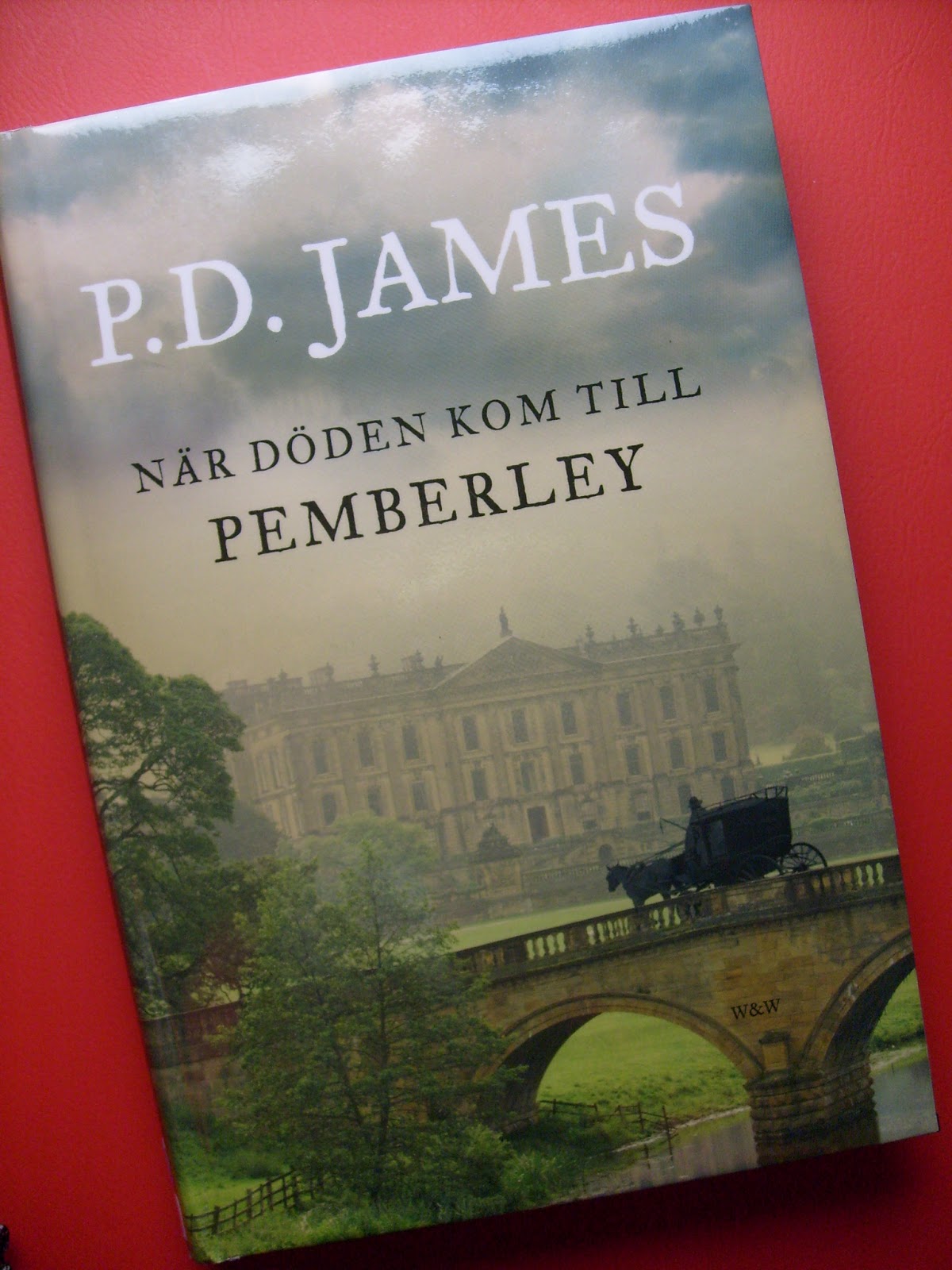
I have only attempted P D James once, and failed to get through one of her Dalgliesh-mysteries. Frankly, I found her boring, though I like Roy Marsden´s Dalgliesh on television. (We saw a re-run of "Death of an Expert Witness" from 1983 about a year ago - and wow! is that a slow tale. The murder happened in the third episode, if I remember correctly!) Still, I couldn´t resist "Death Comes to Pemberley" when I saw it.
I read it in Swedish ("När döden kom till Pemberley"), and the translator is reputable, but in one or two places I felt like perhaps she had misunderstood some archaic turn of phrase. I could be wrong though, without the original text to compare. I do prefer to read English books in English. When I don´t, I tend to translate the dialogue in my head, particularly when it´s set in an environment that I associate strongly with particular types of language. This is a tiresome way to read.
James has been very respectful to Austen. Unlike Hill, who takes Austen´s style and stories and runs away with them, putting his own spin on it, James stays firmly within the boundries of "Pride & Prejudice". And even though she writes what is technically a who-done-it, a murder mystery, and sets it six years later, it´s more or less a repeat of P&P. It reminds me of all those Star Wars comics I read in the 80´s, with writers trying to come up with stories that didn´t take the characters anywhere, that didn´t allow them to develop. Here, the characters spend a lot of time reiterating what happened in P&P. And the bad guys still make all the trouble, the good guys are still paying for it - actually, they are all competing with Jane Bennett for the prize Most Meek Character in fiction, ever. James never manages to go outside Austen´s work, doesn´t pull it a single inch forward. Or sideways, or anywhere.
Mr and Mrs Darcy keep talking to each other "mildly", touching each other "mildly", and giving each other "mild" looks. This is perhaps why no one should write a sequel to "happy ever after", unless they are willing to disregard the original author´s intentions. Like Hill did when he turned Emma Woodhouse/Knightley into a murderess in the short story "Poor Emma" in the collection "There are no ghosts in the Soviet Union" (which I highly recommend). Not that I think Jane Austen imagined the Darcy marriage would evolve quite like this. Elisabeth has lost all her wit, Darcy all his confidence and experience. If James longed to prove herself inferior to another author, she certainly has succeded. Or perhaps she has lost it; this novel was published in her 91st year!
And you know, whatever I might think of the book, just being alive at that age is an achievement! Also, she dedicates the book to her loyal secretary of 35 years, and having personally helped my mother-in-law write her memoir, I know how much work a secretary does. I do think people doing this kind of work full-time all deserve to have books dedicated to them!
If you like P D James, perhaps you will not be disappointed. If you like Austen, you certainly will.
2013-01-16
Russell&Holmes - once again
So, "Garment of Shadows" by Laurie R King. I didn´t mean it to happen that way, but this story takes place relatively close to where I was when I started reading it. Not terribly far beyond those surfers on the picture, about 100 kilometers or so, is Western Sahara. And just a few days before Christmas in 1924, that is where Mary Russell and Sherlock Holmes find themselves.
Russell is starring in Fflytte Films´ new movie, "The Pirate Queen", and having had enough of film crews, Holmes decides to to walkabouting, brushing up on his Arabic, and visiting a distant cousin who happens to live in Fez. When he returns, he finds that Russell has gone missing. She has walked straight out into the desert, at the hand of a small boy.
He immediately starts looking for her, and when he finds her, she is in pretty bad shape. Not only is she beat up, but she can´t remember where she has been, who he is, or even who she is. As it happens, Holmes´ cousin is also the Resident-General in Morocco, Hubert Lyautey. And it turns out some of the answers have to do with him, as well as a Berber rebel leader from the Rif, Abd el-Krim. King mixes fact and fiction, and gives a pretty thorough history lesson of the area, which I appreciate.
The story isn´t particularly complicated this time, but rather it´s the three driving characters who give the plot its complexity. There is, lurking deep in the shadows and far away in London, the Brain of Britain, Mycroft Holmes. As ever. And there are the operatives, the Hazr brothers (no prizes for guessing they would be mixed up in this). They are loyal to the British crown, but they are also far away from it´s soil, and while being useful and resourceful, they are also independent thinkers, who are beginning to redefine what that loyalty is about. Much like Russell herself.
I enjoyed this book, as I always enjoy another Russell&Holmes story. I heartily recommend it, and hope there will be more of them. A quick look at King´s blog, suggests there is a new book coming, a sequel to "Touchstone", a novel I took home from the library some months ago, but never got to reading. Might have to go find it again. And then there is this. Oh my !!!! - the world is just too full of books I want to read!
2013-01-08
Murder in lala-land
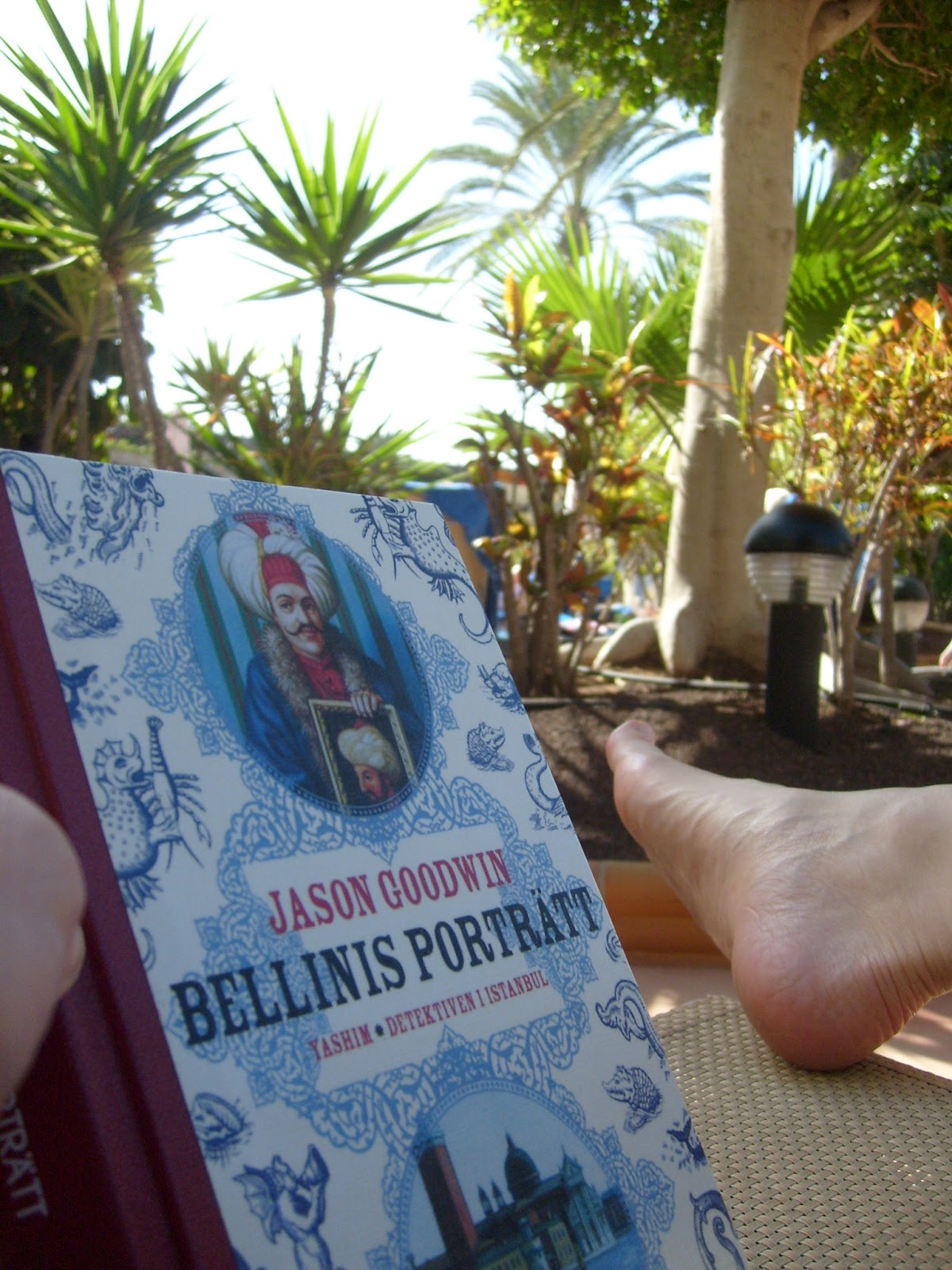
For a week on a lounger, it is necessary to bring a proper detective story. I brought two, and one of them I finished while still under the palmtrees. Jason Goodwin, historian and Byzantine specialist, has written four volumes so far in a series about the eunuch Yashim, and this is the third, "The Bellini Card". I chose it after seeing Goodwin appear in a documentary on Swedish television only a week or so before Christmas, about Topkapi Palace, the old residence of the Sultans. The library had it, and so I packed it.
I just searched my own blog, to see what I had written about the other two, but I can´t find that I have written about this author before. It doesn´t seem that long ago that I read him, but it must be pre-blog, I presume. It really, really doesn´t feel that long. Probably because Yashim and the stories of Istanbul in the 1800´s made an impression on me, and is very much alive in my memory. I have read better books than Goodwin´s last year, that I can hardly remember at all, so there you are: quality and impact is not necessarily linked.
Yashim is not the kind of eunuch you might think of, when you think of a sultan´s palace. He is not fat, soft-skinned, or squeeky-voiced. He was already a young man, well into puberty, when enemies of his father killed his mother and kastrated him. After that, he was sent to the Ottoman Sultan´s court, to be educated and given a place in life. And he has worked for the Sultan since, doing "special services" suited to his talent of being "invisible" and really, really clever. He is like the Sultan´s own James Bond, when he needs to be. When he doesn´t, he is a quiet and peaceful man, mostly interested in cooking. He is such a foodie that he can´t even go on a dangerous mission, without stopping somewhere to make a pilaff or a moussaka. He uses his cooking knife for a weapon, even.
This time, the new, young Sultan wants a painting. This painting, a portrait of a legendary ancestor, is supposedly for sale in Venice. However, an advisor of the Sultan, a pasha, tells Yashim to lay low, that the Sultan is young, inexperienced and that some of his wishes are "like water". Yashim decides to send his best friend, the Polish ambassador Palewski, who is itching to get away from Istanbul for a while (the background story of Palewski is very interesting), to see if the painting can be acquired. He goes disguised as an American art collector, Mr Brett.
Of course, Venitian art dealers turn up dead in the canals of Venice, and Yashim has to come sort things out. And cook a meal. He meets some interesting characters on the way, does some fighting, beds a woman (I know, who would´ve thought - he is a eunuch, isn´t he?) solves the riddle, and in the process the reader has learned quite a few interesting things about Venice´s history.
The one thing that bugs me just a little bit has to do with the tempo. The action scenes just doesn´t feel right in all of this. Yashim is more of a Poirot than a Bond, but Goodwin makes him both. Ok, there is a second thing that isn´t quite ... and that is the sex. Yashim has a very androgynous feel to him, he is considered sexless in Istanbul, and perhaps all that cooking and history also contributes to that. He is called Yashim lala, sort of like "uncle", which is what the eunuchs were called, who had access to the harem, the women´s house, and the Sultan´s private quarters. I can´t really see him make love to... but that would be to spoil it for you. My objections are small, after all, Goodwin is certainly not the only writer who writes crappy sex scenes for no reason at all. And maybe these odd bits that stand out are what makes him so particularly memorable.
The books about Yashim are special. The hero is special, the milieu is special, the plots are well thought out. There is more brain than heart in these books, but what do you expect from an academic? And sometimes (perhaps most of the time), that is just what I want. And I´m not the only one. This series is translated into almost 40 languages.
2012-10-02
Building a House for the Soul
A man comes shellshocked from the trenches at Passchendaele, leaves his wealthy Boston family to travel across the continent, ending up on an island outside Vancouver, building his house and restoring his health. Then, his house goes up in flame and he disappears. A letter to his brother some few years later suggests he is alive, but after that, there is only silence.
Seventy years later, his great-niece follows in his footsteps, after a sojourn at a mental hospital, following a terrible accident where she is severely injured and which takes the lives of her husband and youngest daugher. She brings with her a tent, lumber, and goes cold turkey on her medicines.
The symbolically named Rae Newborn faces her demons, both imaginary and real, and at the same time she solves the mystery surrounding her great-uncle´s disappearance. Building her house becomes (of course) a metafor for healing, and bit by bit she opens up and is drawn in to the community around her. The novel is "Folly" by Laurie R King, and it´s the most Jungian novel I think I have ever read. In Jungian symbolism, the house is a symbol for the Self, and Desmond´s and Rae´s house has two stone towers, one for each of them. Those of you who have read Jung´s memoars know that he built his own tower. Clues come to Rae in dreams, and she and the reader is given the chance to see beyond the obvious, but both of us (she and this particular reader) are pretty surprised when the reckoning comes.
The book is a thriller, a suspense drama, but also a very good portayal of a woman psychologically frail, and an excellent depiction of what it can be like to have a selfish, manipulative person as part of your family. And one thing that I think King does so well: she can really do happy, harmonious relationships, great friendships and love affairs, without making them boring and too-good-to-be-true. King does not turn away from the shit that happens, she often returns to the trauma of war, particularly the Great War, but she also recognizes that there is profound goodness in the world, that there are many people out there who work in silence and without reward for the good of others. I recognize all of it in my own personal life, and it feels reassuring to read someone who has that same experience.
Sometimes, in the way she ties it all together, she reminds me a bit of Reginald Hill, but she gives her characters an emotional depth that he never manages to do. Ok, so "Folly" will not give her the Nobel Prize, but you know, this story, and these characters, will stay with me a long time. If I had been younger, I might have taken up carpentry, just like Rae Newborn.
Do read it.
2012-09-27
The Disappointment of Light Reading
Sometimes, particularly on holiday, I crave some light reading. Something not involving murder. And I am always open for good ideas on everything from cooking to sewing to traveling. This title, "The Art of More for Less - Savvy chic", was irresistable to me. It is written by Anna Johnson, who has lived all over the world and written for ladies magazines. I thought it would be fun to see what she had to say in book format.
Not much, it turned out. The tone is certainly light-hearted, she is full of tips and tricks and knows what is right and what is wrong. And that´s perhaps what pushes me away. There´s just too much of that "dos and don´ts"-attitude that magazines have and that is the reason I don´t buy them anymore. Johnson promotes that anxious attitude towards dressing that promotes looking at what they are wearing before deciding on one´s own wardrobe. They, being the cool people who feature on the Sartorialist´s blogg (yes, really). The object of thrift is to cheaply dress so well that people in the business (of fashion, which of course are the people Anna Johnson need to impress) actually think you are wearing vintage Balenciaga. If you get there, you are savvy.
As a 20-something I suppose this would have impressed me, or at least entertained me. Now, it just makes me tired. Reading Johnson is a bit like listening to a slightly topsy (going on drunk) friend from highschool, who talks too much about all she knows, giving unsolicited advice that really only is a disguise for bragging about her fabulous lifestyle. Not that Johnsons advice is unsolicited - I did buy the book, didn´t I. Only when I got to know her, I changed my mind.
I´m too old for this. I´m not tired, really, but what makes me tired is that there is very little light-hearted, shallow reading left in this world that I really enjoy. What am I going to read in the bathtub?
Subscribe to:
Posts (Atom)


.jpg)
.jpg)
.jpg)
.jpg)
.jpg)
.jpg)
.jpg)
.jpg)
.jpg)

.jpg)
.jpg)
.jpg)


.jpg)
.jpg)
.jpg)