Showing posts with label history. Show all posts

2014-11-23

Bertila

Some weeks ago, I got an email from Marta, a lover of Barna Hedenhös, of which I blogged - oh my! - exactly one year ago! Must be some kind of benign sign... Anyway, this led to my discovery of a recent publication on the collected works of Barna Hedenhös´ creator, "Boken om Bertila", or Bertil Almqvist as was his full name, by Nisse Larsson. I immediately walked over to the library and got it, and what a revelation!

I was completely unaware that Bertila was the man behind one of the most iconic images in Swedish history: En Svensk Tiger. These words mean two things: A Swedish Tiger, and A Swede Keeps Silent. It was a variation on those many posters the Brits had, like this one. But because of the word play, it was also an affirmation of the strength of both the nation and its individuals during a time when they needed reassurance. A brilliant image, really, and the words that was part of it made it go beyond the visual. It is so ingrained in the nation´s conscience that it has been re-used for other purposes, like selling Swedish milk and Swedish magazines.

 A high ranking military man didn´t like the tiger, he thought it should have been a lion instead,
completely missing the point - a story Bertila enjoyed telling. 


Bertila´s column, with tall Prime Minister
Erlander as the father of the Swedish "folkhem"
(the Swedish Welfare State) with the leader of
the Farmer´s Party, Gunnar Hedlund, as his
supportive wife.
 You can see more columns here.
Bertil Almqvist was born in 1902, to a middle-class family in Stockholm. He got into drawing and writing funny verse already in school, and pretty much continued to do that for the rest of his life. He was perhaps not the most gifted visual artist of his time, but in combination with his word play, his output was unique. For many, many years, he published a weekly drawn and written column that commented on anything that was happening, from politics to sports and culture. It was called "På tapeten", which means literally "on the wallpaper" and means "the topic of the day". He made a sport of drawing the headline differently each week and in accordance with the topic.

He made all kinds of illustrations: theatre posters, children´s books, campaigns. And, of course, he wrote and drew "Barna Hedenhös": the books, the comics, the films. He died in 1972, while working hard on a film for Swedish Television about the Hedenhös children (he wasn´t just overworked, he was fond of his drink and his cigarettes, too, there is hardly a photo of him without a fag between his lips). He had by then been retired - quite forcibly - from his newspaper column, something that had made him so upset he even complained to the Prime Minister of Sweden! Perhaps he had lost touch with the times. When you look at his works they have very much that 50´s positivity, a stout belief in progress.
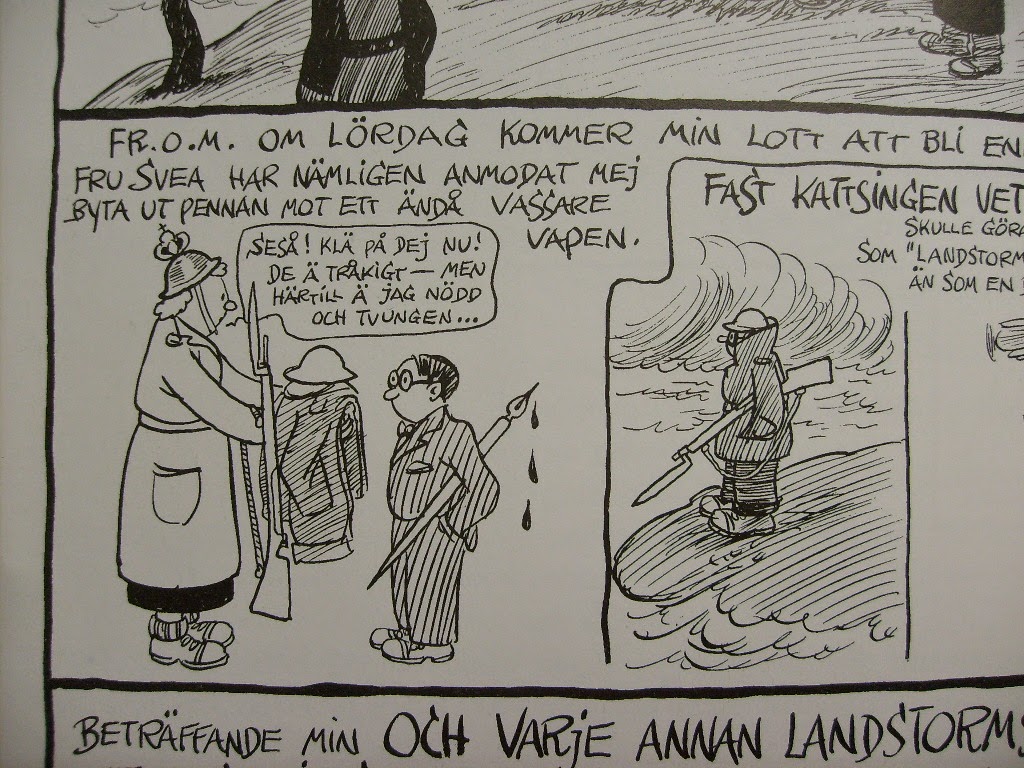
Mother Svea (Sweden) gives Bertila his uniform.
Word play was part of his game and the Swedish language started to change in the 70´s, as a new political and social awareness developed, as Swedes became more internationally aware, and society was being reshaped by immigration and the developement of modern media. Some of the Hedenhös books are no longer reproduced, considered racist and misogynist - which would have offended Bertila, who was a pacifist and a very outspoken advocate of equality and progress, both social, cultural, and technological. For example, he was a keen driver and fiercely lobbied for right-hand traffic for more than 30 years before it became a reality, in 1967. He also had strong convictions about spelling reforms. He did go into the army during the war, but reluctantly so, as he explained in comic form. He thought he could do more for the nation with his pen, and he did that as well, as you already know.

He also composed, which was a surprise to me. He wrote one of the most loved children´s songs in Swedish history, "Droppen Dripp och Droppen Drapp" (performed below by Alice Babs and her daughter Titti), and even recorded songs and put up a revue in 1934, where he sang his own songs in front of fifteen large drawings.

I only knew him for Barna Hedenhös, but I think now that his most lasting work will be "En svensk tiger" - even though perhaps that work has outgrown the memory of the man who created it.

(on Youtube by Tosukep)

Lyrics:

Droppen Dripp och Droppen Drapp    (the drop Drip and the drop Drap)
satt på varsin isetapp                         (sat each on his own icicle)
ovanför vår förstutrapp                      (above our landing)
Droppen Dripp och Droppen Drapp!   (the drop Drip and the drop Drap)

- Hej, sa Dripp till Droppen Drapp       (- Hi, said Drip to the drop Drap)
trivs du bra uppå din tapp?                 (are you happy on your icicle?)
- Åjavars, sa Droppen Drapp              (- Oh, allright I guess, said the drop Drap)
fast min sittplats är rätt knapp!            (although my seat is rather small.)

- Hördudu, sa Dripp till Drapp,            (- Hey listen, said Drip to Drap)
ska vi hoppa ner ikapp,                       (shall we race each other down,)
ner på våran förstutrapp?                    (on to our landing?)
Så sa Dripp till Droppen Drapp.           (That´s what Drip said to Drap the drop.)

- Hu, så högt! sa Droppen Drapp,         (- My, that´s high! said Drap the drop,)
såge helst jag hoppa slapp.                   (I wish I didn´t have to jump.)
- men det gör väl hipp som happ,          (but I guess it´s neither here nor there,)
låt oss hoppa ner i kapp!                      (let us race each other down.)

Och så hoppa Dripp och Drapp            (And then Drip and Drap jumped)
från sin isetapp ikapp,                          (from their icicles together)
ner på våran förstutrapp                      (down onto our landing)
- och blev platta som en knapp!            (and became flat like a button!)

(my own translation - quick and dirty)

Bertila with his daughter Monne Kristina, to whom he wrote the first Hedenhös book. 


2014-01-14

More Quilts

Quiltbag by Marianne Öqvist.
This week, full of new year´s resolution energy, I pulled myself together and went to the regional museum, Norrbottens Museum. They close at 16 every day, which is making it very hard to find a comfortable hour to go, but I made it happen. In the nick of time, too, as the exhibition I wanted to see closed Sunday. Again, it´s about quilts. I have never made quilts myself, but I am fascinated by the effort and the result.

This is an exhibition celebrating the 25th anniversary of the national quilt association Rikstäcket (= the State Quilt, or perhaps the Quilt of the Kingdom; and it is quilt as in bed covering or duvet, not the technique), with local quiltgroup Lapprutorna (= the square patches, also a pun on Laplander, I imagine) showing off their work. I can´t say exactly who did each one of these quilts (my notes turned out very sloppy and nearly unreadable), but they are all wonderful and I think the group should think of starting a blog of their own! 


The work is plentiful and the exhibition starts at the entrance hall, you follow it all the way up the stairs two floors up, and three very large and heavy quilts hang at the centre of the stairwell. This probably was the only place they had room for these impressive pieces.

It is a diverse collection of things: bags, vest, hat, necklaces, purses, pot holders, bed coverings, wall-hangings, and even baskets. There is something infinitely cheerful and - am looking for the proper word here, but I think a mix of solicitous and safeguarding is what I´m after - about it. The mummy-factor is very high, and - no surprise - there are only women contributing to this exhibition. I find it hard to object, really. Quilting is something that is done for the joy and the creativity of it these days, we don´t have to out of scarcity and survival (as we had to not very long ago). It was a woman´s work, and keeping the traditionally female arts and crafts alive naturally concerns women more than men. With a few exceptions, no doubt.

In spite of the awkward opening hours, I found the museum bustling with people. The café was filled with 15 (I counted) women of the kulturtant species (= culturally inclined elderly lady, which I am becoming, fast), and working teams from the companies nearby popped in to have coffee and conduct their meetings in this culturally charged atmosphere. Nice!


By Inger Johansson.

By Gudrun Larsson.

Vest by Inger Johansson; hat flower by Birgith Bergqvist.

The necklace is by Karin M Döri.

One of the bags made in the children´s group.

Christmas pot holders (or is it wall hangings?), promising that you can "Relax, it will still be Christmas".

2013-12-07

Fashion Film Fun

Swedish blogger Torsten Kälvemark alerted me to the treasure trove of the Swedish-speaking Finnish television archive. Among other things I found this fashion show from 1920 (it´s narrated in Finnish which I don´t understand, but it hardly matters). The dresses are lovely, and the models move awkwardly, but it seems to have been the way it was done, judging from this other film from 1939. I suppose the idea was that the audience get a really good look at the garment. The three children that finish the 1939 fashion show are just too cute!

This is also cool: a 1930´s film about the virtues of tricot. We see a historical expose (ever since ancient times...), we go on a visit to a stocking factory, see pretty girls in bathing suits, moms keeping themselves and their children in warm winter underwear, and of course there is a fashion show towards the end. It´s not just pretty dresses, but sportswear as well.

Leaning more towards the hilarious: an over-choreographed fashion show from 1972. The models are still waving their arms about like they did in the 20´s clip...

2013-11-16

The Overlord Embroidery

After I had posted about the Quilt exhibition, it occured to me that I have told you nothing about an amazing work that I particularly wanted to see when we were in Portsmouth, and the reason we had to run from the Historic Dockyard to get there before it closed. "There" being the D-Day Museum.

It looks a bit like a pillbox, and there is a real Picket-Hamilton fort on display outside the entrance. There are also tanks, canons, and a statue of Monty. 


Monty´s plan for invasion.
Inside the museum you find all sorts of D-Day souvenirs. 

I can´t remember now how I heard of the Overlord Embroidery, but I can tell you it was commissioned by Lord Dulverton (that would have been Frederick Anthony Hamilton Wills in 1968), to commemorate the invasion of France during the Second World War, as a kind of counterpart to the Bayeux tapestry. I have never seen the Bayeux tapestry in real life, but it´s used to illustrate medieval battle quite often, so if you are the least interested in history, you will have seen bits of it. It´s 70 meters long, made in the late 11th century, and isn´t really a tapestry at all, but an embroidery. According to legend, it was made by William the Conquerer´s wife, lady Matilda, but that´s not likely to be true. It does, however, depict the events around the Norman invasion and the battle of Hastings and it was, indeed, made shortly after, probably in England. There´s a replica in Reading, and they have this website that explains all about it.


The Overlord Embroidery was designed by artist Sandra Lawrence, and made by the Royal School of Needlework. It´s 83 meters, which makes it longer than the Bayeux tapestry, and well, of course it would be. It´s made, as far as I can figure, in a similar way as its French counterpart. (If you can indeed argue that the Bayeux tapestry is French. France as we know it didn´t exist, nor did Great Britain, the Normans were never actually thrown out, the rules to rule changed over hundreds of years, and the tapestry is, I think, more about the history of England than the history of France. The French own it, though, it was discovered in the cathedral in Bayeux, and today it´s on display in a museum in Normandy.)


Photography wasn´t allowed, but I got one little snap before I realized, and living dangerously, I will share it with you, to give you an idea of what it looked like in real life, up close. Excellent handicraft, no unfinished edges there! It´s amazing, even the husband, not having a particular interest in needlework, was impressed.

I bought a fold-out souvenir of the whole embroidery, and have taken a few snaps of those, to give you an idea. There is more information at Sarah Lawrence´s site, and at the museum´s website.


When we were finished with the museum we walked leisurely back to our hotel along the Millenium Walk, passing the Capstan Square, where there was once a chain going over the entrance to Portsmouth harbour, stopping ships from entering. You can also see the Palmerston Forts, built in the mid-1800´s in case of a French invasion. Some of these have now been turned into hotels, I understand! Wouldn´t it be cool to stay there!


The Capstan.

2013-11-09

Dover Castle - Day Three (Western Heights)

Our third day in Dover, we had smashing weather. Not knowing how long it would last, we decided to make the best of it and go for a morning stroll on the pier. This is not a fancy entertainment pier, like they have in Brighton, but a more sensible and useful sort of construction. They have a café, of course, and we had a cup of tea while watching the gulls, the anglers, and the ferries.

Like I said, there isn´t much beachlife (at least not in early July), but there were a few people stretched out on the gravelly beach.


When we had had enough of the sea, we went to find something called The Grand Shaft. The fort on the Western Heights was built mainly during the Napoleonic Wars, that is, early 1800´s. The shaft is a shortcut to the town, and it was finished in 1809. It has three staircases, and was intended to get the troups down quickly from the Drop Redoubt to the harbour in case of an invasion. As it turned out, the invasion never came, and the shaft was used mainly for quick access to the pubs and the brothels of Snargate Street.

It wasn´t open, sadly, so all I have is photos of the entrance. There are great photos of the shaft here, and of the old Barracks, which were demolished in the 50´s.

After that we walked up towards the Western Heights, in search of the forts there. We weren´t entirely sure what it was going to look like, but we knew there wasn´t some kind of ordered and organized museum with opening hours and tea rooms. We had a rough idea of where to look, though.

First, we entered an enclosed pasture for Dexter cattle - bulls, scarily enough. It was a rather steep climb, pretty views all around, and orchids growing in the grass. I was walking along rather absent-mindedly when suddenly the ground opened up before me and behold: a castle dug into the ground! It was pretty amazing. After we had a good look at it from ground level we found the entrance, walked around inside the moat, and came out through a narrow tunnel.


The remains of the old Roman pharos - the lighthouse - was lost during the construction of the Redoubt, but later rediscovered and put back in its original place, on top of the Redoubt. Not accessible to us, unfortunately.


A hole in a hatch...

... enough to get a glimps of the inside.


A bit shaky, the small film here, but I´m posting it anyway.


There weren´t that many people up there, perhaps a handful of other visitors - only men (what, ladies aren´t interested in old forts?).

The blue arrows show where we came up through the cattle field and how we walked from the Drop Redoubt over to the detached bastion. Clearly, there was a lot to explore on the Western Heights, and we easily could have spent a week or two exploring Dover and its surroundings. Which is a good thing, if we decide to come honeymooning in Dover Castle´s little flat some time in the future!

The detached bastion was even harder to spot since it is not kept in any condition for proper display. And this is what would happen to the Drop Redoubt as well, if nature could have free reign there; it only takes a few years for the bushes and trees to completely cover it up. It´s all owned by, and cared for, by English Heritage.


The view from the detached bastion over the Drop Redoubt and the castle: the Great Tower to the left and the church with the Roman lighthouse appoximately center picture.


When we got back to the hotel, we treated ourselves to a proper English Afternoon Tea, with sandwiches, scones, and cakes. If you have one of these, you needn´t bother with dinner.

There is much more to see in Dover, like a Roman painted house, a Bronze age boat, a Bronze age metal hoard (axes and things), and... ok, that´s about it. But they have the castle, and it´s pretty cool.