I am not getting a whole lot of reading done, and considering how much I anticipated the new Russell&Holmes adventure, "Dreaming Spies", by Laurie R King, it has taken me an uncharacteristically long time to get through it. The last quarter, however, was so exciting I sacrificed a few hours of sleep for it.
Our detective partners are just come home from their latest adventure in Marocko ("Garment of Shadows") and finds Mrs Hudson puzzled about a rock that has been delivered and carefully placed in their garden. The Holmeses do not take this as a puzzle to be solved, so we understand that they know what this rock is and why it has been given to them. Russell goes up to her house in Oxford, where she is met by an intruder, asking for her help. And so starts a lengthy flashback of their round-the-world trip and visit to Japan, one year earlier. (This would have taken place between "The Game" and "Locked Doors".)
One of the things I really like about King is how well she seems to understand the context in which she places her protagonists. Japanese culture - that whole thing about loosing face - is usually incomprehensible to me (I recently read an article in the paper about a Swedish exchange student in China who got into trouble with the police when trying to stop a fight in a nightclub, and how his attitude - perfectly understandable to a European - caused him a year of grief with the justice system, until he swallowed his pride and was promptly released after having begged forgiveness for something he hadn´t done) but King explains it well through the situations she puts the husband/wife team in.
This is the first of the novels where Russell and Holmes are really one hundred percent comfortable with each other as working partners - there is a higher level of trust and confidence, and a natural and easy division of labour - and I like how King has let her characters evolve through the series. She is, as always, very humouristic, sometimes slapstick funny. And again, she gives the most interesting and complex roles to the women of her cast; not that one really notices, as she is never overtly feminist.
Well, you can tell, I find it hard indeed to find fault with King´s work. I have realized that this series is not to everyone´s taste, although I can´t really understand why, but there it is. I do wish, however, that every reader finds a few series that he or she can relish as much as I do this!
Showing posts with label favourites. Show all posts
2015-03-21
2014-06-17
Love in a Cold Climate
Yesterday I finished "Love in a Cold Climate" by Nancy Mitford. I enjoyed it very much, I really like the way she writes, without frills, much dialogue, great characters, good action. It ended a bit abruptly, but I suppose she felt the story was over, so she finished it.
This story is again narrated by Fanny, the Bolter´s daughter, raised by her aunt Emily and uncle Davey, cousin of the Radlett children, among them Linda, who was the protagonist of "The Pursuit of Love". Linda does not appear here at all, though the story takes place at about the same time as Linda´s story did. This time Fanny becomes involved with the Radlett´s neighbours, the Montdores, and particularly the mother, lady Montdore, and her daughter Polly, who is the same age as Fanny and Linda (though not on friendly terms with Linda, which is why their stories do not intersect).
Lady Montdore and Polly is at odds over marriage. Polly is "out", and is almost twenty, but shows absolutely no interest in men at all (or in anything else, for that matter), which frustrates her mother. Fanny, recently married to a junior Oxford don and staying with the Radletts at Alconleigh while her new house is being done up, is brought in by both of them to act as a kind of buffer between them. Lady Montdore is bossy and overbearing, but can also be very charming and Fanny likes her a lot. Polly, also loved by Fanny, is a rather vapid, boring and unattractive personality - even though she is the most beautiful debutante in London society, a fact that is repeated over and over. Perhaps it is hard for a reader to like her, since we can not see her - beauty seems to be her only asset and she has such an abundance of it that it makes up for her lack of character. It´s hard to get particularly upset when she, upon her aunt´s death, confesses that she has been in love with her uncle-in-law Boy, a middle-aged historian, since the age of fourteen and is now intending to marry him. The matter is made even worse by the fact that this uncle has been her mother´s lover for years, is bisexual, and has paedophile tendencies (the Radletts call him "the lecherous lecturer").
So, things go spectacularly bad, but in the end everything turns out all right, in a rather amusing way, as one would expect from a story like this. My favourite passage in this book is about Uncle Matthew, who is aging and softening (and Fanny is also maturing, which perhaps mellows her view of him), and this is what happens when his younger daughter Jassy insists on being buried at a particular spot in the churchyard:
![]() |
| Castle Howard, 2009. |
Lady Montdore and Polly is at odds over marriage. Polly is "out", and is almost twenty, but shows absolutely no interest in men at all (or in anything else, for that matter), which frustrates her mother. Fanny, recently married to a junior Oxford don and staying with the Radletts at Alconleigh while her new house is being done up, is brought in by both of them to act as a kind of buffer between them. Lady Montdore is bossy and overbearing, but can also be very charming and Fanny likes her a lot. Polly, also loved by Fanny, is a rather vapid, boring and unattractive personality - even though she is the most beautiful debutante in London society, a fact that is repeated over and over. Perhaps it is hard for a reader to like her, since we can not see her - beauty seems to be her only asset and she has such an abundance of it that it makes up for her lack of character. It´s hard to get particularly upset when she, upon her aunt´s death, confesses that she has been in love with her uncle-in-law Boy, a middle-aged historian, since the age of fourteen and is now intending to marry him. The matter is made even worse by the fact that this uncle has been her mother´s lover for years, is bisexual, and has paedophile tendencies (the Radletts call him "the lecherous lecturer").
So, things go spectacularly bad, but in the end everything turns out all right, in a rather amusing way, as one would expect from a story like this. My favourite passage in this book is about Uncle Matthew, who is aging and softening (and Fanny is also maturing, which perhaps mellows her view of him), and this is what happens when his younger daughter Jassy insists on being buried at a particular spot in the churchyard:
"'Write it down,' said Uncle Matthew, producing a piece of paper and a fountain-pen, 'if these things don´t get written down they are forgotten. And I´d like a deposit of ten bob please.' 'You can take it out of my birthday present,' said Jassy, who was scribbling away with great concentration, ' I´ve made a map like in Treasure Island,' she said. 'See?' 'Yes, thank you, that´s quite clear,' said Uncle Matthew. He went to the wall, took his master-key from his pocket, opened a safe, and put in the piece of paper. Every room at Alconleigh had one of these wall-safes, whose contents would have amazed and discomfited the burglar who managed to open them. Aunt Sadie´s jewels, which had some very good stones, were never kept in them, but lay glittering about all over the house and garden, in any place where she might have taken them off and forgotten to put them on again, on the downstairs wash-basin, by the flower-bed she had been weeding, sent to the laundry pinning up a suspender. Her big party pieces were kept in the bank. Uncle Matthew himself possessed no jewels and despised all men who did. (Boy´s signet ring and platinum and pearl evening watch-chain were great causes for tooth-grinding.) His own watch was a large loudly ticking object in gun-metal, tested twice a day by Greenwich mean time on a chronometer in the business-room, and said to gain three seconds a week. This was attached to his key-ring across his moleskin waistcoat by an ordinary leather bootlace, in which Aunt Sadie often tied knots to remind herself of things. The safes, nevertheless, were full of treasures, if not of valuables, for Uncle Matthew´s treasures were objects of esoteric worth, such as a stone quarried on the estate and said to have imprisoned for two thousand years a living toad; Linda´s first shoe; the skeleton of a mouse regurgitated by an owl; a tiny gun for shooting bluebottles; the hair of all his children made into a bracelet; a silhouette of Aunt Sadie done at a fair; a carved nut; a ship in a bottle; altogether a strange mixture of sentiment, natural history, and little objects which from time to time had taken his fancy."This is probably the most endearing description of a man´s character I have ever read (don´t you love how the wife ties knots in her husband´s key"chain" to remind herself of things?). And it is a good example of Nancy Mitford´s skill. If you like Austen-style stories with British excentric aristocracy in great houses, this is for you.
2013-03-28
The Little Bear Stories
I was reading the Guardian online, and found the obituary of Barbara Firth. She was an illustrator, mostly known for some children´s stories called "The Little Bear Stories", written by Martin Waddell. Being of a curious nature, I started click-clicking away, and before I came to my senses I had clicked the book into an envelope going my way, from Greener Books, London.
What does an old(er) lady like me want with a book for very smallish children? I rationalized the purchase by telling myself that when I had satisfied my curiosity about the illustrations, I could send it on to some friend´s child. And, you know, the book cost nothing. Postage was 4.02 British pounds, and the book itself was sold for a symbolic sum of 0,01 pounds. That´s right, one penny. It costs more to breathe, practically. No way does that penny cover the cost of acquiring that book (even if it was given to them, they still had to take it), putting it on a shelf, getting an ad out on amazon, getting it into an envelope, even just printing the receipt. None of those things. That business can only be run by true booklovers.
The drawings are beyond gorgeous. Intensely wonderful. And the stories are heart-melting. Very politically correct too, as neither Big Bear or Little Bear is of any particular sex. Not that they are queer exactly. They are both just bears. Like humans might be just humans, if there was no gender police around.
The bears are living in a Bear Cave, reading Bear Books, playing Bear Games, and mostly falling asleep (eventually) in the Bear Chair. Simple, but brilliant.
And forget that I´m passing this on. I love this book, gollum-like. It speaks to my soul, and I shall keep it on my bedside table forever. And all the children I know are far too old for it anyway (I am totally not rationalizing that). And it´s translated to Swedish, so they have probably all read it. For sure.
| "Can´t you sleep, Little Bear?" |
2013-03-18
Torsten Ehrenmark, Master of the Causerie
![]() |
| Poul Ströyer: The illustrator most associated with Ehrenmark. |
When I was little, my mother would buy his yearly collection, published just in time for Christmas, and then she would chuckle all through Christmas Day, while we kids were busy playing with our toys. It seemed like she was having more fun than us, so I would be second (and last, perhaps) on the book. I became very much enamoured with Ehrenmark, and I still read him with delight. The illustrations by Poul Ströyer contributed a lot, I think, to his literary persona.
![]() |
| Ehrenmark´s parents were actors and he grew up with his grandparents. |
![]() |
| He made himself out to be a most impractical man,... |
![]() |
| ...constantly embarrassing himself with barbaric northern manners. |
Also, as it happened (because I´m in this vortex of synchronicities right now) I had just had the librarians search their storage shelves deep and hard for a copy of his eight-part series from 1979, "Jorden runt på 8 dagar" (= Around the World in 8 Days) published first in 1975 in the national newspaper Dagens Nyheter (the Daily News, his employer from 1963 until his death in 1985). I remember this one from when I was a kid, not just because of Ehrenmark´s texts, but for the illustrations by Björn Berg. I was very much into drawing and illustration, and it is still an artform I much admire.
What Dagens Nyheter did, was to send Ehrenmark and Berg around the globe in the footsteps of Phileas Fogg and his trusty servant Passepartout, to report on the adventure in an amusing manner. The library had a hard time finding it. Finally, they tracked down a copy in Malmberget, a big print edition (for the visually impared), but they assured me that the illustrations were all there, so I agreed to have it sent to me. Oddly, the big print didn´t extend to the illustrations, which were much smaller than I remembered. One drawing was so shrunken that much of the finely drawn details were invisible. Odd priority, considering that Berg´s drawings contribute greatly to the work as a whole. To me, as an 11-year old, to imagine having a job travelling the world to draw, and getting paid to do it, seemed like the perfect career. I still think that.
But look at the cover! How can anyone have thought it a good idea to make a cover like that? This, is what the original book looked like:
![]() |
| Source |
![]() |
| Ehrenmark with students in Yokohama. |
"Hundreds of people stood on a lawn around a black jazzband playing deafening music, and the brave got carried away and started to dance solo with cramp-like quivers and closed eyes. It seemed more like a religious rite than popular entertainment, a kind of Western dervish-dance. I, who lack all understanding of rite and ecstasy, withdrew self-consciously. It is not the kind of behaviour one expects from people when one is from Närke where we stand with both feet firmly in the mud.
Houseboat living in San Francisco.
I managed to tear the fascinated Passepartout away from all this exhibitionism and get him down to Fisherman´s Wharf. I thought it was the name of a restaurant, but it was the name of the entire waterside, with hundreds of restaurants, fishing boats, and yachts. It smelled like sea, crabs, and lobsters, but our crab was rather drab, and cooked without European imagination.
Haiphong Road, Hongkong.
The boat rides to Alcatraz with one and a half hour tours of the empty prison, of the prisoner´s canteen, the lounges, the cells, the isolation cells, and death row, were sold out weeks in advance to people who have never been to prison, and relieved we gave up the idea of such entertainment. We walked south again towards the centre, leaned back with tripping steps downhill. And staggering, leaning forward with our noses to the ground like sleuth-hounds, uphill.
The lifeless, tree-less streets in the middle of town filled me with the anxiety and ennui that I call "Sunday Afternoon Blues", a melancholy I suffer from when I am faced with any kind of organized leisure. I, who have never worked a machine do not understand what leisure time is for. I realized that what I really needed was sleep, and promptly fell asleep on top of my hotel bed at sex o´clock, fully dressed. I woke up without feeling at all rested at midnight, and lay awake wondering what time it might be in Tokyo, but it was impossible to figure out. I undressed and continued to lay awake half the night. I woke at eight in the morning, still feeling weary.
It occured to me that it was Monday morning again, or as the maid sighed in my youth: "It´s always, always Monday morning, but never, never Saturday night!" I had experienced one Sunday in Tokyo and one Sunday in San Francisco, I had had lunch at Fisherman´s Wharf on Tokyo´s Monday morning, and now it was Monday morning again. And soon it would be Tuesday morning in Tokyo and the day after that it would be Tuesday morning in San Francisco. I would live through every day twice for the rest of my life, just because I had passed the International Date Line in the eastern direction. A carbon paper had been placed between the pages of my life. I was just about to go crazy, when Passepartout came in and saved me..."
New York.
![]() |
| Bangkok. |
| The yellowish tint to this photo come from the light source available in the bank vault... |
Torsten Ehrenmark - I miss you. Poul Ströyer and Björn Berg - I miss you, too.
2013-03-09
An Homage to Childcraft
Today, my eyes fell on my bookshelf, and the only set of books I still
have from when I was a child: "Barnens Bästa", or, as they are known in
the US, "The Childcraft books". They were published by Field Enterprises in Chicago
from the late 40´s and my edition is adapted to Swedish and published
in the early 60´s. There are fifteen volumes: 1. Poems of early childhood, 2.
Storytelling and other poems, 3. Folk and fairy tales, 4. Animal friends and
adventures, 5. Life in many lands, 6. Great men and famous deeds, 7. Exploring
the world around us, 8. Creative play and hobbies, 9. Science and industry,
10. Art for children, 11. Music for the family, 12. You and your family, 13. Your young
child, 14. Your child goes to school, 15. Your child in today´s world.
The first book is in shreds, most of it contained in a plastic folder. And, leafing through it, there isn´t much that I really remember about it. But clearly, I have played with it. I like to think this is the toy that made me comfortable with books.
The second book is also well read, but these stories and illustrations I do remember. The illustrations more than the stories, actually, so I imagine these were read to me while I was looking at the pictures. There is a lot of information about the world already snuck in these stories, and some moralities, too.
I don´t mind moralities, I happen to think these are great. If you can teach children that science is about progress for the betterment of everyones lives, that everyone should be friends with everyone no matter their skin colour or language or other preferences, that can not be a bad thing. Stories where the bad guy gets his ass whipped have always had a strong attraction on me, as well. I suppose I was the kind of child who´d rather play alone, and other children and their games were mostly in the way. I would sit in my room in the afternoons, liberated from a tough day at school, totally identifying with stories about famous inventors as children, doing experiments grownups don´t understand. At heart, I´m still convinced I would have been a great man doing great deeds if I had only been left alone...
The illustrations are wonderful, and made by many different artists in many different styles. I find that I still loose track of time when I look at them.
I see now that volume four and five are not much read, and they don´t ring many bells either, as I leaf through them. Animal friends and life in many lands seems not to have appealed to me as much as great men and famous deeds and exploring the world around me. When I look in those well-read volumes, I realize that I pretty much everything I know comes from these books. Anything I have later learned, has somehow been attached to these first images.
The last few books were perhaps not as influential. By the time I was that age, I had moved on to other kinds of literature. They are also a bit more about growing up, and that probably didn´t appeal to me, not in the way of the 50´s and early 60´s, anyway. Times had changed, I suppose.
And when I look at volumes 8-11, I laugh and think that in so many ways, I am still a Childcrafter! Here it all is, the basic instructions to all the things I still do, and the way I do them. My grandmother once reflected that I don´t do things like she did and like my mother did - the explanation is, I learned everything from Childcraft, even cooking!
If I ever really do become a great man doing great deeds, and someone asks me to write my memoirs, I shall structure them just like the Childcraft series. That way, I think they will become most true to the way I´m really thinking.
Yeah, I see what I just wrote. My memoirs will be about the way I´m thinking. Of course.
The first book is in shreds, most of it contained in a plastic folder. And, leafing through it, there isn´t much that I really remember about it. But clearly, I have played with it. I like to think this is the toy that made me comfortable with books.
The second book is also well read, but these stories and illustrations I do remember. The illustrations more than the stories, actually, so I imagine these were read to me while I was looking at the pictures. There is a lot of information about the world already snuck in these stories, and some moralities, too.
I don´t mind moralities, I happen to think these are great. If you can teach children that science is about progress for the betterment of everyones lives, that everyone should be friends with everyone no matter their skin colour or language or other preferences, that can not be a bad thing. Stories where the bad guy gets his ass whipped have always had a strong attraction on me, as well. I suppose I was the kind of child who´d rather play alone, and other children and their games were mostly in the way. I would sit in my room in the afternoons, liberated from a tough day at school, totally identifying with stories about famous inventors as children, doing experiments grownups don´t understand. At heart, I´m still convinced I would have been a great man doing great deeds if I had only been left alone...
The illustrations are wonderful, and made by many different artists in many different styles. I find that I still loose track of time when I look at them.
| The Moon is a Griffin Egg. |
| Peter Rabbit |
| The Emperor´s new clothes. |
| Rapunzel |
| Snow White and Rosy Red, who saved the Prince, then married him, and his brother. |
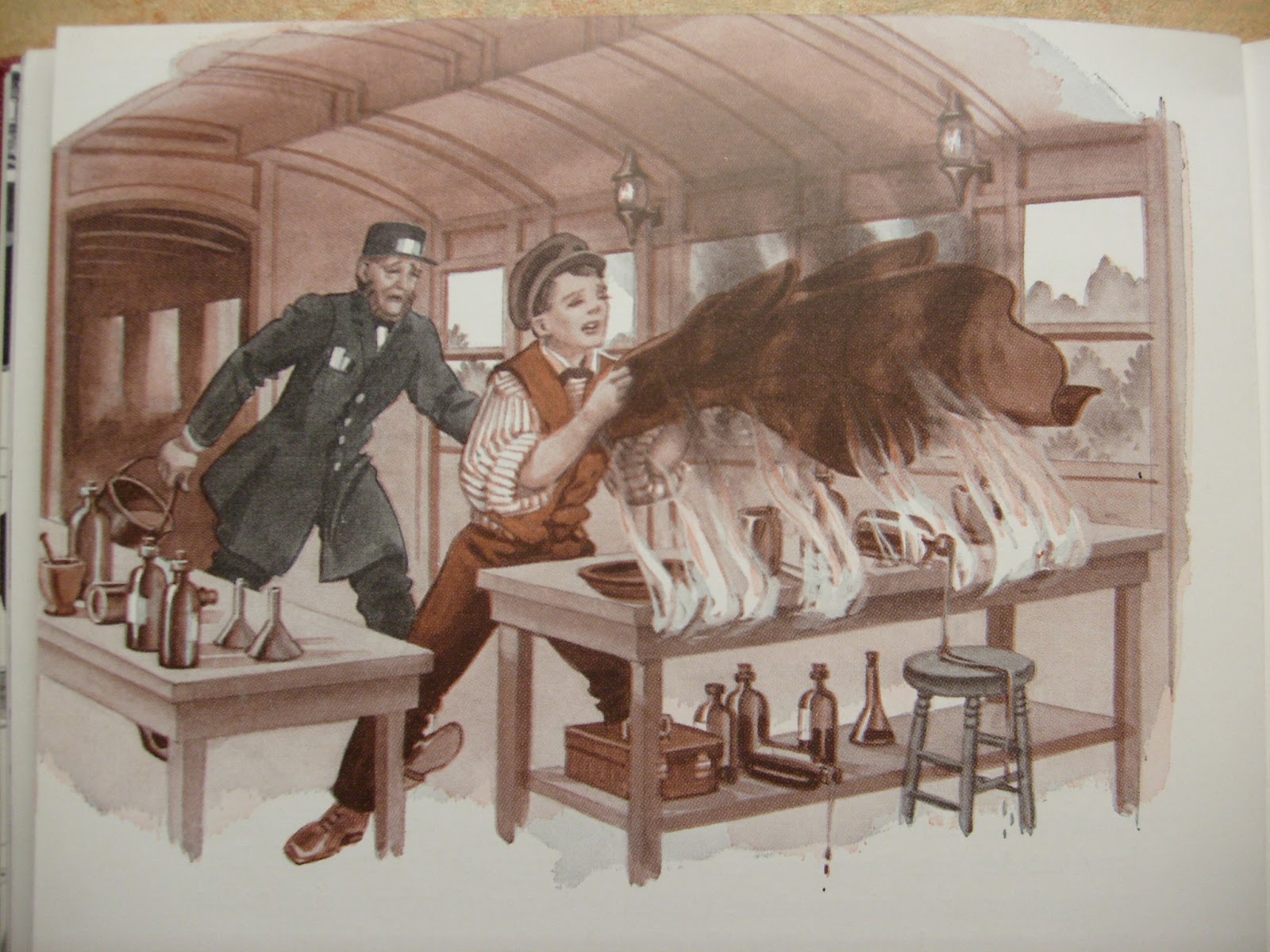
| George Washington Carver, with a book. Total identification! |
I see now that volume four and five are not much read, and they don´t ring many bells either, as I leaf through them. Animal friends and life in many lands seems not to have appealed to me as much as great men and famous deeds and exploring the world around me. When I look in those well-read volumes, I realize that I pretty much everything I know comes from these books. Anything I have later learned, has somehow been attached to these first images.
The last few books were perhaps not as influential. By the time I was that age, I had moved on to other kinds of literature. They are also a bit more about growing up, and that probably didn´t appeal to me, not in the way of the 50´s and early 60´s, anyway. Times had changed, I suppose.
| Thomas Alva Edison failing creatively. This almost happened in real life. |
| Did I mention my grandpa was a goalie, too? A real hero. |
| The seed of my devotion to Time Team. (And perhaps why I think archeology is so sexy.) |
| I still have a good grasp of what is moving in the sky. |
| And of course I did all these experiments. |
And when I look at volumes 8-11, I laugh and think that in so many ways, I am still a Childcrafter! Here it all is, the basic instructions to all the things I still do, and the way I do them. My grandmother once reflected that I don´t do things like she did and like my mother did - the explanation is, I learned everything from Childcraft, even cooking!
| How to write a story. I do this every day. Sit and stare at the wall, that is... |
| A whole book in the series is devoted to different types of art. |
| The Bayeaux tapestry, depicting the Normand invasion of Britain. |
| Seeing this totally cracked me up, because... |
| ...the last week or so, I have been working on this. |
If I ever really do become a great man doing great deeds, and someone asks me to write my memoirs, I shall structure them just like the Childcraft series. That way, I think they will become most true to the way I´m really thinking.
Yeah, I see what I just wrote. My memoirs will be about the way I´m thinking. Of course.
2013-01-16
Russell&Holmes - once again
So, "Garment of Shadows" by Laurie R King. I didn´t mean it to happen that way, but this story takes place relatively close to where I was when I started reading it. Not terribly far beyond those surfers on the picture, about 100 kilometers or so, is Western Sahara. And just a few days before Christmas in 1924, that is where Mary Russell and Sherlock Holmes find themselves.
Russell is starring in Fflytte Films´ new movie, "The Pirate Queen", and having had enough of film crews, Holmes decides to to walkabouting, brushing up on his Arabic, and visiting a distant cousin who happens to live in Fez. When he returns, he finds that Russell has gone missing. She has walked straight out into the desert, at the hand of a small boy.
He immediately starts looking for her, and when he finds her, she is in pretty bad shape. Not only is she beat up, but she can´t remember where she has been, who he is, or even who she is. As it happens, Holmes´ cousin is also the Resident-General in Morocco, Hubert Lyautey. And it turns out some of the answers have to do with him, as well as a Berber rebel leader from the Rif, Abd el-Krim. King mixes fact and fiction, and gives a pretty thorough history lesson of the area, which I appreciate.
The story isn´t particularly complicated this time, but rather it´s the three driving characters who give the plot its complexity. There is, lurking deep in the shadows and far away in London, the Brain of Britain, Mycroft Holmes. As ever. And there are the operatives, the Hazr brothers (no prizes for guessing they would be mixed up in this). They are loyal to the British crown, but they are also far away from it´s soil, and while being useful and resourceful, they are also independent thinkers, who are beginning to redefine what that loyalty is about. Much like Russell herself.
I enjoyed this book, as I always enjoy another Russell&Holmes story. I heartily recommend it, and hope there will be more of them. A quick look at King´s blog, suggests there is a new book coming, a sequel to "Touchstone", a novel I took home from the library some months ago, but never got to reading. Might have to go find it again. And then there is this. Oh my !!!! - the world is just too full of books I want to read!
Russell is starring in Fflytte Films´ new movie, "The Pirate Queen", and having had enough of film crews, Holmes decides to to walkabouting, brushing up on his Arabic, and visiting a distant cousin who happens to live in Fez. When he returns, he finds that Russell has gone missing. She has walked straight out into the desert, at the hand of a small boy.
He immediately starts looking for her, and when he finds her, she is in pretty bad shape. Not only is she beat up, but she can´t remember where she has been, who he is, or even who she is. As it happens, Holmes´ cousin is also the Resident-General in Morocco, Hubert Lyautey. And it turns out some of the answers have to do with him, as well as a Berber rebel leader from the Rif, Abd el-Krim. King mixes fact and fiction, and gives a pretty thorough history lesson of the area, which I appreciate.
The story isn´t particularly complicated this time, but rather it´s the three driving characters who give the plot its complexity. There is, lurking deep in the shadows and far away in London, the Brain of Britain, Mycroft Holmes. As ever. And there are the operatives, the Hazr brothers (no prizes for guessing they would be mixed up in this). They are loyal to the British crown, but they are also far away from it´s soil, and while being useful and resourceful, they are also independent thinkers, who are beginning to redefine what that loyalty is about. Much like Russell herself.
I enjoyed this book, as I always enjoy another Russell&Holmes story. I heartily recommend it, and hope there will be more of them. A quick look at King´s blog, suggests there is a new book coming, a sequel to "Touchstone", a novel I took home from the library some months ago, but never got to reading. Might have to go find it again. And then there is this. Oh my !!!! - the world is just too full of books I want to read!
2012-06-25
Meta Level Literature
After having marathon slept night before last, no wonder I couldn´t sleep. I finally dozed off at half past ten in the morning, and made sure I got up at two in the afternoon, to prevent becoming too freakishly out of touch with any form of normal life.
The upside of insomnia is that one has what seems like endless hours of silence and stillness to read and think. I finished Gerald Murnane´s "Barley Patch", an unexpected and truly original find, thanks to a favorable review in some newspaper or other. I really can´t say I have come across anything like it. It´s not really a story, as such, more like an exploration of a mind, a consciousness, that may or may not be the author´s own. He paints pictures with his words, of flat landscapes with mostly grass, some trees, one or two storey houses; he dwells on men with an obsession for horse racing, convents, boys trying to meet girls, the nature of reading, and whether or not one should write.
Some readers might find him repetitive. There are turns of phrases that keep coming back, in different ways. They are elements of his imagination that he uses like a child uses building blocks to make different structures. One gets the impression that he is showing us how he works. I´m sure I would have much more to say on that subject if I had read anything else by him, but he is a completely new aquaintance for me.
I keep returning, throughout the reading, to the photo of the author himself. Looking for clues, perhaps. I find none. He is rather handsome, I think. He seems unaware of himself. He seems not to pose for the camera.
I know I will read more by him, I know this book will mean a lot to me and perhaps I will return to it later. That does not mean that I recommend it to anyone. If you´re looking for a story, an adventure, something that has a beginning and an end, look elsewhere. This is a book for those who are interested in literature and the mechanics of it, if you will. It´s solid stuff, a real nugget of preciousness in an ocean of mediocrity. They say he is on the short list at the Swedish Academy for the Nobel Prize, and I can´t think of a more worthy recipient of that award.
The upside of insomnia is that one has what seems like endless hours of silence and stillness to read and think. I finished Gerald Murnane´s "Barley Patch", an unexpected and truly original find, thanks to a favorable review in some newspaper or other. I really can´t say I have come across anything like it. It´s not really a story, as such, more like an exploration of a mind, a consciousness, that may or may not be the author´s own. He paints pictures with his words, of flat landscapes with mostly grass, some trees, one or two storey houses; he dwells on men with an obsession for horse racing, convents, boys trying to meet girls, the nature of reading, and whether or not one should write.
Some readers might find him repetitive. There are turns of phrases that keep coming back, in different ways. They are elements of his imagination that he uses like a child uses building blocks to make different structures. One gets the impression that he is showing us how he works. I´m sure I would have much more to say on that subject if I had read anything else by him, but he is a completely new aquaintance for me.
I keep returning, throughout the reading, to the photo of the author himself. Looking for clues, perhaps. I find none. He is rather handsome, I think. He seems unaware of himself. He seems not to pose for the camera.
I know I will read more by him, I know this book will mean a lot to me and perhaps I will return to it later. That does not mean that I recommend it to anyone. If you´re looking for a story, an adventure, something that has a beginning and an end, look elsewhere. This is a book for those who are interested in literature and the mechanics of it, if you will. It´s solid stuff, a real nugget of preciousness in an ocean of mediocrity. They say he is on the short list at the Swedish Academy for the Nobel Prize, and I can´t think of a more worthy recipient of that award.
Subscribe to:
Posts (Atom)