Before Christmas I saw a television programme about Marguerite Yourcenar, and I thought, wow! must read something by her. I got her most famous novel, "Memoirs of Hadrian" and I got through the first chapter. I will not blame the anachronisms, but I did get a little bit hung up on them. Mostly, it was intelligent, dense, deep, and... boring. Not my thing. It´s all me, I´m sure.
Instead, I picked this one up, and I can´t think what I was thinking at the library, can´t remember even grabbing it. I imagine it was the title. It´s "Hallucinating Foucault" by Patricia Duncker. I remember Foucault from school, I read a couple of his and enjoyed them much, he was more accessible I think than a lot of other philosophers. Or should I call him a social scientist? Wikipedia seems to do both.
Anyway, the novel is about a 22-year old guy who is in Cambridge working on a thesis about a novelist called Paul Michel (which happen to be Foucault´s first names), a writer who was very inspired by Foucault. The young protagonist starts a relationship with a slightly dominant Germanist (working on Schiller), who pushes him to go in search of Paul Michel, who has been locked up in an asylum since Foucault´s death in 1984. He is reluctant at first, he says he is more interested in the work than in the man, but he soon becomes obsessed with Michel. Or absorbed by him, perhaps. If I say anything more about the plot I will give too much away.
It´s a horror story, of sorts. There is a riddle in here, and not what you think. It´s also one of those coming of age stories, almost like an old-fashioned fairy tale about a young boy being sent on a mission by a fair princess, you know. And Michel is both the dragon of the dungeon and the maiden in the tower. And the Germanist is both princess and sage. There are plenty of meta in this book, and I bet most of it is over my head, but I get enough to feel a bit clever. And at heart, it´s a book about reading and writing, readers and writers, and how the two are related. I think it´s a book that would be perfect for a discussion group. Plenty of enigmatic metaphors and analogies, if you wish.
I loved this book, I have to say. She has had one more novel translated to Swedish and I think I must read it. Soon. Excellent.
2012-01-17
2012-01-09
Master Art Collector
One of the books in my Christmas pile was this one. It´s "Från kart till fallfrukt" (= from unripe to windfalls), a memoir from the Swedish art collector, curator, art professor, art critic, jazz musician, member of the Swedish Academy, etc, Ulf Linde.
I got to know a little about him in a documentary made by Swedish television a few years back and I hoped I had saved the programme, but apparently I had not. Too bad, because I really wanted to see it again after reading this book.
It´s a very unpretentious little thing, he tells it as he remembers it, and in a short afterword he confesses that some things he remembers wrong. (Or perhaps it´s the others who remembers wrong, who knows.) However, he hasn´t changed the texts, because, still, it is as he remembers it. Just like Leif GW Persson, whose memoir I read before Christmas. Linde hasn´t actually written this book, he has recorded it on tape and had it transcribed by a secretary and corrected by his wife. Linde is going on 83 and is bound to a wheelchair. I suppose that his strength is not what it once was.
I suppose that unless you know something about the Swedish cultural scene during the 20th Century, you might not find this very interesting. It´s the gossip that´s fun. Linde gives some flesh to the bones of those long gone artists and bohemians and legendary personalities. And, no one can talk about art like Linde. I think I might have to read some of his old essays.
I got to know a little about him in a documentary made by Swedish television a few years back and I hoped I had saved the programme, but apparently I had not. Too bad, because I really wanted to see it again after reading this book.
It´s a very unpretentious little thing, he tells it as he remembers it, and in a short afterword he confesses that some things he remembers wrong. (Or perhaps it´s the others who remembers wrong, who knows.) However, he hasn´t changed the texts, because, still, it is as he remembers it. Just like Leif GW Persson, whose memoir I read before Christmas. Linde hasn´t actually written this book, he has recorded it on tape and had it transcribed by a secretary and corrected by his wife. Linde is going on 83 and is bound to a wheelchair. I suppose that his strength is not what it once was.
I suppose that unless you know something about the Swedish cultural scene during the 20th Century, you might not find this very interesting. It´s the gossip that´s fun. Linde gives some flesh to the bones of those long gone artists and bohemians and legendary personalities. And, no one can talk about art like Linde. I think I might have to read some of his old essays.
2012-01-08
Meanderings of a Mind
So, I have finished WG Sebald´s "The Rings of Saturn". Gosh, what to say about it? Hm. It´s not really what it seems. It seems to be about a walk through parts of Norfolk, but it´s really not. It´s more about what Sebald was thinking about as he was walking. Sometimes he thinks about other walks he has made and what he was thinking while making them. He really walks in his head, mostly.
Some of the stuff he thinks about: Thomas Browne´s skull (he was a doctor in Norwich 400 years ago), the bombing of German cities, gardens, the lifestyles of kings, the fishing of herring, human demographics, sea battles, war camps, Joseph Conrad´s life, slavery, colonialism, the hunger for power, English excentrics, love, silk worms. And more. It all seems to have nothing to do with anything, but after a while you see that all these things are connected in a number of ways. And isn´t that often how our minds work: we move from one interesting thing to another, but because we make the choices, there will eventually be a red thread there somewhere. I think our questions lead us fairly clearly and surely in the directions we need to go, it might just not always be obvious to us at the time. It is usually easier to see in hindsight.
I suppose that is part of Sebald´s mission, to explore the ways of the mind. Of memory. I have, of course, read some of the reviews and writings about Sebald on the net, and my impression is pretty much everyone´s. I think Sebald might be one for the re-reading-list, I find it a book to rest in, to lounge in, while thinking about thinking. And about writing. What is a story? What is an essay? What is genre? Words and pictures? Does it matter? Shall one discipline one´s thoughts to fit the mould, one of the moulds, or should one just make a mould out of the shape of one´s thoughts?
Sebald is attracted to excentrics. People who, seemingly, have the freedom to choose a life suited to them, who shapes their circumstances to fit them. I imagine that was his dream. He was a German who could not come to term with what had happened in Germany during the war. He made a new life for himself in England, but he struggled, of course, and the books he wrote was part of that. Perhaps that was his ideal: to be able to shape a life that fit him, like he shaped his books.
WG Sebald died young, only 57. He had a heart attack while driving and died in the crash. Luckily, his daughter, who was with him, survived. In one of his last interviews, he showed the journalist Maya Jaggi (for the Guardian), a photograph:
Some of the stuff he thinks about: Thomas Browne´s skull (he was a doctor in Norwich 400 years ago), the bombing of German cities, gardens, the lifestyles of kings, the fishing of herring, human demographics, sea battles, war camps, Joseph Conrad´s life, slavery, colonialism, the hunger for power, English excentrics, love, silk worms. And more. It all seems to have nothing to do with anything, but after a while you see that all these things are connected in a number of ways. And isn´t that often how our minds work: we move from one interesting thing to another, but because we make the choices, there will eventually be a red thread there somewhere. I think our questions lead us fairly clearly and surely in the directions we need to go, it might just not always be obvious to us at the time. It is usually easier to see in hindsight.
I suppose that is part of Sebald´s mission, to explore the ways of the mind. Of memory. I have, of course, read some of the reviews and writings about Sebald on the net, and my impression is pretty much everyone´s. I think Sebald might be one for the re-reading-list, I find it a book to rest in, to lounge in, while thinking about thinking. And about writing. What is a story? What is an essay? What is genre? Words and pictures? Does it matter? Shall one discipline one´s thoughts to fit the mould, one of the moulds, or should one just make a mould out of the shape of one´s thoughts?
Sebald is attracted to excentrics. People who, seemingly, have the freedom to choose a life suited to them, who shapes their circumstances to fit them. I imagine that was his dream. He was a German who could not come to term with what had happened in Germany during the war. He made a new life for himself in England, but he struggled, of course, and the books he wrote was part of that. Perhaps that was his ideal: to be able to shape a life that fit him, like he shaped his books.
WG Sebald died young, only 57. He had a heart attack while driving and died in the crash. Luckily, his daughter, who was with him, survived. In one of his last interviews, he showed the journalist Maya Jaggi (for the Guardian), a photograph:
he showed me a sepia photograph of a young boy from his mother's Bavarian clan, who was destined to return mentally disturbed from the first world war. "This is before he knew," Sebald marvelled at the innocent countenance. "I find that frightful - the incapacity to know what's round the corner."
Practical Psychology
Those days between Christmas and New Year´s, when I was too tired in my head to read Sebald, I bought some scary women´s magazines, something I rarely do nowadays. I really enjoy fashion, even though I´m not a fashionable person, just like I enjoy art. I just have to take care not to actually read them, as this can cause unnecessary stress. (No, anonymous fashion journalist, Pandora´s box was not a chest full of wonderful bling! Idiot...)
There was also a magazine called Må Bra (= Feel Good), that I buy even more rarely, but I picked it up because enclosed with it was a book called "Lycka nu - en praktisk guide i mindfulness" (= happiness now - a practical guide to mindfulness) by Titti Holmer, and one of my projects for this year (not a resolution, mind you) is to be more mindful. I suppose that´s she on the cover.
Already on the first page I began to argue with her about the definition of happiness. I was tempted to throw it away, but then I thought she was probably right and I wrong, she is after all a practicing psychologist (and sooo pretty) and I´m, well, not. And she has quite a few good points. She writes well. She is very much focusing on what to do, how to make it work.
I came away from Holmer with a few tips I´m going to try. And from the magazine, a tempting recipe for salmon rolls with avocado (I intend to eat more fish, but that´s not a resolution either). I think I got value for my money.
There was also a magazine called Må Bra (= Feel Good), that I buy even more rarely, but I picked it up because enclosed with it was a book called "Lycka nu - en praktisk guide i mindfulness" (= happiness now - a practical guide to mindfulness) by Titti Holmer, and one of my projects for this year (not a resolution, mind you) is to be more mindful. I suppose that´s she on the cover.
Already on the first page I began to argue with her about the definition of happiness. I was tempted to throw it away, but then I thought she was probably right and I wrong, she is after all a practicing psychologist (and sooo pretty) and I´m, well, not. And she has quite a few good points. She writes well. She is very much focusing on what to do, how to make it work.
I came away from Holmer with a few tips I´m going to try. And from the magazine, a tempting recipe for salmon rolls with avocado (I intend to eat more fish, but that´s not a resolution either). I think I got value for my money.
2012-01-07
Creative in the kitchen
I´m totally anti-resolution this new year. However, as I´m always trying to better myself and get rid of those three kilos that keep coming back be more healthy, I have read Mats-Eric Nilsson´s "Smakernas återkomst" (= the return to taste), a kind of inspirational cooking book.
Nilsson is a journalist and his mission is to inform the public about all the crap that´s being added to our food, particularly the ready-made stuff that we buy. And he has inspired changes, both to our own household, as I have been baking all our own bread since I read one of his books two years ago, and in the industry, from which one could not buy a decent meatball a few years ago. This year, for Christmas Eve, the holy day devoted to (as we all know) worshipping the meatball and pickled herring, we actually ate Dafgård´s "Farfars köttbullar" (= grandpa´s meatballs) and dare I say it, it tasted just like home-made. Almost. Near enough.
Nilsson thinks we should ditch the customary tomato, that honestly tastes like crap even in season these days, and learn to appreciate the vegetables that are easy to store and transport, or that grow in our neighbourhoods in season, like black salsify, parsnip, Jerusalem artichoke, fennel, plums (when I last ate one I honestly can´t remember), gooseberry, and dandelion (yes! I know! for free, everywhere!). Nilsson is, I think, very inspired by the Italian kitchen, everything seems to be best just slightly cooked and then taken to a quick session in the frying pan with olive oil and garlic, and lemon, salt, and pepper. I´m not arguing with that.
I had some baby spinach left from Christmas that was starting to sag (I normally use it for sallads), and inspired by Nilsson I made a real quick stew with sour cream and freshly ground pepper and it was heavenly. I also scoured the shelf with spices and found two sad old vanilla pods. Hard as rusty nails. I put a pint of vodka over them in a preserving jar and now the sweetest smell is coming from that jar. I intend to add some syrup later and make it into a liqueur for spicing up old sponge cake for desserts. Not that Nilsson literally suggests doing this, it was just what I became inspired to do, instead of throwing it away. I like being thrifty, I feel totally bettered as a person by it, and wasn´t that where I started with this post?
And isn´t the cover of this book just lovely? What can be more beautiful than red cabbage? Seriously?
Nilsson is a journalist and his mission is to inform the public about all the crap that´s being added to our food, particularly the ready-made stuff that we buy. And he has inspired changes, both to our own household, as I have been baking all our own bread since I read one of his books two years ago, and in the industry, from which one could not buy a decent meatball a few years ago. This year, for Christmas Eve, the holy day devoted to (as we all know) worshipping the meatball and pickled herring, we actually ate Dafgård´s "Farfars köttbullar" (= grandpa´s meatballs) and dare I say it, it tasted just like home-made. Almost. Near enough.
Nilsson thinks we should ditch the customary tomato, that honestly tastes like crap even in season these days, and learn to appreciate the vegetables that are easy to store and transport, or that grow in our neighbourhoods in season, like black salsify, parsnip, Jerusalem artichoke, fennel, plums (when I last ate one I honestly can´t remember), gooseberry, and dandelion (yes! I know! for free, everywhere!). Nilsson is, I think, very inspired by the Italian kitchen, everything seems to be best just slightly cooked and then taken to a quick session in the frying pan with olive oil and garlic, and lemon, salt, and pepper. I´m not arguing with that.
I had some baby spinach left from Christmas that was starting to sag (I normally use it for sallads), and inspired by Nilsson I made a real quick stew with sour cream and freshly ground pepper and it was heavenly. I also scoured the shelf with spices and found two sad old vanilla pods. Hard as rusty nails. I put a pint of vodka over them in a preserving jar and now the sweetest smell is coming from that jar. I intend to add some syrup later and make it into a liqueur for spicing up old sponge cake for desserts. Not that Nilsson literally suggests doing this, it was just what I became inspired to do, instead of throwing it away. I like being thrifty, I feel totally bettered as a person by it, and wasn´t that where I started with this post?
And isn´t the cover of this book just lovely? What can be more beautiful than red cabbage? Seriously?
Etiketter:
learning,
non-fiction,
personal development
2011-12-20
Jingle, Jingle
I have had several false starts lately. I began with two books, Nicole Krauss´ "Great House" and the new August winner Tomas Bannerhed´s "Korparna" (= the ravens). I kept going between them, driven by, dare I say it, boredom. And after about 30 pages of each I just gave up. Perhaps they are prizeworthy both of them, I know they are both well written, but hey, I got nowhere. It was the same with Bengt Ohlsson´s "Gregorius" the other year, also an August prize winner and me, I got nowhere. After about five pages I closed it. Perhaps unfairly, perhaps I should have stuck with it. But I didn´t.
I just today got a link to a page I didn´t know about: http://nanoismer.se/. Of course it all started in the US of A: http://nanoism.net/, and it seems easy: a story in less than 140 characters. Like a haiku, almost. I need to explore this.
To get through Christmas I have borrowed a few "real" books from the library, to encourage my husband to read Leif GW Persson´s excellent memoir on my Story. I am totally engulfed already in WG Sebald´s "The Rings of Saturn". Now here´s a book for me! What´s it about? No clue. Is it fiction? No, I think not. Is it fact? Questionable, after what I hear. Is it inspiring? Plenty! Odd little pictures, too. This is the perfect book for my Christmas mood. A bit off, you know.
I am also reading Eckhart Tolle, simultaneously, and attempting to drop my negativity. I don´t know what it is about Christmas that brings it out in me, but it has something to do with tradition (it´s ok, but too often, though, don´t you think? Every year?), with Christmas decorations, Christmas songs, Christmas shopping, Christmas food (that ham is not as good as everyone makes it out to be), and if you´re not happy and grateful you´re kinda spoiling it for everyone else. I know. I do love to see everybody, though. But can´t we get together and have a Blue Hawaii-party? Umbrella drinks and sun lamps and sand on the floor? Recliner chairs and old Elvis movies? We need more light at this time of year, not more candles, I think.
And everyone who knows me just thought "well, here she goes again". As I said, I´m attempting to drop my negativity, accept what is and become transparent to it. Or something. Back to Tolle...
And to all my friends (and anyone else reading this) who are so stressed out you are becoming accident prone: slow down! Take it easy. Let it be. Let it go. Take a break. Have an egg-nog. With plenty of whisky. Let it all pass through you. Play "Summertime" on the stereo/iPod. It will all pass. And return. Next year.
I just today got a link to a page I didn´t know about: http://nanoismer.se/. Of course it all started in the US of A: http://nanoism.net/, and it seems easy: a story in less than 140 characters. Like a haiku, almost. I need to explore this.
To get through Christmas I have borrowed a few "real" books from the library, to encourage my husband to read Leif GW Persson´s excellent memoir on my Story. I am totally engulfed already in WG Sebald´s "The Rings of Saturn". Now here´s a book for me! What´s it about? No clue. Is it fiction? No, I think not. Is it fact? Questionable, after what I hear. Is it inspiring? Plenty! Odd little pictures, too. This is the perfect book for my Christmas mood. A bit off, you know.
I am also reading Eckhart Tolle, simultaneously, and attempting to drop my negativity. I don´t know what it is about Christmas that brings it out in me, but it has something to do with tradition (it´s ok, but too often, though, don´t you think? Every year?), with Christmas decorations, Christmas songs, Christmas shopping, Christmas food (that ham is not as good as everyone makes it out to be), and if you´re not happy and grateful you´re kinda spoiling it for everyone else. I know. I do love to see everybody, though. But can´t we get together and have a Blue Hawaii-party? Umbrella drinks and sun lamps and sand on the floor? Recliner chairs and old Elvis movies? We need more light at this time of year, not more candles, I think.
And everyone who knows me just thought "well, here she goes again". As I said, I´m attempting to drop my negativity, accept what is and become transparent to it. Or something. Back to Tolle...
And to all my friends (and anyone else reading this) who are so stressed out you are becoming accident prone: slow down! Take it easy. Let it be. Let it go. Take a break. Have an egg-nog. With plenty of whisky. Let it all pass through you. Play "Summertime" on the stereo/iPod. It will all pass. And return. Next year.
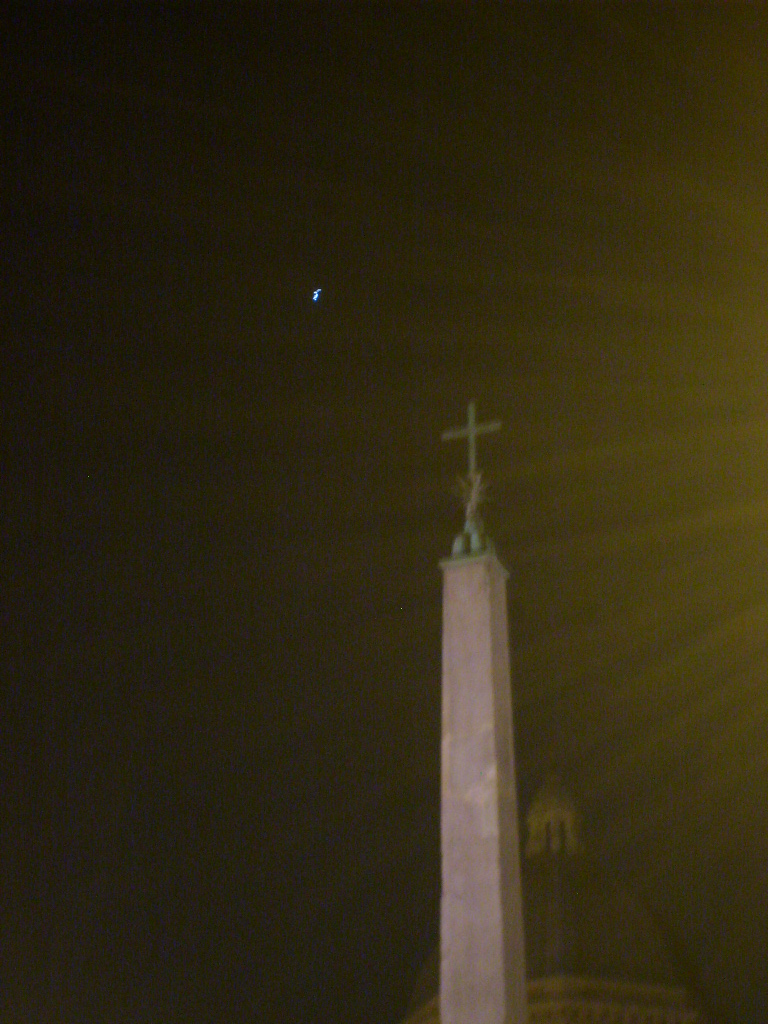
| From Rome. The divine Trinity: Jupiter in the sky, The Cross of Christ and shining over both: The Light of Technology. |
2011-12-01
Memories of a life
Leif GW Persson is Sweden´s most well-known criminologist, professor and advisor to the government, with a television program that has made him "a national treasure" (as the British tend to call people like Stephen Fry, the Swedish word would be folkkär, something like "people-loved") and even a string of successful crime novels behind him. He has recently published his memoar, "Gustavs grabb" (= Gustav´s kid), and I had a really good time reading it. Persson is one of those people who tell it like it is, or at least as they see it, calls a spade a spade and so on, and this memoar is no different. However, Persson is very frank about his memories being not entirely trustworthy. Like the very detailed story of how his best friend lost his school cap down the bear pit at the zoo. His friend claims this never happened. Persson chooses to make this his life´s story, though, with reservations about the truthfulness of it in every direction. And the result is excellent, a man´s personal mythology; this is what it´s like to be Leif GW Persson, in this world.
Persson has a few scores to settle, a few clarifications to make. He is also very funny, not just a little bit cynical, and humble about his own short-comings, especially with the social and emotional bits. He seems honestly surprised and grateful that none of all his children have lashed back with a vengeance at him for being a crap dad. He is certainly pretty hateful towards his own mother. I think about the reasons for this and the only answer I can come up with, from the pages of this book, is that being a good parent is about respect and trust. He writes very candidly about his mother´s betrayals and controlling behaviour and I guess that even a distant father can be ok as long as you can trust him completely.
He is also a social climber with a chip on his shoulder, but at the same time with well-nigh gargantuan self-confidence. His soft spot is his father, Gustav, who was, one understands, the foundation on which Persson built his life. I see a lot of parallells with Kerstin Ekman´s novel about her life in regard to class. This is an experience shared by so many people in the Western World who were born somewhere between 1940 and 1970, when the working classes become the middle/consumer classes.
I find myself thinking a lot about people´s need to make their lives into stories. It think some are just born with it. Ekman says somewhere in her novel that there are no stories in real life, it just goes on and on. And certainly, I know plenty of people who live like that and will share their facts of life with you, but who are no story-tellers. But story-telling, the narrative gene, is a survival gene, I think. When life as you know it is taken from you, when what gives your life meaning is ripped away, whether it is a person, a job or something else, story-telling is the way we cope and find new direction. That´s what therapy is all about: telling it. In some cultures, when someone has died everybody asks: How did it happen? And the grieving person has to tell it, over and over, as part of the process. In our culture, I fear we are much too afraid to ask, too afraid to increase the pain.
I enjoyed this book a lot and I think I can recommend it to just about everyone, it´s the perfect Christmas read. It´s interesting, entertaining, and makes you think about your own story, why do I tell my own life the way I do? And how would it change me if I changed the narrative?
Persson has a few scores to settle, a few clarifications to make. He is also very funny, not just a little bit cynical, and humble about his own short-comings, especially with the social and emotional bits. He seems honestly surprised and grateful that none of all his children have lashed back with a vengeance at him for being a crap dad. He is certainly pretty hateful towards his own mother. I think about the reasons for this and the only answer I can come up with, from the pages of this book, is that being a good parent is about respect and trust. He writes very candidly about his mother´s betrayals and controlling behaviour and I guess that even a distant father can be ok as long as you can trust him completely.
He is also a social climber with a chip on his shoulder, but at the same time with well-nigh gargantuan self-confidence. His soft spot is his father, Gustav, who was, one understands, the foundation on which Persson built his life. I see a lot of parallells with Kerstin Ekman´s novel about her life in regard to class. This is an experience shared by so many people in the Western World who were born somewhere between 1940 and 1970, when the working classes become the middle/consumer classes.
I find myself thinking a lot about people´s need to make their lives into stories. It think some are just born with it. Ekman says somewhere in her novel that there are no stories in real life, it just goes on and on. And certainly, I know plenty of people who live like that and will share their facts of life with you, but who are no story-tellers. But story-telling, the narrative gene, is a survival gene, I think. When life as you know it is taken from you, when what gives your life meaning is ripped away, whether it is a person, a job or something else, story-telling is the way we cope and find new direction. That´s what therapy is all about: telling it. In some cultures, when someone has died everybody asks: How did it happen? And the grieving person has to tell it, over and over, as part of the process. In our culture, I fear we are much too afraid to ask, too afraid to increase the pain.
I enjoyed this book a lot and I think I can recommend it to just about everyone, it´s the perfect Christmas read. It´s interesting, entertaining, and makes you think about your own story, why do I tell my own life the way I do? And how would it change me if I changed the narrative?
Subscribe to:
Posts (Atom)