Lisbeth, my child, do not poke my paining, it is wet!
Lisbeth immediately stops and turns her back to the easel.
Lisbeth, if you touch my sketch, you will be spanked!
Lisbeth is a bit perplexed, still, she lifts her index-.
Lisbeth, don´t you dare!
Lisbeth changes her mind, but can´t get the idea from her head.
Now mum and dad can´t take it any more (they burst out laughing) - Lisbeth had to poke!
As you can see from the above, Lisbeth is a real character!
This charming and loving little comic was drawn by Swedish artist Carl Larsson for his book "De Mina" (= my family) from 1895. I found it when I was browsing "Svenska teckningar - 1800-talet" (= Swedish drawings from the 19th century). He is most famous for his paintings of his home in Sundborn, which was created by his wife, Karin (who was a very talented artist and gave up a promising career when she married), in a style very much inspired by the Arts & Crafts movement. Thanks to the Swedish Academy, you can enjoy his book "Ett Hem" (= a home) on their website. Perhaps not so much the introductory text, but the paintings that start on page ten (X). This was the first of the books that established the Larsson home as one to be admired and copied. You can also read "De Mina", "Larssons", and "Åt solsidan" (= on the sunny side). These books make even me want to re-paint my furniture in warm red shades!
If Larsson´s style of painting sometimes reminds you of comic books it´s no wonder - some are more or less coloured drawings with very bold linework. These images in particular are perennially popular in the form of postcards, wallhangings (prints or embroidery), trays, cups, plates - anything! In the 70´s those little girl´s dresses and ladies aprons were so popular; I remember them on my cousins. Also, Rörstrand porcelain factory has a service called "Sundborn", its design inspired by the Larsson home. (They also do Ostindia, a classic Swedish pattern that I grew up with and still use.)
This is very much how the Swedes see themselves. Larsson´s images define a typically Swedish aesthetic that probably includes you whether you grew up in a suburb of Stockholm or in a red house with white trimmings in the country.
Funnily enough, one of Karin Larsson´s paintings from her time at artschool pokes a nice big hole in the idea of a blond, blue-eyed and homogenous and (therefore, if you listen to the Sweden Democrats) happy past. This is "The negro Pettersson", a very popular model who also worked at the Stockholm harbour, was married twice to Swedish women and raised several children with them. He lived his life in Stockholm in the 19th century, without as many raised eyebrows as one might have thought, although I think he would have been a fairly exotic character at the time. I have seen several paintings of him, and Karin Larsson´s is one of the very best. It was featured not long ago on the "Antiques Roadshow" (on Swedish television).
Some weeks ago, I got an email from Marta, a lover of Barna Hedenhös, of which I blogged - oh my! - exactly one year ago! Must be some kind of benign sign... Anyway, this led to my discovery of a recent publication on the collected works of Barna Hedenhös´ creator, "Boken om Bertila", or BertilAlmqvist as was his full name, by Nisse Larsson. I immediately walked over to the library and got it, and what a revelation!
I was completely unaware that Bertila was the man behind one of the most iconic images in Swedish history: En Svensk Tiger. These words mean two things: A Swedish Tiger, and A Swede Keeps Silent. It was a variation on those many posters the Brits had, like this one. But because of the word play, it was also an affirmation of the strength of both the nation and its individuals during a time when they needed reassurance. A brilliant image, really, and the words that was part of it made it go beyond the visual. It is so ingrained in the nation´s conscience that it has been re-used for other purposes, like selling Swedish milk and Swedish magazines.
A high ranking military man didn´t like the tiger, he thought it should have been a lion instead, completely missing the point - a story Bertila enjoyed telling.
Bertila´s column, with tall Prime Minister Erlander as the father of the Swedish "folkhem" (the Swedish Welfare State) with the leader of the Farmer´s Party, Gunnar Hedlund, as his supportive wife. You can see more columns here.
Bertil Almqvist was born in 1902, to a middle-class family in Stockholm. He got into drawing and writing funny verse already in school, and pretty much continued to do that for the rest of his life. He was perhaps not the most gifted visual artist of his time, but in combination with his word play, his output was unique. For many, many years, he published a weekly drawn and written column that commented on anything that was happening, from politics to sports and culture. It was called "På tapeten", which means literally "on the wallpaper" and means "the topic of the day". He made a sport of drawing the headline differently each week and in accordance with the topic.
He made all kinds of illustrations: theatre posters, children´s books, campaigns. And, of course, he wrote and drew "Barna Hedenhös": the books, the comics, the films. He died in 1972, while working hard on a film for Swedish Television about the Hedenhös children (he wasn´t just overworked, he was fond of his drink and his cigarettes, too, there is hardly a photo of him without a fag between his lips). He had by then been retired - quite forcibly - from his newspaper column, something that had made him so upset he even complained to the Prime Minister of Sweden! Perhaps he had lost touch with the times. When you look at his works they have very much that 50´s positivity, a stout belief in progress.
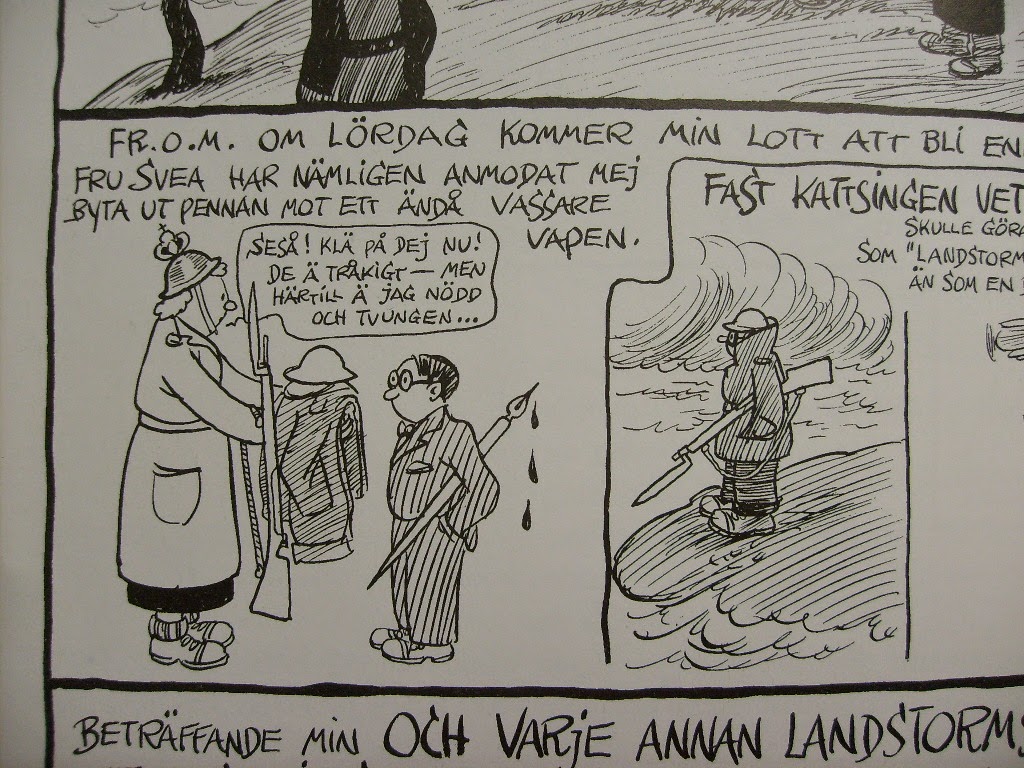
Mother Svea (Sweden) gives Bertila his uniform.
Word play was part of his game and the Swedish language started to change in the 70´s, as a new political and social awareness developed, as Swedes became more internationally aware, and society was being reshaped by immigration and the developement of modern media. Some of the Hedenhös books are no longer reproduced, considered racist and misogynist - which would have offended Bertila, who was a pacifist and a very outspoken advocate of equality and progress, both social, cultural, and technological. For example, he was a keen driver and fiercely lobbied for right-hand traffic for more than 30 years before it became a reality, in 1967. He also had strong convictions about spelling reforms. He did go into the army during the war, but reluctantly so, as he explained in comic form. He thought he could do more for the nation with his pen, and he did that as well, as you already know.
He also composed, which was a surprise to me. He wrote one of the most loved children´s songs in Swedish history, "Droppen Dripp och Droppen Drapp" (performed below by Alice Babs and her daughter Titti), and even recorded songs and put up a revue in 1934, where he sang his own songs in front of fifteen large drawings.
I only knew him for Barna Hedenhös, but I think now that his most lasting work will be "En svensk tiger" - even though perhaps that work has outgrown the memory of the man who created it.
Droppen Dripp och Droppen Drapp (the drop Drip and the drop Drap)
satt på varsin isetapp (sat each on his own icicle)
ovanför vår förstutrapp (above our landing)
Droppen Dripp och Droppen Drapp! (the drop Drip and the drop Drap)
- Hej, sa Dripp till Droppen Drapp (- Hi, said Drip to the drop Drap)
trivs du bra uppå din tapp? (are you happy on your icicle?)
- Åjavars, sa Droppen Drapp (- Oh, allright I guess, said the drop Drap)
fast min sittplats är rätt knapp! (although my seat is rather small.)
- Hördudu, sa Dripp till Drapp, (- Hey listen, said Drip to Drap)
ska vi hoppa ner ikapp, (shall we race each other down,)
ner på våran förstutrapp? (on to our landing?)
Så sa Dripp till Droppen Drapp. (That´s what Drip said to Drap the drop.)
- Hu, så högt! sa Droppen Drapp, (- My, that´s high! said Drap the drop,)
såge helst jag hoppa slapp. (I wish I didn´t have to jump.)
- men det gör väl hipp som happ, (but I guess it´s neither here nor there,)
låt oss hoppa ner i kapp! (let us race each other down.)
Och så hoppa Dripp och Drapp (And then Drip and Drap jumped)
från sin isetapp ikapp, (from their icicles together)
ner på våran förstutrapp (down onto our landing)
- och blev platta som en knapp! (and became flat like a button!)
(my own translation - quick and dirty)
Bertila with his daughter Monne Kristina, to whom he wrote the first Hedenhös book.
I have already told you about Danny Gregory´s fabulous book about creativity, "The Artistic Licence". He is also one of the people behind Sketchbook Skool, which looks like a pretty interesting project. I was curious for something more personal by him, and got this, "Everyday Matters", which is a memoir of sorts, a compilation I would assume, of pages from his own personal illustrated diary, with a no doubt heavily edited text to make a coherent story.
It starts when he and his wife Patti are a young, successful couple in New York, he is an advertiser, she a stylist, they have a dog and a new baby, and the terrible thing happens: she falls onto the railway track and is run over by a train. Her spine is crushed and she ends up wheel chair bound.
This book has none of that cheerful entusiasm that "The Artistic Licence" had, as you can imagine. This is personal, this is an account of what it´s like to have life - as you expected it to be - taken away from you. Gregory starts to draw in an attempt to deal with things - the word he keeps using is "slow"; this new life is slower than it used to be, and that is frustrating. Some things he took for granted are suddenly out of reach. Some things he took for granted now seems incredibly valuable. Other things he took for granted means nothing any more.
These aren´t cute drawings of beautiful still lifes. There is no sentimental glow to any of Gregory´s drawings. His surroundings - as he sees it - is what I recognize when I look around my own home, just the stuff of every day. Gregory draws himself into his new life. What Gregory is communicating to me is a lack of self-awareness - a mindfulness - that I find admirable and difficult to obtain. Perhaps only really difficult times can get you there. Or drawing, I hope.
I´m not entirely sure why I decided to read "A Writer´s House in Wales (Directions)" by Jan Morris. I have never read anything by her before, and I am not particularly interested in Wales and things Welsh. I thought I had read about her in the Guardian, but if I have I can´t find the article, so probably I remember it wrong. It is a short read, at 192 pages, and there is nothing in it about writing.
That said, it has been an enjoyable read. It´s a love letter to a place where the writer has domiciliary rights, so to speak, and for this particular writer that must be something special, as Morris is mostly known as a travel writer. She has written much appreciated books about Venice, South Africa, Spain, Hong Kong, Sydney, Oman, and even one about Wales. She was there as a reporter in 1953 when Hillary and Tenzing reached the summit of Mount Everest, and there is of course a book about that as well. She has also written what is said to be a very good trilogy about the British Empire, which I have added to my reading list.
She has a very friendly, personal tone in this book, like you are there with her in her home, leafing through signed first editions in her extensive library. You can almost feel her touching your upper arm while saying this:
...while you’re here, put yours in the Trefan Morys visitors’ book, would you? It’s volume three, not because we have heaps of visitors, but because I like to have just a single signature on each page, so that later on, when I have the time and the energy, I can draw pictures all around it, or stick in relevant photographs, or generally grangerize it. Just your name, that’s all, large as you like. You’d be amazed how hard it is to make people sign their names big and bold, so as to make a proper page of it, and it’s almost as hard to prevent them adding some fulsome phrase of gratitude or commendation.
As it happened, the same day I finished this book I saw a television program, the Swedish version of "Who do you think you are?" where famous people go genealogize. Actually, I think they have it done for them; searching through birth records from the 16th Century is hard work and takes some special skills. Anyway, the person discovering her roots this time was Maud Adams, which is why I tuned in. Remember Maud Adams? Twice Bond-girl? "The Man With the Golden Gun" and "Octopussy"? She was born in Ale, a small village outside Luleå, and grew up here on Malmudden, where we live. As it happens, she lived in the same house that my mum-in-law lived in until we helped her move four years ago. Adams is one year younger than my sister-in-law and was 15 when my in-laws moved in, in 1960. Actually, they moved into the house next door (mum-in-law changed flats in 1990), and I have never heard anyone in the family mention her, so I guess they didn´t know each other. In those days, not everyone went to school further than seventh grade. I´m not sure what Adams did, but she said in the program that she worked as a model, was brought to the US by Eileen Ford, and broke into the film industry in the early 70´s, so perhaps she was already on her way by then. (She was in school with author Torbjörn Säfve, which is someone I should read and blog about some day.)
Turns out that Adams (Wikström was her maiden name) has roots in Swedish Lapland that goes back to at least the 16th Century, on both her mother´s and father´s side. Probably longer. Northern Sweden wasn´t colonized by Swedes until the 14th Century. Several countries claimed the right to tax the Sami, and colonization by so called birkarlar, traders that worked as middlemen in the Crown´s dealings with the Sami were among the first to move in. Adams has at least two of those among her ancestors. And a high-ranking soldier, buried in Gammelstad´s church (that´s old Luleå), who was one of the founding fathers of this town. Which is pretty impressive.
Morris also devotes many, many pages to her Welsh roots, the history of her house, and how important these things are to the Welsh (who keep their family tree under the bed, she says). It gives a person a kind of domiciliary right that goes far beyond legal rights, into layers of biology. These things are tricky to adress for all sorts of reasons, but I know there is something to it: on a visit to Prague 12 years ago, I experienced what it was like to see parts of your own face in strangers on the street. It hadn´t even occured to me before that that was a... thing. I told a woman who was in my history study group, and she said she had experienced that exact same thing in Karelia, when she had gone to search for her ancestors.
Most of us are immigrants; all of us, if you go far enough back in time, even the Welsh. Personally, I have rootlets, thin ones, all over the place, some of which I can only guess in which direction they go. To the lower classes in particular, lots of children were born out of wedlock or with obscure paternity. And modern people move all the time. What kind of point am I trying to make here? Perhaps that Morris´ book makes me reflect on these things, on how much it takes to get that genuine feeling of belonging, a sense of right to a place or a community. Morris has already had the gravestone made for herself and her wife, and if I caught Adams correctly, she also plans to be buried in Luleå, though she spends most of her time in Los Angeles and has lived there for more than 40 years.
I did write "herself and her wife" up there: another thing that makes Morris special is that she transitioned from male to female during the period 1964 - 1972, something she has also written about in a book titled "Conundrum". She is still married to the same lady that she married as a man in 1949 and has four children with. That is a book I´d be interested to read as well.
I can´t exactly recommend that you read "A Writer´s House in Wales (Directions)", unless you already know and love Jan Morris´ writings. I did enjoy it, I am going to read more of hers, but I don´t think it´s the best introduction to a writer. If a writer I loved had written something like this, or any person whose work I admire, I´d be all over it, looking for clues and influences. As a first taste of someone´s writing, it´s just... nice.
I went to the library the other day to dig up one of my favourite books: "Kungen som grävde" (= the king who dug) with photos by Jan Mark. It´s a reportage from one of King Gustav VI Adolf´s archeolgical work trips to Italy, where he excavated some Etruscan ruins.
Gustav Adolf first took part in a dig in 1898, when he was 15 years old. A grave field from the Iron Age was being dug out near one of the summer homes of the royal family, Tullgarn, and he got himself involved. A few years later, his mother´s close friend and doctor, Axel Munthe, arranged a dig for him at Capri, where he had a villa. Munthe was also very interested in antiquity (it was a bit of a gentleman´s sport in the 19th Century, wasn´t it?); we visited the villa a few years ago, and it was full of debris from ancient cities.
When Gustav studied in Uppsala, he participated in the first course the university arranged in Swedish archeology. He then initiated the excavation of the Håga mound from the Bronze Age, and a few years later a professor of archology stated that the crown prince was without a doubt the best all-round archeologist in Sweden. I can believe it - because I like him, but it´s hard to find anyone from that time saying anything the least critical about any member of the royal family. I wonder how much of the praise is real and how much is just standard servility. He did get 17 honorary doctorates during his lifetimes, among them one from Oxford, both for his work in archeology and his patronage of art, something he was introduced to by his uncle Eugen, who was - and still is considered - a respected artist, besides being a prince.
Queen Margrethe of Denmark, at 16.
The Bernadotte family was offered the Swedish crown in 1818, after the last of the Vasa-kings had been dethroned. Jean Bernadotte was one of Napoleon´s generals and had quite a career for a lawyer´s son. His wife and queen was the daughter of a silk merchant. Rich, but not royal. Their descendants have been an interesting mix of artists, intellectuals, and incapables. Of course, being royal, with all it used to mean in terms of duty and class, it can´t have been easy for those inclined to do something really useful.
Gustav Adolf´s parents were King Gustav V, who is mostly known today for being a homosexual tennisplayer with a keen interest in embroidery, and Queen Viktoria, a Preussian princess who spent much of her time in Italy, both because of a cold marriage (I understand she had a very close relationship with her doctor) and severe asthma. He was set up with a granddaughter of the British Queen Victoria, but fell in love with her sister instead, and married Margaret of Connaught in 1905 at Windsor Castle. They had five children and then she died, very young, after an unfortunate series of minor colds, chicken pox, and ear infections. Gustav remarried, a great-grandchild of Queen Victoria this time, Louise of Mountbatten. They had no children together.
Queen Louise on the right.
Gustav VI engaged some of his family for the cause of archeology. Queen Louse often came to visit at the excavation sites, and she did her part of washing old potsherds. Several of his grandchildren, among them Margrethe (the present Queen of Denmark), spent summers there. Margrehte is also a very accomplished artist and illustrator.
Gustav was also a good photographer, as was his mother, Queen Viktoria. I´m queueing at the library for a book from last year, about Viktoria´s photographs from Egypt, and will blog about that later.
Ok, maybe not always so elegant...
The reason I like this king the best is, I suppose, that I always thought he seemed so kind. I liked Prince Bertil, his son, as well. They both remind me of my grandfather and of actors like James Stewart and Alec Guinness. I also have a weakness for archeology, and 50´s fashion. He was so elegant, don´t you think? I want to dress like that!
The photographer Jan Mark, by the way, seems to still be active. His father-in-law was the king´s marshal of the court, and his wife took part in the digs. This is how come Mark and his camera became involved, at this and other royal projects. He has also shot a photo book about Capri and the villa San Michele, where Queen Viktoria spent so much of her time.
"...the war occurred half a lifetime ago, and
yet the remembering makes it now. And sometimes remembering will lead
to a story, which makes it forever. That's what stories are for. Stories
are for joining the past to the future. Stories are for those late
hours in the night when you can't remember how you got from where you
were to where you are. Stories are for eternity, when memory is erased,
when there is nothing to remember except the story. "
A couple of weeks ago I found a brief report in the news of two men found in the Vietnam forrest, having lived in hiding since 1973, a father of 82 and his now 41-year-old son. They were last seen fleeing their village after an explosion that killed the man´s wife and two other children. They were recently found by villagers looking for wood in the forrest. The ill father is now in hospital, and the son is with relatives, trying to cope with civilization.
Clearly, the Vietnam war is not entirely over. Perhaps wars never do end with a peace treaty as we would like to imagine, they just kind of... fade. Danish novelist Susanne Brögger, in her excellent novel "The Jade Cat" (which I should re-read and write about on the blog, really) says that it takes three generations to become free of a war. Personally, I´m just second generation from some of the worst frontlines of the second world war and I have thought a lot about that.
As it happened, when I read that in the paper I was in the middle of "The Things They Carried" by Tim O´Brien, a book I bought after reading a very interesting review of it at Robby Virus´ excellent blog. I had a feeling it might be the kind of book I would like, and I was right. Not only is this a chilling account of the ordinary foot soldier´s hardships, it´s also a discussion on storytelling. O´Brien mixes accounts (of what the carried, both materially and mentally) with stories (both of what happened to the characters in his story, and the stories that they told each other), and also adds some other stories from his childhood about how he handled traumatizing experiences of death and loss of loved ones. It´s categorized as being a collection of short stories, but I didn´t think of it that way. They are so well connected - the same people appear again and again - that it felt much more like a novel to me.
Stanley Kubrik has said that an artwork is always upliftning and never depressing, whatever it´s subject might be. I can´t think of a single book I have read that demonstrated this truth better. However, it would seem that O´Brien thinks otherwise:
"A true war story is never moral. It does not instruct, nor encourage virtue, nor suggest models of proper human behavior, nor restrain men from doing the things men have always done. If a story seems moral, do not believe it. If at the end of a war story you feel uplifted, or if you feel that some small bit of rectitude has been salvaged from the larger waste, then you have been made the victim of a very old and terrible lie. There is no rectitude whatsoever. There is no virtue. As a first rule of thumb, therefore, you can tell a true war story by its absolute and uncompromising allegiance to obscenity and evil.[...] In a true war story, if there's a moral at all, it's like the thread that makes the cloth. You can't tease it out. You can't extract the meaning without unraveling the deeper meaning. And in the end, really, there's nothing much to say about a true war story, except maybe "Oh.""
Many have testified that veterans rarely speak of what they have been through, except perhaps for a few bland anecdotes. And reading O´Brien´s account of the stories the soldiers told each other, you can understand why. They are pointless and obscene - not the kind of stories the folks back home would understand or know how to handle. And I suppose that what O´Brien is trying to do is tell those stories anyway, within a framework that makes them digestible, and make sense - somehow.
I find now, trying to write about this book, that it is really hard. And you know what, I think that this is such an exceptional and brave story that all I can say is: read this book! O´Brien must have worked so hard to write it, and if you only read one book in your whole life, this is one of the best choices you can make, that´s how important it is. I´ll just finish with another brilliant quote from O´Brien, on the subject of grief and storytelling:
"...I had begun to practice the magic of stories. Some I just dreamed up. Others I wrote down—the scenes and dialogue. And at nighttime I'd slide into sleep knowing that Linda would be there waiting for me. Once, I remember, we went ice skating late at night, tracing loops and circles under yellow floodlights. Later we sat by a wood stove in the warming house, all alone, and after a while I asked her what it was like to be dead. Apparently Linda thought it was a silly question. She smiled and said, "Do I look dead?" I told her no, she looked terrific. I waited a moment, then asked again, and Linda made a soft little sigh. I could smell our wool mittens drying on the stove. For a few seconds she was quiet. "Well, right now," she said, "I'm not dead. But when I am, it's like ... I don't know, I guess it's like being inside a book that nobody's reading." "A book?" I said. "An old one. It's up on a library shelf, so you're safe and everything, but the book hasn't been checked out for a long, long time. All you can do is wait. Just hope somebody'll pick it up and start reading.""
All translations from Swedish are mine - quick and dirty.
It´s 1928, and young Vendela Berg is crossing the Atlantic on her way to America, to work as a bookkeeper at her uncle´s firm. She is traveling economy, but by bribing the staff, she hangs around the first class deck, attracted by the presence of the greatest movie star of the time: Greta Garbo, who is on her way back to Hollywood after a visit in the old country. Garbo has already made a name of herself being a very reluctant and shy celebrity, fleeing her admirers in Stockholm.
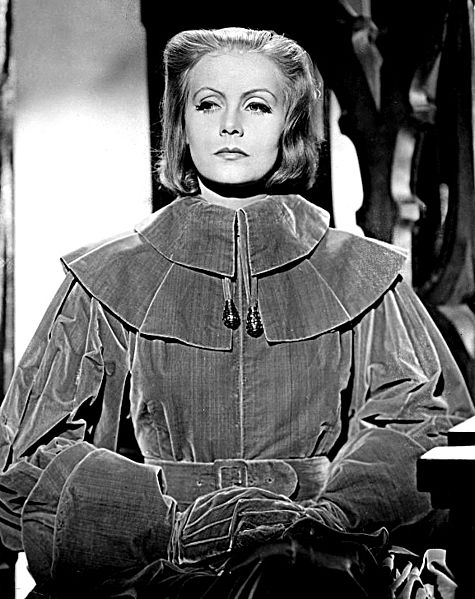
Garbo in Stiller´s "Gösta Berlings Saga", from Wikipedia
This is the beginning of Ellen Mattson´s "Vinterträdet" (= the winter tree), which I have wanted to read for a long time, and after "The Music Box" I felt that it was right to read something good in Swedish again. Garbo seems to be in the cards this year. I liked Mattson´s "Snö", which I blogged about in 2011, and that one, "Snow" in translation, is available in English now. She is probably one of the best writers in Sweden, and it would surprise me if this one wasn´t released into English as well, eventually.
For some reason, Garbo is attracted to Vendela too, and she is offered employment as Greta´s social secretary, a kind of personal assistant/lady´s companion, to handle her affairs and live with her in Hollywood. She orders Vendela to loose weight, to better fit into her clothes, and teaches her to pretend to be her, this way attracting diverting attention when Greta wants to slip away unnoticed.
Mattson
works in first-person narrative, and through Vendela enables us to see
Garbo both from a distance and from within, as Vendela and Greta at
times almost seem to be the same person, sharing the same experiences and feelings. And you can interpret their relationship as two sides of Garbo´s personality, Greta being the emotionally driven,
mostly by fear, and Vendela being the rational, thinking, clever one.
In 1928 Greta is very much in mourning
over Stiller, who made her fortune, and who was perhaps the only person
with whom Greta had a really loving relationship. She is drawn to (and mirrored against) fellow
Swedish actor Nils Asther, with whom she makes two movies. He was known as "the male Garbo" for his
beauty, was also discovered and mentored (or groomed) by Stiller, and feels both grateful and resentful towards him.
Mattson lets Greta say about Stiller:
"... jag trodde på allt han sa.
Det gör jag än, för allt han sa var sant. När direktörerna på Metro
talade om för mig att jag var en kossa som inte gick att filma nedanför
naveln visade han dem vem jag var, han höll själv i kameran och
förklarade hur jag skulle röra mig: stanna vid fönstret, dra undan
gardinen, böj huvudet bakåt! Jag fanns knappt innan dess. Jag visste
inte vem jag var. Han visade mig för mig själv, jag tittade på
provfilmen och tänkte: så detta är jag. Jag hade plötsligt börjat
finnas." "... I believed everything he said. I still do, because everything he said was true. When the managers at Metro told me I was a cow who couldn´t be filmed below the navel, he showed them who I was, he held the camera himself and explained how I should move: stand by the window, pull the curtain, bend your head back! I hardly existed before then. I didn´t know who I was. He showed me to myself, I saw the screen test and thought: so, this is me. I had suddenly come to life."
Mercedes de Acosta is another admirer that
becomes perhaps closer to Vendela than Greta. They both work hard at
Greta´s dream project, a film about the Swedish 17th Century Queen Christina. This is a film where Greta thinks she
will be able to do something of quality, not just be a tragic, bad woman
who must be punished for her wicked ways in crappy films, which she
hates. Both Vendela, Mercedes, and Greta herself projects the real Greta
on the historical character of Queen Christina, who in their script
version is no more authentic than what eventually is filmed. Vendela and
Mercedes share a passionate conviction that Greta must be saved from
Hollywood, and that there is something in her that is not being respected, some artistic
genious behind the beautiful face. But she betrays them both
for more money, and makes the Hollywood version of Christina. But no matter, Vendela loves the movie.
In the end, does Vendela ever get
close to the real Garbo? They live together for seven years, is that
enough? Is Greta being entirely open, entirely honest? Is she the only
person in Hollywood who doesn´t act, who is just being herself, a
naturally shy woman of integrity, who just wants to be left alone?
This novel is about Greta Garbo, and yet, it´s not. Towards the end of the story Vendela says, and this very much sums up the entire novel:
"Under alla de år jag kände Greta pratade hon bara när det passade henne och svarade bara på en bråkdel av mina frågor. Tyst sträckte hon ut handen och rörde vid tekannan, sockerskålen, brödkorgen, askkoppen, lampfoten, allt som fanns inom räckhåll, allt som fanns i den verkliga världen och gick att ta på, och sedan vände hon sig mot fönstret där gråa sjok av blötsnö gled över glaset och då såg det ut som om hon tänkte på sin vän, hans ensamma död, snöns ensamhet när den faller ur en stor svart rymd och försvinner i vattnet, sugs upp av modden på den våta gatan eller rinner som tårar på glaset. Men det var jag som tänkte på allt det där. Det går inte att berätta en annan människas historia." "In all the years I knew Greta she only talked when it suited her and only answered a fraction of my questions. Quietly she put out her hand and touched the teapot, the sugar bowl, the breadbasket, the ashtray, the lampstand, everything that was within reach, everything that was in the real world and could be touched, and then she turned towards the window where grey chunks of wet snow slid over the glass, and in those moments it looked as if she was thinking about her friend, his lonely death, the solitude of the snow when it falls from a black sky and disappears into the water, is sucked up by the slush on the wet street or runs like tears on the glass. But it was I who was thinking all that. It is not possible to tell another person´s story."
I am not going to reveal how it ends. And there is more than one way to interpret this novel. I read a critic in one of the major Swedish newspapers who thinks this is, above all, a novel about female friendship. I say: what? I don´t find that to be a major theme at all. If anything, I find the relationships more metaphorical than real. I think this is a story that can be looked at from a number of different angles, concerning authenticity, projection, integrity, honesty, courage, and other things. In that way, the story is as enigmatic (or, as projectionable) as Garbo´s beautiful face.
I highly recommend this to anyone who can get their hands on it. It´s hard to say how Mattson sounds in English, but the original prose is... well, delightful. Amazing. Truly clever.
Due to a series of flukeish circumstances, we ended up at Strand Hotel, in the Greta Garbo suite. A hotel suite is like a small flat without a kitchen, giving the guests ample space to lounge and relax. I can´t say it´s something we normally get to do, and it was fun to have a sofa each, instead of trying to be comfortable on the bed while reading the paper or a book. Not that the bed in this suite was anything to complain about, you understand.
Instead of going out to a café in the afternoon, we bought some exotic pastries in the market halls and used the hospitality tray to make afternoon tea for ourselves, just to get the chance to enjoy our surroundings properly.
We still had lots of time for museums, long walks, restaurants, and such. Strand Hotel is so conveniently located, in the middle of town, that nowhere interesting is very far away, really. Just outside our window was Nybro Quay, with it´s old-fashioned-looking entertainment ships. I spotted a wedding party on Saturday afternoon, going on board for a ceremony on the waves, and what looked like a proper banquet. The fine weather didn´t hurt, either, but it´s still pretty cold in the air, you feel it as soon as the sun hides behind a cloud. I felt sorry for those who decided to leave their jacket at home.
The suite was decorated in a way that intended to give the impression that the Divine Garbo was still staying there, just not being in at the moment. There was a handbag on a drawer handle, an evening purse in the window, a few hats resting on armchairs. All the art was all images from her pictures. Like this one, which demonstrates that Garbo really knew the art of spreading herself on a sofa. (And she did actually stay at this hotel.)
There were several coffee-table books on the, well, coffee-table. Luckily for me, the only one that didn´t set my asthma off, was the most interesting one. It was an auctioneer´s catalogue, from a series of auctions in 2010, where all of Greta Garbo´s personal things were sold off. All of it. And from what it looks, she saved everything. There are loads of clothes. And shoes, and handbags. And just ordinary things, like kitchen bowls, Swedish guest towels, and Christmas ornaments.
I became totally fascinated, leafed through it several times, feeling like I was getting to know her a little. She had one of the books that I have. She liked silly toys. And she painted, as a hobby.
Her clothes, most of it, could easily be worn today, you wouldn´t know they were made in the 30´s, 40´s, 50´s, and 60´s. She never got into 70´s and 80´s fashion, not in a big way anyhow, and just as well, probably. She died in 1990, after all. Much of it was designed by Valentina Schlee. According to the book and Garbo´s nephew, Garbo had a good relationship with the Schlees all her life (there were rumours that Garbo had an affair with Valentina´s husband), but some rumours say they avoided each other from the 60´s on, still living in the same apartment building in New York. Since none of them talked or wrote about it, I suppose we will never know what really happened between Garbo and the Schlees.
There is not a single high-heeled shoe in Garbo´s wardrobe. And I don´t count one-inch healed loafers. This didn´t make her any less glamorous, or elegant. It just made her look more powerful, I think. She has a reputation for having been very sensible, but there are lots of clothes and shoes that are on the whimsy side. I really think she would have been an interesting person to know!
A neighbour put a box of books out with an invitation to take anything anyone wanted. Since my head is still soft, I fell for this gossipy thing, tabloid journalist Cecilia Hagen´s "De osannolika systrarna Mitford" (= the unlikely Mitford sisters). I can´t call this a serious biography, it´s more like a bound, lengthy magazine article.
Hagen is herself the character around which her story evolves: Hagen in pursuit of the Mitford sisters. There are pictures, mostly of closed doors to houses where one of them lived at some point. There is also one of Hagen going to have tea with the queen. She and a thousand other people. She makes comedy from the tribulations of having to wear a hat (something Swedish women never, ever have to do), and even managing to spill her tea on it!
Since this is not a learned biography with notes and such, Hagen instead tries to build some authority on stories about herself that proves that even if she is not upper class herself (she is related to the Bonnier family, though, who owns most of the publishing industry in Sweden, but even bona fide upper class Swedes never confess to being upper class, ever), she has hobnobbed with them from time to time. Her father was a diplomat and she herself spent some years in a boarding school. Writing about the upper classes has become Hagen´s niche, you might say.
She favours hacked off sentences. This can be a very efficient way to create Voice in a text, as a series of periods instead of commas creates... well, a louder rhythm. It´s like banging on a bigger drum with a harder stick. However, if you use this technique indiscriminately, it begins to look sloppy, and the Voice can become so loud that the story drowns in it. In Hagen´s case, I think she is aiming for comedy. She wants to create the illusion of sitting with the reader at a bar, with wine in their glasses, becoming rather tipsy and indiscreet and doing a lot of backhanded whispering. Sometimes she will write something and then half take it back, like "but I´m not saying that, just suggesting it - in between the lines". Which is nonsense, of course. Either you write it, or you don´t.
And what about the subject of the book, the Mitford sisters? There have been plenty written about them, and plenty will be written about them in the future. They wrote lots of letters, some of which have been published already. There were six of them, and one brother, who was killed in the war. Their father was the second Baron Redesdale, who married the daughter of Thomas Gibson Bowles, who founded Vanity Fair. Like all upper class English girls, they grew up in a very excentric household.
The oldest, Nancy, became a famous novelist. Her best known work is "In Pursuit of Love" and "Love in a Cold Climate". They have been adapted to television at least twice. I haven´t read them, but reading about her have made me so curious I got them for the Kindle. She never made anything up, everything she wrote was about the people she knew and what they did, apparently. I understand she was mean and witty, which is probably both good traits for a best-selling novelist.
The second, Pamela, was the kind, slow one, and she married a scientist, divorced him, and then lived the rest of her life with a woman (this last bit Hagen says nothing about - actually she says very little about Pamela - but according to Wikipedia she did).
The third sister, Diana, is perhaps the most famous one, as she married first into the Guinness family, then left her husband for Oswald Mosley, the British Fascist leader, who kept her on the side for years (along with a bunch of other mistresses) before he eventually married her. In Joseph Goebbels´ livingroom, with Hitler as a witness. Yes, really. She was the beautiful one, and to her dying day she always claimed that Hitler was a very nice fellow. She was the mother of Lord Moyne, who is known to all Swedes through the Trustor affair. The Mosleys were held in Holloway Prison during the war, and then settled in France.
The fourth, Unity Valkyrie (yes, that was her full name! and her parents claimed she had been conceived in the Canadian town Swastika, near where they had a mining-concession!), fell in love with Hitler of all people, and stalked him until he noticed her. When England declared war on Germany, she shot herself in Englisher Garten in Munich. She survived, but the bullet remained in her head and ten years later she died from complications. By all accounts, she was bad, mad and dangerous to know.
The fifth, Jessica, became an equally fanatical communist, moved to the US, where she made a great success of herself socially, and as a journalist. She and Diana never spoke to each other after the war on account of political differences. She married Robert Treuhaft, a lawyer who worked for a time for the Black Panthers, and he had a young Hillary Clinton as an intern.
The sixth, Deborah, is the one who fulfilled the hopes that the parents had for all the girls: she married a Duke. She is most known these days for the small industry she has created around her house, Chatsworth, which was the inspiration for Jane Austen´s Pemberley, and for being the grandmother of Stella Tennant, supermodel extraordinaire. She is still alive, at 92 years old.
I can´t say that I found it all that funny, though I imagine that´s what Hagen intended to do: write a funny, fun book. Reading about the Mitford sisters is a bit like reading about a high speed train accident. You can´t stop, can´t look away, but fun isn´t exactly what I´d call it. I have heard that Nancy Mitford´s books are very funny, though, and I´ll give them a chance. I think they might be the perfect holiday reading for this summer, as we have decided to go to Isle of Wight and Dover this year! (Hurrah!)
Nausea has been my constant companion this last week. It has been impossible to focus on anything for longer than just a few minutes. People ask me if it´s the flu or just a common cold. Well, I think the flu kicked the door in, and then several common viruses came to squat. I think of them like that unhealthy looking bunch from "Trainspotting". There was one they called Sickboy, remember? I know him, he´s been on the premises. But never mind. I´m better now, if not entirely back to my old self.
To amuse myself, I have been leafing through Jan Lundgren´s "The Kary H Lasch Collection" from 1995. Lasch didn´t just keep a collection of photographs, he collected everything that he found amusing. Jokes, french cards (= old fashioned pornography), letters from hopeful girls (and their mothers), anything. The book is a misch masch of photos, stories, bits and pieces. A bit like a scrap book.
La Loren meets the press.
The first story is the best: In 1955, new film star Sophia Loren is coming to Stockholm for the Italian film week. The Swedish press photographers meet her at the Central Railway Station, and they all get photos like this:
A few days later, picture magazine Se publishes this, from inside Sophia Loren´s railway compartment:
How did he do it? Everyone wants to know. "I just got on the train in Copenhagen", says Lasch, giving a few humorous hints to the use of bribery and seduction.
Tony Wilson, of Factory Records fame, once said that if you have to choose between the truth and the legend - always choose the legend. Lasch probably would have agreed. He cultivated his own legend, that of being the guy who could talk himself into (or out of) any situation, any picture. Lasch may have liked people to believe that he came from nothing, that he got his very first picture on the cover of a magazine, but the truth is, he was a rich little Central-European boy, he got his first camera from his dad, who used to take him to art museums to show him the secrets of good portraiture. His first "girl picture" was of his mum, and he had a Swiss boarding school education. In 1955 he was well known in Cannes, and an ambitious girl like Sophia Loren would have already made her introductions. Lasch also spoke fluent Italian (and likely German, French, English and a few languages more), and had been to the Loren/Ponti house for dinner.
Picasso watching Lasch´s bullfighting pictures.
One time, he decided to go see Salvador Dali. He knocked twice, but the great artist was not at home. Or so he was told. Lasch then went to a book store, asked for the best biography of Dali, noted the author´s name, and the third time he knocked, said he had a greeting from the biographer. Dali welcomed him with open arms. Lasch may have told a lie or two, but he knew how to tell them, he knew how successful people behaved. As long as you were generous and of use, a little lie would be nothing to them. They had probably all got where they were the same way. He would snap unwelcome pictures of celebrities, get a bollocking, send all the photos to them the next day, and some of the time he would get commissioned. Picasso liked his pictures, as they made him look tall.
In his collection was a key. It belonged to the back door of the cathedral where Grace Kelly got married to Prince Rainier. Lasch stole it, so that he could sneak in during the night and get a good spot. Unfortunately, the gendarm found him out and posted guards by the door. He got pretty good pictures anyway, being an old aquaintance of the bride.
One season there was a play on at the Royal Dramatic Theatre, "Waiting
for Bardot", about two photographers wanting to be as successful as Kary H
Lasch, wanting to discover a new Bardot. He was a bit pissed at not
getting a free ticket to the show - he was always generous himself like
that. When he had been abroad, he always brought home small, preferably indecent, gifts to the editors of the women´s magazines. One year, he brought them knit penis warmers, which were a great success. A few weeks later, one of them had knit one for him, but much larger. "The right size, and everything", he responded. Someone said of him that "when he is serious, he seems to have the wisdom of a 100- year-old, but when he is joking, you´d think he was eight."
Among his photos, you´ll find images of very young girls like Britt Ekland, Bibi Andersson, Gina Lollobridgida, Eartha Kitt, and Isabella Scorupco. You´ll also find pictures like the one above, of bull fights. Picasso liked them, he thought they were art, but Lasch said categorically that photography was not art. To him, it was a craft. A photographer didn´t create, he just snapped what was already there. Or so Lasch thought, anyway. He liked to take photos of children, he often borrowed his friends´ kids. He also liked to horse around in front of the camera, being a bit of a clown.
Fashion photography for H&M, when they were just Hennes.
Childplay, on the streets of Milan.
Having lunch with the soon-to-be princess of Monaco, getting kissed by a cheeky waiter.
Probably my favourite: window cleaners at Solvalla trotting track.
I´d like to finish with a Kary Lasch-style limerick, from his vast collection:
There was a young girl from Australia who painted her ass like a dahlia the colours were bright and the effect was alright but the smell was an awful failure.




.jpg)
.jpg)
.jpg)
.jpg)
.jpg)
.jpg)