But now, a few days later, as I think back, my favourite piece was Morten Lauridsen´s "O Magnum Mysterium". I found a version of it on youtube (put there by GP Eleria) by the Nordic Chamber Choir, and here it is.

Showing posts with label music. Show all posts
Showing posts with label music. Show all posts
2013-12-18
Christmas Meditation
Sunday the 15th we went to church and listened to Erik Westbergs Vokalensemble celebrating their 20th anniversary with a Christmas concert. Among other things we got to listen to the first performance of composer Jan Sandström´s "Veni, Emmanuel", which was a real treat.
But now, a few days later, as I think back, my favourite piece was Morten Lauridsen´s "O Magnum Mysterium". I found a version of it on youtube (put there by GP Eleria) by the Nordic Chamber Choir, and here it is.
But now, a few days later, as I think back, my favourite piece was Morten Lauridsen´s "O Magnum Mysterium". I found a version of it on youtube (put there by GP Eleria) by the Nordic Chamber Choir, and here it is.


2013-11-27
Music for Dark Evenings
There is much to do and little time to play right now. Which is why posting is becoming less frequent, and I suppose it will stay this way for the rest of the year. I will try to do something every week, at least, and more if I can. I so enjoy blogging (I think I probably carve out a new neural path in my brain every time) and it distresses me a bit when I have nothing to contribute. It´s like life itself is on hold.
We did get a real treat Sunday, however, when we attended the farewell concert for the collaboration between Norrbotten Chamber Orchestra and its long-time artistic leader, Petter Sundkvist, who is moving on to other projects. The program selection was the result of suggestions from the faithful audience, and they played such favourite composers as Sibelius, Mozart, Bach and de Frumerie. My personal favourite, though, was the last piece, an adaptation for orchestra of Sjostakovitj´s String Quartet No 8. My, that woke me up!
According to the conductor, Petter Sundkvist, this piece was written both as a lament over Dresden, which Sjostakovitj visited in 1960, and as a memorial piece over the the composer himself, who did not think it likely that anyone else would compose anything with him in mind after his death. He quotes from his earlier works, and the notes in the main theme corresponds to his initials. It was performed at his funeral in 1975. It´s really sad, but full of vitality as well; perfect for dark November evenings.
I found a version of it on youtube, courtesy of Rodney Leinberger. Enjoy!
We did get a real treat Sunday, however, when we attended the farewell concert for the collaboration between Norrbotten Chamber Orchestra and its long-time artistic leader, Petter Sundkvist, who is moving on to other projects. The program selection was the result of suggestions from the faithful audience, and they played such favourite composers as Sibelius, Mozart, Bach and de Frumerie. My personal favourite, though, was the last piece, an adaptation for orchestra of Sjostakovitj´s String Quartet No 8. My, that woke me up!
According to the conductor, Petter Sundkvist, this piece was written both as a lament over Dresden, which Sjostakovitj visited in 1960, and as a memorial piece over the the composer himself, who did not think it likely that anyone else would compose anything with him in mind after his death. He quotes from his earlier works, and the notes in the main theme corresponds to his initials. It was performed at his funeral in 1975. It´s really sad, but full of vitality as well; perfect for dark November evenings.
I found a version of it on youtube, courtesy of Rodney Leinberger. Enjoy!
2013-10-25
A National Treasure
I noticed that a my post about the squirrel was getting a lot of hits. This made me think more about Alice Babs, who sings the squirrel-song in that clip. I don´t know if the younger generation knows much about her, but when I grew up, she was an institution, practically. National treasure and court singer, by special appointment to the King.
The first thing most people think about when they think of Alice Babs, is her break-through film and hit song, "Swing it, magistern" from 1940:
It´s pretty hard to imagine, but Babs was like the Ozzy Osborne of her day. "Swing it, magistern" - the lyrics go something like: swing it, mr teacher, it´s the song of our time, we don´t want the old nursery rhymes, we want be-bop, teacher, swing it! - was considered the devil´s music, designed to seduce the innocent young Swedes to sinful behaviour. Proper associations were formed dedicated to combat these new strange sounds and the debate was rather rancourus (if not outright racist; I don´t intend to spell it out) at times. I saw a documentary about her just a few years ago and she was still finding it hard to understand, she was still very emotional about it. It must have been horrible to experience for a girl just 16 years old. Before "Swing it", she was known as a yodeling girl, and 1939 she heard Duke Ellington for the first time, which hooked her on jazz.
The controversy didn´t stop her from singing whatever she liked, and in the 50´s she was part of trio Swe-Danes, with Danish musicians Svend Asmussen and Ulrich Neumann, which is mostly remembered for the Scandinavian Shuffle:
Babs´ voice had a range of three and a half octaves. This caught the attention of Duke Ellington, who wrote the second and third of his Sacred Concerts with her in mind:
Directing the Swedish Radio Choir in this performance is the legendary Eric Ericson, by the way. There is more of them here.
All her career she also worked a lot with pianist Charlie Norman:
She was 75 at this performance. And despite having lived a whole life doing such sinful music, she led a scandal-free life; she married at 19, had three children (one of whom, Titti Sjöblom, is also a singer), and lived happily until she was widowed two years ago.
These days, sadly, she does not sing. She has been diagnosed with Alzheimers and is in a carehome, almost 90 years old. A real legend.
The first thing most people think about when they think of Alice Babs, is her break-through film and hit song, "Swing it, magistern" from 1940:
(put on youtube by frogpondium)
It´s pretty hard to imagine, but Babs was like the Ozzy Osborne of her day. "Swing it, magistern" - the lyrics go something like: swing it, mr teacher, it´s the song of our time, we don´t want the old nursery rhymes, we want be-bop, teacher, swing it! - was considered the devil´s music, designed to seduce the innocent young Swedes to sinful behaviour. Proper associations were formed dedicated to combat these new strange sounds and the debate was rather rancourus (if not outright racist; I don´t intend to spell it out) at times. I saw a documentary about her just a few years ago and she was still finding it hard to understand, she was still very emotional about it. It must have been horrible to experience for a girl just 16 years old. Before "Swing it", she was known as a yodeling girl, and 1939 she heard Duke Ellington for the first time, which hooked her on jazz.
The controversy didn´t stop her from singing whatever she liked, and in the 50´s she was part of trio Swe-Danes, with Danish musicians Svend Asmussen and Ulrich Neumann, which is mostly remembered for the Scandinavian Shuffle:
(on youtube by wasaexpress)
Babs´ voice had a range of three and a half octaves. This caught the attention of Duke Ellington, who wrote the second and third of his Sacred Concerts with her in mind:
(on youtube by roger b)
Directing the Swedish Radio Choir in this performance is the legendary Eric Ericson, by the way. There is more of them here.
All her career she also worked a lot with pianist Charlie Norman:
(at youtube by nostalogteket)
She was 75 at this performance. And despite having lived a whole life doing such sinful music, she led a scandal-free life; she married at 19, had three children (one of whom, Titti Sjöblom, is also a singer), and lived happily until she was widowed two years ago.
These days, sadly, she does not sing. She has been diagnosed with Alzheimers and is in a carehome, almost 90 years old. A real legend.
2013-10-22
Norwegian Wood - Part IV (the song)
There is probably not a single Beatles-song in the universe that everyone hasn´t heard at some point, and of course I recognized this. The lyrics really fit Murakami´s novel, the scene in the song might be any scene, with any two of the main characters in the book. It really nails the mood.
I chose this Alanis Morissette-version, because I love her. I can still remember the exact moment I first heard "You oughta know", and exactly how I felt...
I chose this Alanis Morissette-version, because I love her. I can still remember the exact moment I first heard "You oughta know", and exactly how I felt...
(From trulycinderella, over at youtube.)
I once had a girl, or should I say, she once had me...
She showed me her room, isn't it good, norwegian wood?
She asked me to stay and she told me to sit anywhere,
So I looked around and I noticed there wasn't a chair.
I sat on a rug, biding my time, drinking her wine
We talked until two and then she said, "It's time for bed"
She told me she worked in the morning and started to laugh.
I told her I didn't and crawled off to sleep in the bath
And when I awoke, I was alone, this bird had flown
So I lit a fire, isn't it good, norwegian wood.
She showed me her room, isn't it good, norwegian wood?
She asked me to stay and she told me to sit anywhere,
So I looked around and I noticed there wasn't a chair.
I sat on a rug, biding my time, drinking her wine
We talked until two and then she said, "It's time for bed"
She told me she worked in the morning and started to laugh.
I told her I didn't and crawled off to sleep in the bath
And when I awoke, I was alone, this bird had flown
So I lit a fire, isn't it good, norwegian wood.
(From lyricsfreak.)
2013-10-08
A Squirrel in a Fir Tree
When I was out photographing foliage, I took a lot of shots up in the trees, some of which didn´t turn out so well. When I came across this one, I thought, what is that thing?
.jpg)
.jpg)
There have been verses added later, that can not be attributed to Tegnér. According to them, the squirrel then goes home to mummy (who lives in a green field, which doesn´t sound very natural to a squirrel, but rhymes well in Swedish), is put to bed with a stiff drink, a plaster on his toe and a bandage on his tail.
PS: Some great advice, via Humans of New York.

I wish I had seen him when I was there, I had so much more zoom in the lens! But I am rather myopic (autofocus is a godsend). Anyway, the photo reminded me of an old nursery rhyme by Alice Tegnér I am sure the kids still sing.
The squirrel was sitting in the fir tree
about to peel his cones.
When he heard the children coming
he hurried away.
He jumped onto the pine branch
but bruised his little leg
and his long shaggy tail.
(Awkward & unmusical translation by me. Video by Mrs Bean. Song by Alice Babs.)
There have been verses added later, that can not be attributed to Tegnér. According to them, the squirrel then goes home to mummy (who lives in a green field, which doesn´t sound very natural to a squirrel, but rhymes well in Swedish), is put to bed with a stiff drink, a plaster on his toe and a bandage on his tail.
PS: Some great advice, via Humans of New York.
2013-06-18
We´d roll and fall in green
I have never paid much attention to Kate Bush. I don´t suppose she was ever that big in Sweden. The other day I read something somewhere about her song "Wuthering Heights" and I decided to go check it out. I recognize it, of course, but I always thought those chorus lyrics were just la-la-li-la-la-la or something. Now I realize she is singing Cathy´s ghost! It´s hard to hear, even when you know the lyrics.
Anyway, now it´s running non-stop in my head (in a very clingy, Cathy-sort-of-way). So I thought I´d share.
(from lyricsfreak)
Out On the wiley, windy moors
We'd roll and fall in green
You had a temper, like my jealousy
Too hot, too greedy
How could you leave me
When I needed to possess you?
I hated you, I loved you too
Bad dreams in the night
They told me I was going to lose the fight
Leave behind my wuthering, wuthering
Wuthering Heights
Heathcliff, it's me, Cathy, I've come home
I'm so cold, let me in in-a-your-window
Heathcliff, it's me, Cathy, I've come home
I'm so cold, let me in in-a-your-window
Oh it gets dark, it gets lonely
On the other side from you
I pine alot, I find the lot
Falls through without you
I'm coming back love, cruel Heathcliff
My one dream, my only master
Too long I roam in the night
I'm coming back to his side to put it right
I'm coming home to wuthering, wuthering
Wuthering Heights
Heathcliff, it's me, Cathy, I've come home
I'm so cold, let me in in-a-your-window
Heathcliff, it's me, Cathy, I've come home
I'm so cold, let me in in-a-your-window
Ooh let me have it, let me grab your soul away
Ooh let me have it, let me grab your soul away
You know it's me, Cathy
Heathcliff, it's me, Cathy come home
I'm so cold, let me in in-a-your-window
Heathcliff, it's me, Cathy come home
I'm so cold, let me in in-a-your-window
Heathcliff, it's me, Cathy come home
I'm so cold
Anyway, now it´s running non-stop in my head (in a very clingy, Cathy-sort-of-way). So I thought I´d share.
(from lyricsfreak)
Out On the wiley, windy moors
We'd roll and fall in green
You had a temper, like my jealousy
Too hot, too greedy
How could you leave me
When I needed to possess you?
I hated you, I loved you too
Bad dreams in the night
They told me I was going to lose the fight
Leave behind my wuthering, wuthering
Wuthering Heights
Heathcliff, it's me, Cathy, I've come home
I'm so cold, let me in in-a-your-window
Heathcliff, it's me, Cathy, I've come home
I'm so cold, let me in in-a-your-window
Oh it gets dark, it gets lonely
On the other side from you
I pine alot, I find the lot
Falls through without you
I'm coming back love, cruel Heathcliff
My one dream, my only master
Too long I roam in the night
I'm coming back to his side to put it right
I'm coming home to wuthering, wuthering
Wuthering Heights
Heathcliff, it's me, Cathy, I've come home
I'm so cold, let me in in-a-your-window
Heathcliff, it's me, Cathy, I've come home
I'm so cold, let me in in-a-your-window
Ooh let me have it, let me grab your soul away
Ooh let me have it, let me grab your soul away
You know it's me, Cathy
Heathcliff, it's me, Cathy come home
I'm so cold, let me in in-a-your-window
Heathcliff, it's me, Cathy come home
I'm so cold, let me in in-a-your-window
Heathcliff, it's me, Cathy come home
I'm so cold
2013-06-15
Legendary Poet - Bellman´s Epistles
"If Carl Michael Bellman, a unique figure in world literature, has been as unknown to the world at large as he has been perennially popular in Scandinavia, it has been due to the untranslatability of poetry. His great song-cycle Fredman´s Epistles, a genre 'which had no forerunners and cannot have any successors', is perhaps the only great work of poetic art to be concieved throughout to music. In Sweden it has been the means of preserving a whole treasure trove of lovely melodies which once delighted Europe.
A brilliant mimic and improviser, Bellman was chiefly appreciated by his contemporaries as an entertainer who conjured up for them a drastic picture of the low-life of Stockholm. Subsequent generations have found in him a poet of almost shakespearean dimensions."
The Swedish Academy is not just a bunch of old farts admiring each other, occasionally pulling themselves together to choose the next recipient of the Nobel Prize of Literature, even though some may think so. They actually do quite a lot of work for the preservation and promotion of Swedish literature. In their latest newsletter they have brought Bellman - in English! to the world. (You can read the whole thing right there on the website, page-turning arrows on the left side of the page.)
If Nationalmuseum presents the image of Sweden, then Bellman is surely providing the soundtrack. He lived in the 18th Century, and was patroned by king Gustav III (whose leisure ship the Amphion I blogged about a few weeks ago).
On youtube I found several performances from two of our most legendary Bellman interpreters: Fred Åkerström and Cornelis Vreesvijk.
Epistle 82, Vila vid denna källa (= Come now, ourselves reposing)
Epistle 81, Märk hur vår skugga (= So to her rest)
The translations are really interpretations - some are quite far from the original text, I find. And I suppose this is how it often is with poetry. The interpretation becomes an artwork of itself, close perhaps, but not quite the same. I wonder how big Shakespeare really would have been if he hadn´t been lucky enough to write in a language that would become the dominant lingua franca of our time. And I wonder how many literary treasures have been forgotten as peoples and their languages have died out.
One song all Swedish children sing at graduation (or at least they used to, it would be a crime if they didn´t still), is "Fjäriln vingad syns på Haga" (= the butterfly is seen in Haga). Haga was one of the king´s favourite palaces, and is now the residence of the crown-princess Victoria and her family. While Bellman used a lot of traditional melodies for his songs, this is one that he did compose himself. I found this English version:
Another part of Swedish childhoods are the Bellman jokes, which are rather childish jokes with Bellman competing in some way - and coming out on top - with two other guys, often just named a German, a Dane, or a Frenchman. From the beginning Bellman jokes were obscene jokes about court life, and I found this one that may be as old as from the early 19th Century:
A brilliant mimic and improviser, Bellman was chiefly appreciated by his contemporaries as an entertainer who conjured up for them a drastic picture of the low-life of Stockholm. Subsequent generations have found in him a poet of almost shakespearean dimensions."
The Swedish Academy is not just a bunch of old farts admiring each other, occasionally pulling themselves together to choose the next recipient of the Nobel Prize of Literature, even though some may think so. They actually do quite a lot of work for the preservation and promotion of Swedish literature. In their latest newsletter they have brought Bellman - in English! to the world. (You can read the whole thing right there on the website, page-turning arrows on the left side of the page.)
If Nationalmuseum presents the image of Sweden, then Bellman is surely providing the soundtrack. He lived in the 18th Century, and was patroned by king Gustav III (whose leisure ship the Amphion I blogged about a few weeks ago).
On youtube I found several performances from two of our most legendary Bellman interpreters: Fred Åkerström and Cornelis Vreesvijk.
Epistle 82, Vila vid denna källa (= Come now, ourselves reposing)
Epistle 81, Märk hur vår skugga (= So to her rest)
The translations are really interpretations - some are quite far from the original text, I find. And I suppose this is how it often is with poetry. The interpretation becomes an artwork of itself, close perhaps, but not quite the same. I wonder how big Shakespeare really would have been if he hadn´t been lucky enough to write in a language that would become the dominant lingua franca of our time. And I wonder how many literary treasures have been forgotten as peoples and their languages have died out.
One song all Swedish children sing at graduation (or at least they used to, it would be a crime if they didn´t still), is "Fjäriln vingad syns på Haga" (= the butterfly is seen in Haga). Haga was one of the king´s favourite palaces, and is now the residence of the crown-princess Victoria and her family. While Bellman used a lot of traditional melodies for his songs, this is one that he did compose himself. I found this English version:
Another part of Swedish childhoods are the Bellman jokes, which are rather childish jokes with Bellman competing in some way - and coming out on top - with two other guys, often just named a German, a Dane, or a Frenchman. From the beginning Bellman jokes were obscene jokes about court life, and I found this one that may be as old as from the early 19th Century:
Bellman went to the Queen and asked if she wanted to make a bet.
- I would, said the Queen. What bet would Bellman like to make?
- I bet fifty crowns that the Queen has a birthmark on her left buttocks.
- That was easy money, said the Queen, lifted her skirt and pulled down her underpants.
- Now you lost fifty crowns, Bellman, she said.
- That may be, said Bellman. But look out the window. The King is looking in and I bet him a thousand crowns that the Queen would show me her arse...
2013-06-09
Applying Science to Music
I have to start this post with a spoiler:
Update, June 24:
I just heard that the book is now available on amazon for Swedish readers - and I understand it has been for American readers (and others, perhaps) all along. (Those who don´t have the Kindle reader can download a free app from amazon for their computer or smartphone or read it in their browser. All is explained on the amazon website.)The author, Nyssim Lefford, is a collegue of my husband, and he happened to mention one day over fika that she had written a novel. I googled it immediately, and the name, "The Music Box", and the description made me curious. I asked him to pass along an inquiry about where to get it. Next thing, it was in my mailbox. It´s a great book, by far the most interesting thing I have read in years. I don´t think I have underlined a novel this much since I read my first Kundera in the 80´s.
.jpg)
"At every juncture, decide. Reading all the options at each fork leads to outcomes that are not as interesting, not as musical, as they might be. Our agency comes from choosing. To avoid choosing is to abdicate the part of us that is most worth recording."And I haven´t. I made my choices and read my story. I imagine that someone else´s choices would give a slightly different story, although I suppose the foundations are the same. Exactly what levers the readers are allowed to (blindly) push, only the author knows. The whole structure is just like the mixing console that this story takes place at, for this is a story about music production, and a discussion about the creative process and what art really is, and is for.
.jpg)
"Cass sighed. "Something will have to happen soon." "It will," said Leo, "and when it does you´ll realize that the distance between here and there was not as great as you had imagined.""Second, Cass, his trusted and brilliant engineer, who has producer dreams of her own (and a severe shortage of confidence).
""Beauty isn´t a one-sided thing," said Cass. "A painting isn´t beautiful unless we take part in viewing it. It just is without us. We choose to see it a certain way, the eye of the beholder thing. It´s a relationship... and we each have different ways of participating..." She drew a breath. "...which is terrifying." "Why terrifying?" asked Leo. "When no one else gets it. Sometimes, Leo, the sound is so clear in my head and no one else hears it.""Then, Liam, Leo´s best friend and agent, a clever and smartly dressed lawyer, who is also a devoted art lover.
"I don´t shop for relationships. It´s like music. Music, art, they take you. Relationships, at the end of the day, it´s not about the size or color or the name romantic on the label. Like art, it´s the quality of the experience. I don´t care how that experience comes packaged. It can be pop music or a painting. Does the experience deliver, that´s all that matters."And, Gabe, owner of the studio where much of the action takes place, super-kind, quietly writing his own music by his desk when he has a minute to spare.
"Great players, in Gabe´s humble opinion, players like Thurston Moore or Jonny Greenwood, their music reflected most clearly when it was at its dirtiest. Players like that zeroed in on a specific emotion, like a parametric equalizer. They boosted or cut emotion until hearing it and feeling it was the same thing."
.jpg)
"Andrew loved this problem. He was smitten with the notion that some goals could not be sufficiently described, and that humans faced those sorts of problems a lot. Humans produced things without having a specific goal in mind all the time, and they did it extremely well. They produced great things. Andrew wanted to find out about that process, how did humans make decisions when they did not know where they wanted it to lead."
This is a novel of ideas. The character´s lives are fairly simple, they don´t have relationships that complicate the story, no spouses (except Leo´s wife who is a very minor character), no children. There is Gabe´s mom, but she is there to make a point, I think. Often, these kinds of novels can feel a bit fakey. I felt this very much with "Sofie´s World" by Jostein Gaardner, a novel I couldn´t even finish because I found the dialog so awkward. But Lefford really is a good writer of dialogue. People who concern themselves with ideas really do talk like this (I know a few), and I found myself very much drawn into the discussion.
"Leo observed the rhythmic structure of Andrew´s intellectual arguments. Andrew paused for preplanned moments of reflection. Key points, whether made by him or others, were given a moment to establish themselves in the mind. Threads closed. There were dominant chords, dissonances and resolutions. Leo wondered how Andrew worked out his timings. It was a tight, if nuanced, performance, and it brought them to Andrew´s main interest in record producers, not knowing what will ultimately be produced."
.jpg)
"Why make the process artificial? Why put it in a Box?" he asked. "In the studio, the piecing together of combinations, the decisions, they race by so fast. There´s no way to hang on to ideas. No way to think about them. It almost feels like the decisions are made for you by something external. The Box was a way to look at those choices and to make the instinct tangible.""
Tragically, before they can start testing the box, Leo dies, and the others are left with the box and the project he started. Cass, Liam, and Gabe are all idealists, all good guys working for art and the benefit of artists and their audiences. The evil forces are represented by a big record company trying to get their hands on the box (which they seem to think is Leo´s brain in a bottle!) (even Liam kind of feels that way, which makes him particularly protective of it) and put it on a website to make money.
.jpg)
Another enemy is Gabe´s mom, who sees art as a rival for the attention she feels entitled to. Really, the scenes with her and Gabe are quite spooky, and I think Lefford has done a marvelous job of dramatizing that manipulation that some people are so good at, particularly with their children. It´s so easy to feel just what Gabe feels in those situations. I mean, she really nails it. I´d love to give you a shorter, meaningful quote, but the scenes have a long build-up, and I´d have to quote at least a whole page. I think there should be a whole novel about Gabe and his mom.
As you have noticed, I quote heavily from this book. Partly because I can´t say anything more intelligent about it than what is already in there, and my small selection might be your only taste of it, so I am sharing. I hope to meet the author in person soon, and I intend to argue for it to be made available somewhere.
.jpg)
Lefford doesn´t give any definite answers, but she asks a lot of very interesting questions, and if I can make a guess, she answers them a little differently in all the versions she provides. It´s astonishingly clever. I´m blown away, really.
""We don´t ever look at art objectively. We´re all biased. Each of us is open to some possibilities and closed to others." "At some point, you have to determine what´s good. Are you biased about my music?" "Yes." He was tickled by the question. "What´s wrong with bias? You built a whole Box of bias. Bias is interesting." "But, then how do I really know when I´m good?" "You don´t find out that way. If that´s your metric, you´ll have to find a different way to make your music.""
2013-05-22
Concert Night
This Sunday, we had the fortune of being invited to a CD release/concert in the Culture House. It was Erik Westbergs Vokalensemble releasing "Dreamlike", with pieces from composers like Emil Råberg, Henk Badings, and (perhaps more well known) Johannes Brahms. Also performing, both on stage and on the recording, was pianist Helge Kjekshus.
 The concert was not in one of the concert halls, but in the art exhibition hall, currently showing Swedish artist Karin Mamma Andersson (and I am soon posting about that). I really like concerts in that space, I think it´s how chamber music in particular should be heard, but the down side is that noise leaks in from outside, since it´s not really made for music performances. This evening, the bass line from a show on the next floor was a bit disturbing. Not that anyone pretended to notice.
I got really excited about a piano piece Kjekshus did on his own, Per Aspera ad Astra by Maj Sönstevold, and as happy as I was to get a free CD (thanks!) I was disappointed that that particular piece was not on it. Wish I could say anything more intelligent about it, but I know so little about music. Can´t find it anywhere on Spotify to point you to either, but you could follow this link and get a 30 second taste of the piece. That´s the best I can do. The vocal ensemble is on Spotify if you are curious.
Update: Better link, thanks to Divers and Sundry. Unfortunately, I couldn´t upload the film and put it up here.
Erik Westberg is a professor at the university and a collegue of my husband, which is how we came to be there. I have been searching youtube and other places to find something of theirs to present to you, but all I can find is a church opera from 2010, about Jesus´suffering on the cross, and that just felt so depressing right now.
The concert was not in one of the concert halls, but in the art exhibition hall, currently showing Swedish artist Karin Mamma Andersson (and I am soon posting about that). I really like concerts in that space, I think it´s how chamber music in particular should be heard, but the down side is that noise leaks in from outside, since it´s not really made for music performances. This evening, the bass line from a show on the next floor was a bit disturbing. Not that anyone pretended to notice.I got really excited about a piano piece Kjekshus did on his own, Per Aspera ad Astra by Maj Sönstevold, and as happy as I was to get a free CD (thanks!) I was disappointed that that particular piece was not on it. Wish I could say anything more intelligent about it, but I know so little about music. Can´t find it anywhere on Spotify to point you to either, but you could follow this link and get a 30 second taste of the piece. That´s the best I can do. The vocal ensemble is on Spotify if you are curious.
Update: Better link, thanks to Divers and Sundry. Unfortunately, I couldn´t upload the film and put it up here.
Erik Westberg is a professor at the university and a collegue of my husband, which is how we came to be there. I have been searching youtube and other places to find something of theirs to present to you, but all I can find is a church opera from 2010, about Jesus´suffering on the cross, and that just felt so depressing right now.
2013-04-16
Meta Music
The other night I saw this wonderful documentary, "John Cage: Journeys in Sound", by Allan Miller and Paul Smaczny. I was so impressed by it that I watched it twice, and filled a couple of pages with notes. I find his story and his work so wonderfully inspiring.
If you have ever been at a performance of a piece of music by Cage, you are not likely to ever forget it. He is perhaps most know for "4´33´´", a piece for piano - or rather not playing the piano for 4 minutes and 33 seconds.
A lot of people would argue, as does Chaim Tannenbaum (philosopher and musician) in the film, that if music is defined as organized sound, that is not what Cage is doing at all. Tannenbaum says that Cage is making it hard - impossible even - to respond to his work as one would respond to music, and therefore, it can not actually be music, but rather a sound performance. He says that Cage inspires interesting thoughts about the nature of music. Still, as unorganized as his sounds may be, he is apparently the bestseller among American composers!
Cage was very influenced by buddhism, and in 1952, he recieved a copy of the "I Ching" from a friend. He learned about its method of throwing coins to procure hexagrams. He says in the film:
One of his teachers was Arnold Schönberg, and he advised the young Cage to seek his fortune elsewhere. He said Cage had no feeling for harmony, which I suppose is another way of saying he wasn´t particularly muscial. "You´ll come to a wall," he said, and Cage responded that "I´ll beat my head against that wall." I find the idea quite comforting, that it´s possible to devote your entire life to doing something you really don´t have any natural talents for, and because of it push the boundries of that field and create something of real importance.
 The most interesting project right now is perhaps the performance of "Organ²/ASLSP (As SLow aS Possible)" in Halberstadt, Germany. It started in 2001 and is supposed to go on for 639 years (!) in the church of St Burchardi. I just put it on my list of things to experience before I die.
And, among his scores there are beautiful pieces of visual art. You can download some of them for free, and this is a page from his "1958 aria (voice) BW - useless without colors".
What I love about Cage is that he gives me lessons in music, in perception, in being even, expressed in tones. He really pushes me and makes me pay attention. He is simply exceptional.
If you have ever been at a performance of a piece of music by Cage, you are not likely to ever forget it. He is perhaps most know for "4´33´´", a piece for piano - or rather not playing the piano for 4 minutes and 33 seconds.
A lot of people would argue, as does Chaim Tannenbaum (philosopher and musician) in the film, that if music is defined as organized sound, that is not what Cage is doing at all. Tannenbaum says that Cage is making it hard - impossible even - to respond to his work as one would respond to music, and therefore, it can not actually be music, but rather a sound performance. He says that Cage inspires interesting thoughts about the nature of music. Still, as unorganized as his sounds may be, he is apparently the bestseller among American composers!
Cage was very influenced by buddhism, and in 1952, he recieved a copy of the "I Ching" from a friend. He learned about its method of throwing coins to procure hexagrams. He says in the film:
Instead of sitting cross legged, I decided to continue sitting at my desk, but changing my work from the making of choices to the asking of questions, which would be answered by the means of chance operation."He didn´t like improvisation, because he believed that improvisation takes you back to what you know, and he wanted to take his art beyond that, into territories you didn´t know. Composing by chance operations prevented his subconscious to interfere with the composition, and that´s what he was after. He was not into self-expression at all (as most artists are), he wanted to create as nature creates (or as he imagined that nature creates). He also said that he had "given up that whole idea of value judgement."
One of his teachers was Arnold Schönberg, and he advised the young Cage to seek his fortune elsewhere. He said Cage had no feeling for harmony, which I suppose is another way of saying he wasn´t particularly muscial. "You´ll come to a wall," he said, and Cage responded that "I´ll beat my head against that wall." I find the idea quite comforting, that it´s possible to devote your entire life to doing something you really don´t have any natural talents for, and because of it push the boundries of that field and create something of real importance.

And, among his scores there are beautiful pieces of visual art. You can download some of them for free, and this is a page from his "1958 aria (voice) BW - useless without colors".
What I love about Cage is that he gives me lessons in music, in perception, in being even, expressed in tones. He really pushes me and makes me pay attention. He is simply exceptional.
2013-03-25
Concert Night
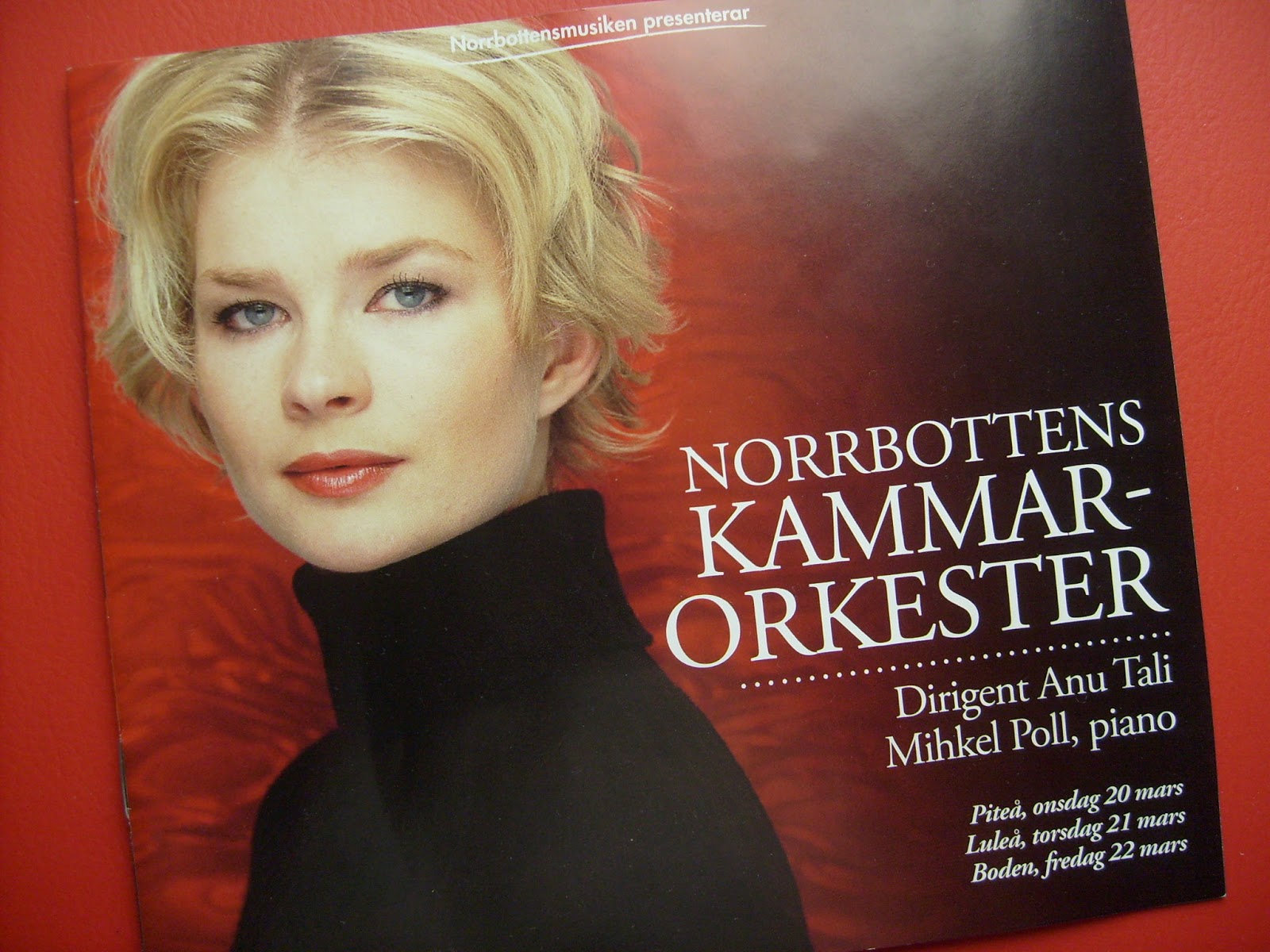
Our local chamber orchestra, Norrbottens kammarorkester, had invited the Estonian conductor, Anu Tali, and on the programme was two Estonian composers, Tubin and Pärt, and also a bit of Mozart in between. All in all, I have to say, it was an evening of easy listening, compared to some of the things they put on. In later years, there has been quite a bit of challenging music on offer. Norrbotten Neo has been a real vitamin injection to the local music scene, and raised the bars for both musicians and listeners.

"I really liked what they had done with the percussionists in that last piece. There were like instruments, like, part of the music!"This cracked me up. And then I thought, I hope he keeps coming to the concerts, and brings all his friends! The average age of a concert visitor must be around seventy-five. If they can´t get young people interested, what´s going to happen to the music repertoire in a small place like this? I think they should really try to bring in the students. And perhaps they should try to avoid hockey nights...

Subscribe to:
Posts (Atom)