2011-12-20

Jingle, Jingle

I have had several false starts lately. I began with two books, Nicole Krauss´ "Great House" and the new August winner Tomas Bannerhed´s "Korparna" (= the ravens). I kept going between them, driven by, dare I say it, boredom. And after about 30 pages of each I just gave up. Perhaps they are prizeworthy both of them, I know they are both well written, but hey, I got nowhere. It was the same with Bengt Ohlsson´s "Gregorius" the other year, also an August prize winner and me, I got nowhere. After about five pages I closed it. Perhaps unfairly, perhaps I should have stuck with it. But I didn´t.

I just today got a link to a page I didn´t know about: http://nanoismer.se/. Of course it all started in the US of A: http://nanoism.net/, and it seems easy: a story in less than 140 characters. Like a haiku, almost. I need to explore this.

To get through Christmas I have borrowed a few "real" books from the library, to encourage my husband to read Leif GW Persson´s excellent memoir on my Story. I am totally engulfed already in WG Sebald´s "The Rings of Saturn". Now here´s a book for me! What´s it about? No clue. Is it fiction? No, I think not. Is it fact? Questionable, after what I hear. Is it inspiring? Plenty! Odd little pictures, too. This is the perfect book for my Christmas mood. A bit off, you know.

I am also reading Eckhart Tolle, simultaneously, and attempting to drop my negativity. I don´t know what it is about Christmas that brings it out in me, but it has something to do with tradition (it´s ok, but too often, though, don´t you think? Every year?), with Christmas decorations, Christmas songs, Christmas shopping, Christmas food (that ham is not as good as everyone makes it out to be), and if you´re not happy and grateful you´re kinda spoiling it for everyone else. I know. I do love to see everybody, though. But can´t we get together and have a Blue Hawaii-party? Umbrella drinks and sun lamps and sand on the floor? Recliner chairs and old Elvis movies? We need more light at this time of year, not more candles, I think.

And everyone who knows me just thought "well, here she goes again". As I said, I´m attempting to drop my negativity, accept what is and become transparent to it. Or something. Back to Tolle...

And to all my friends (and anyone else reading this) who are so stressed out you are becoming accident prone: slow down! Take it easy. Let it be. Let it go. Take a break. Have an egg-nog. With plenty of whisky. Let it all pass through you. Play "Summertime" on the stereo/iPod. It will all pass. And return. Next year.

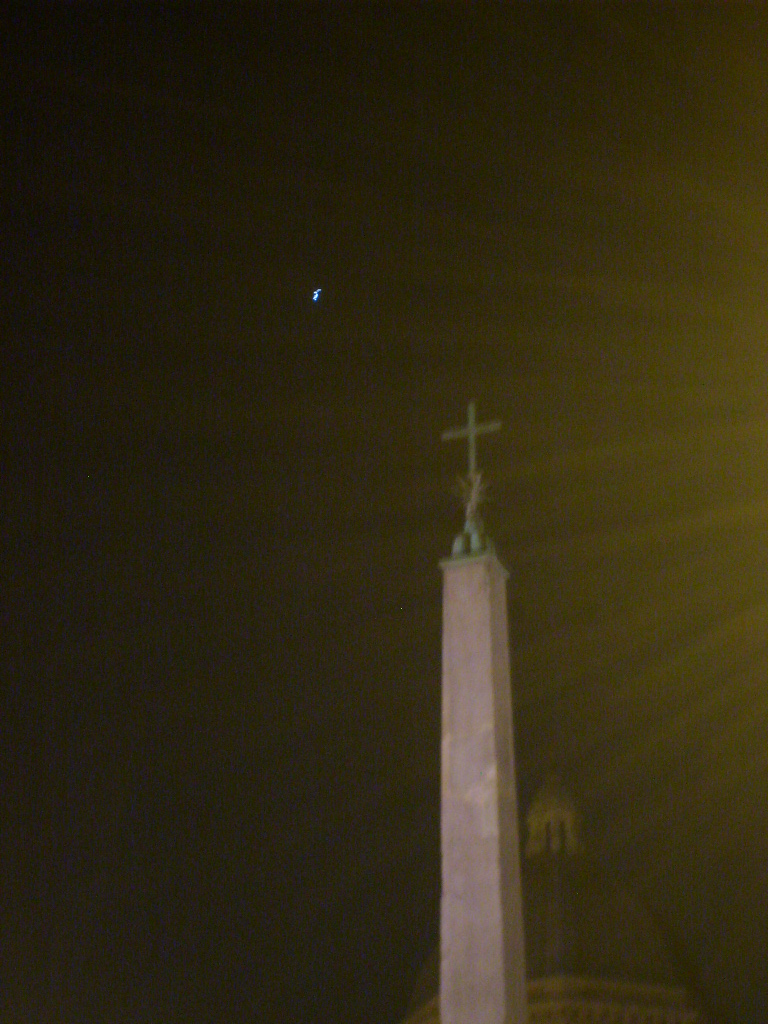
From Rome. The divine Trinity: Jupiter in the sky, The Cross of Christ and shining over both: The Light of Technology.


2011-12-01

Memories of a life

Leif GW Persson is Sweden´s most well-known criminologist, professor and advisor to the government, with a television program that has made him "a national treasure" (as the British tend to call people like Stephen Fry, the Swedish word would be folkkär, something like "people-loved") and even a string of successful crime novels behind him. He has recently published his memoar, "Gustavs grabb" (= Gustav´s kid), and I had a really good time reading it. Persson is one of those people who tell it like it is, or at least as they see it, calls a spade a spade and so on, and this memoar is no different. However, Persson is very frank about his memories being not entirely trustworthy. Like the very detailed story of how his best friend lost his school cap down the bear pit at the zoo. His friend claims this never happened. Persson chooses to make this his life´s story, though, with reservations about the truthfulness of it in every direction. And the result is excellent, a man´s personal mythology; this is what it´s like to be Leif GW Persson, in this world.

Persson has a few scores to settle, a few clarifications to make. He is also very funny, not just a little bit cynical, and humble about his own short-comings, especially with the social and emotional bits. He seems honestly surprised and grateful that none of all his children have lashed back with a vengeance at him for being a crap dad. He is certainly pretty hateful towards his own mother. I think about the reasons for this and the only answer I can come up with, from the pages of this book, is that being a good parent is about respect and trust. He writes very candidly about his mother´s betrayals and controlling behaviour and I guess that even a distant father can be ok as long as you can trust him completely.

He is also a social climber with a chip on his shoulder, but at the same time with well-nigh gargantuan self-confidence. His soft spot is his father, Gustav, who was, one understands, the foundation on which Persson built his life. I see a lot of parallells with Kerstin Ekman´s novel about her life in regard to class. This is an experience shared by so many people in the Western World who were born somewhere between 1940 and 1970, when the working classes become the middle/consumer classes.

I find myself thinking a lot about people´s need to make their lives into stories. It think some are just born with it. Ekman says somewhere in her novel that there are no stories in real life, it just goes on and on. And certainly, I know plenty of people who live like that and will share their facts of life with you, but who are no story-tellers. But story-telling, the narrative gene, is a survival gene, I think. When life as you know it is taken from you, when what gives your life meaning is ripped away, whether it is a person, a job or something else, story-telling is the way we cope and find new direction. That´s what therapy is all about: telling it. In some cultures, when someone has died everybody asks: How did it happen? And the grieving person has to tell it, over and over, as part of the process. In our culture, I fear we are much too afraid to ask, too afraid to increase the pain.

I enjoyed this book a lot and I think I can recommend it to just about everyone, it´s the perfect Christmas read. It´s interesting, entertaining, and makes you think about your own story, why do I tell my own life the way I do? And how would it change me if I changed the narrative?

2011-11-27

Life in Art

I have just finished Kerstin Ekman´s latest novel "Grand final i skojarbranschen" (= grand final in the swindling business, not easy to translate that one...). It´s in the genre of autofiction, a fictionalized autobiography, where Ekman separates her two selves (as she seems to percieve them): the Author and the Writer.

The Author is Lillemor Troj (this is a play with Kerstin Ekman´s own name, she was born Kerstin Lillemor Hjorth, and it´s a bit of a bonus that Troj makes you think of a trojan horse, isn´t it?), a beautiful, blond, blue-eyed, photogenic, well-dressed young woman, who gets engaged to be the front figure for Writer Barbro/Babba Andersson, a woman only described as being "shapeless". She writes herself a body of words, she says somewhere in the book. And the body that the audience sees is Lillemor Troj´s. But Lillemor isn´t all passive in the writing of the books. She often provides the material for the stories and she types and corrects the language, and structures the stories. She is the Good Girl, the one with the good grades at school, the one who knows how everything should be, the disciplined and hard working one. She understands about the world and lives in it, while Babba is only interested in escaping the world and writing her stories, an almost entirely intuitive and physical process that does not seem to require much thought.

The twosome make a prolific partnership, but not without it´s crises. At different times they both try to get away from the other. How it all develops I shall not give away, it would spoil your pleasure. 

This is brilliantly written, and I have read reviews where she is very favourably compared to other authors in the autofiction genre. Someone wrote that she makes Knausgård (the genre´s meteor star of the last year in Scandinavian literature) look like an amateur. I can´t tell if that is right, I haven´t read Knausgård. Or any other autofiction, as far as I know. Ekman´s novel is full of clever metafores about the art of writing, and about the creative process in general, I think. And I imagine that it´s a rather frank autobiography. Life serving art, though, not the other way around.

Any English readers wanting to make Kerstin Ekman´s acquaintance should try "Blackwater". Highly recommendable.

2011-11-20

Reflections on Horace

I have been reading Horace Engdahl. His latest book "Cigaretten efteråt" (= the cigarette afterwards) has been very favourably reviewed and I got curious. While I was at it (on elib.se) I also downloaded an older book of his, "Meteorer" (= meteors).

Horace Engdahl has a bit of a reputation, even internationally. He is a member of the Swedish Academy (who select the Nobel Prize Laureate for literature every year) and for ten years he was the Permanent Secretary. He is a literature historian and has written books about the romantic period and about the author´s voice.

These two small books are collections of reflections, aphorisms and notes. On life, literature, fame, anything that Engdahl has had a reason to give some thought to. I suppose it is a form of autobiography, but not of Engdahl´s life and the trivialities of it, but of his inner life, of his life as an intellectual. Clearly, he is a man who likes to sit in cafés, preferably in Paris, with a notebook and in deep thought. Romantic, you say? A bit of a poser, you might suspect? Beware of casting stones, remember we all have our romantic ideas about what life should be all about. I just last week sat with a group of strangers at table who talked about the necessity to renovate kitchens into a standard that sounds like sci-fi to me. Have a summerhouse by a lake with an outdoor toilet? A walk-in closet? A Harley Davidson? Engdahl has his Parisian cafés and he thinks clever enough thoughts there to publish very enjoyable books. Enjoyable for readers, that is, people who are into literature.

So what kinds of things does he write? Things like this (my own translation):
"Perhaps the most attractive voice in a literary text is the one that sounds like all the others. We are most strongly affected by the voice that nestle up against our own inner voice, yes, that could be our own."
or
"With "trend" or "intellectual fashion" you usually means a kind of thinking that came to town after you yourself became tired of thinking."
or
"Success and failure are really equally repugnant. They disturb the wonderful balance and clarity that depends on forgetting one´s own person."

I don´t always understand what he writes about. But this is the kind of book you can read through quite fast. About every five or ten pages there is something you can relate to, and it´s amusing enough to be worth the trouble. And five or ten years from now, you return to it and suddenly other parts of the book light up and have become understandable. It´s the kind of thing you mature into. Or not. It depends on how close Engdahl´s voice nestle up to you own, doesn´t it?

2011-11-18

A Read to Forget

I just finished Mia Ajvide´s "Mannen som föll i glömska" (= the man who was forgotten). I was attracted to it by the unusual story, which is given away by the title. It´s about a man, Jack, who is forgotten by everyone within a few days. His wife, his mother, all his collegues and friends, they all forget about him, they destroy all traces of him, whereafter they forget that he has ever existed. By experiment he realizes that people can only remember him for as long as they sense his presence, either by looking at him or hearing him or by touching him. If he looses contact with them, only for a second, they totally forget about him.

Jack is soon found by other Forgotten, and he gets to know a whole community of them, lead by a woman named Hanna, who is a Link, a normal person who remembers the Forgotten and can help them to survive. At the same time as he struggles with his strange metamorphosis and his relationship to the Forgotten, he is also researching an old mystery that will prove to have a strange connection to his situation.

This is a ghost story, really. I have never read Ajvide´s husband´s novels about undead and such, but I imagine there are similarities. I had hoped for something interesting, but I found parts of this book rather boring. Like Franzen, Ajvide writes with great attention to detail, but it never seems quite as relevant to the story. Where Franzen´s many words makes his story dense and strong, Ajvide´s many words dilute and weakens. If she had managed to reduce the 300+ pages to 200+, I think it would have improved greatly. But I don´t think it would have saved it from being rather flat and one-dimensional. The story is what happens to Jack. The End. I can´t find any interesting shifts of perspective, ideas, suggestions, anything. It´s all show, no tell. It´s like a stew without any spices at all. Not much veg, either.

It´s an entertaining read in a way, you will want to know how it ends, but then what? I can´t find anything to digest, anything to entertain my mind, anything to keep. Too bad.

2011-11-15

Freedom

The other day I saw an interview with Jonathan Franzen, taped when he visited the Book Fair in Gothenberg earlier this year. It wasn´t his best moment, an "author-moment", he said himself. He began by complaining about the Swedish mineral water, that he said made his mouth more dry the more he drank. I agree, the mineralwater preferred by Swedes is a bit salty, but it wasn´t really a good start. He tried to improve by saying something like "it´s great to be here" and it looked like he was expecting applauds for it, and perhaps that works in the US, but not with an audience of Swedish librarians...

Whatever you think of Jonathan Franzen´s social skills, as a novelist he is damned brilliant. "Freedom", like his earlier novel "The Corrections", is a long, dense thing of a book, and I read it a bit like I watch episodes of "Fawlty Towers". I want to scream at the characters not to say that, not to do that, not to, not to, because it´s going to end badly. And it does. The characters are driven through hell by their own ambitions to not be like their parents, to do good, to be better than everybody else, and what have you.

Patty is a basketball star who hurts her knee, is jilted by sexy rocker Richard and instead marries her admirer, square Walter Berglund and decides to be a perfect mother (unlike her own). When she fails (of course) she falls into deep depression. Walter is an idealist who becomes corrupted by the illusion that he can use dirty money to do good and save bits of the world. Richard becomes a  celebrity who can´t handle his fame or his relationship with the Berglunds. And the Berglund´s son Joey wants to be free from his parents and tries to fly way from the nest sooner than he is ready for it.

It´s like a classic coming-of-age novel, except there are four characters that go through that journey. None of them are particularly sympathetic, but Franzen is still loyal to them all, and I want them all to be happy. They all reach rock bottom, and like a good moralist, Franzen is merciful and gives the repentful a second chance. Perhaps not they way I wanted them to end up, but what the hell, they are who they are and they cannot entirely transform into some other folk, can they?

Franzen´s style is fast, if I can describe it like that. It feels like he writes fast and one get´s a bit out of breath reading him. I find myself taking unusually long breaks from the book, to get some rest. There is plenty of detail, but none of it seems superfluous. He really nails the spirit of the time (from the late 70´s until now, mostly now, or very recently) and I imagine that books that he mentions, like "War and Peace" and "Atonement" holds clues to the story that I don´t get because I haven´t read them. I have a feeling that there are depths in here that hardly any reader will entirely grasp.

In creative writing classes one is often taught to show, not tell. Franzen isn´t afraid to tell, and show, and tell and show at the same time. He does it very elegantly and he really is a master of his craft. He manages to communicate at several levels at the same time and show the mechanisms of manipulation and connect the scenes to the very distant past (generations ago) and the future, sometimes in one elegant sentence. If I hadn´t read the Swedish translation I would have bored you with quotes. As it is, you´ll have to find out for yourself. 

The word freedom comes back all the time in the story, but the one expression that gets stuck in my mind is a Swedish one: "to take freedom with". It means to use something or someone that isn´t legally or morally yours, it means that you expand your freedom of action on someone elses expense. I know that Franzen doesn´t speak Swedish (even though his ancestors were from here), but perhaps he has some intuitive understanding of the expression, because that is what this book is very much about. On every level - personal, economical, political. Everyone is trying to screw everyone else. And it causes resentment and hate. And rage. He could have called the book "Rage".

This is a bona fide, proper, old-fashioned novel. This is what a novel should be to be a great novel. If Franzen can write a couple more of these, he should make the shortlist for the Nobel Prize. I´m sure I´m not the only one who thinks so. 


Freedom, Swedish Style: a Man, a Fire, Sausages, in a Forrest.


2011-10-30

A Monster of Mendacity

I found this book at the e-book library, "Får man vara lite tilltalande i det här samhället" (=is it permitted to be a bit attractive in this society) by Marianne Höök. It´s a collection of her best work, three books, and a number of articles and columns, even extracts from diaries and letters.

Marianne Höök was a Swedish journalist and columnist who was also the most glamourous woman in Stockholm, in Sweden even, during the 50´s and 60´s. She was named the best dressed woman in 1970 and graced the cover of Veckojournalen (= the weekly journal), just a few weeks before she killed herself by means of pills and alcohol, only 51 years old.

I was surprised to see that the texts were so modern, and I suppose that is why they have been republished. Some of the things that were written as late as the 1940´s in Swedish are so old-fashioned language-wise, that young people find it hard to understand. I have even heard suggestions that old Swedish classics should be "translated" inte modern language, to make them accessible to a younger audience. Would the English ever consider modernizing Austen or Shakespeare? I hope not!

I became curious about Marianne Höök and started to parallell-read "Jag var självlockig, moderlös, gripande och ett monster av förljugenhet" (= I was naturally curly, motherless, pathetic and a monster of mendacity) by Anette Kullenberg, a journalist who became friend of Höök´s in the 60´s. She was shocked by the suicide, she writes, and now, more than 35 years later, she embarks on a kind of journey, to find out why she did it. Not that she finds the answer she wants, I suppose life just isn´t that rational and logical. But it´s really exciting to hear all the voices of collegues, friends, lovers, the children, and her own memories and speculations. I find myself arguing with Kullenberg, I listen to the voices and I hear, well, not exactly the same things she does. At times I´m filled with a feeling as if I´m watching something foul, something rotten.

What was it about Marianne Höök? Was it incest, as Kullenberg speculates? I doubt it. Was it "just" mental illness, would she have been helped by a simple medicine if she had been here today? Well, that´s a bit too easy as well. I have a feeling she was caught in circumstances (as many creative and highly gifted women were before the invention of contraceptives, before... well, still are, I guess) that didn´t allow her to do what she was meant to do. I think she self-destructed as a failure to be what she knew she had to be to "earn her keep", so to speak. She may have been deluded, but still, I think that´s what she felt, deep down. Many testify that it was painful for her to age, but I think that pain was deeper than just sorrow over her dwindling beauty. But what do I know, what do Kullenberg know? All we can do is listen and reflect, and learn.