So, almost five years on, I´m back. The blog that was supposed to be (One Sketch A Day on Wordpress) is totally gone from the internet, and I have been completely buried in studies, going for a degree in nursing, which I accomplished. I am now a certified nurse working at an old folk´s home. During this period of going back to school I also had to go through treatment for breast cancer, which went well, considering. On top of that, my mum-in-law and my best friend Marie passed away, from old age and cancer, respectively. Oh, and two summers ago I broke both my arms. And the husband broke his leg, and had some trouble with high blood pressure. In the end, I had to take 4 months off (doctor´s orders) to just process all my stress before I could finish my final practice round. But, I reached my goal in the end.
They say that you can completely change your life in five years, and that is certainly true. Five years ago I wouldn´t even have been able to imagine the life I´m having today. The work is endlessly satisfying, but also endlessly demanding. One could easily be present and useful 24/7.
My problem right now is to find a healthy work-life balance. For so long I poured all my energy into studies and surviving, that now I find my spare time empty of meaning and connection. This leads to me thinking too much about work when I´m supposed to be resting from it. What to do?
I do miss writing. I let go of my ambition to write a novel when I decided to go into nursing, but I now find that the novel is still calling me. However, I can´t seem to even be able to read any more. Studying so hard and all the stress has somehow damaged my ability to read for pleasure, and I feel frustrated about that, since literature has always been my deepest love.
So, bottom line: I´m back blogging about reading because I need to find my way back to my love of literature. I need to get reading again.
Well, times they are a-changing, and suddenly I find myself with a new set of priorities, motivations, and goals in life. More good news on that later, I hope. Until then, I´m attempting to clear my desk, so to speak, finish a few things that I promised to do, simplify routines, and soforth. One thing is the blogging.
I have decided to continue all my blogging on "One Sketch a Day" and simply shoe-horn everything I like to write about into it. It´s funny how, one year ago, I became uncomfortable with how the Bookshelf had expanded, then branched out into several blogs, and now I´m going back to one again. Also, I am leaving Blogger for Wordpress, which right now feels a bit weird to use, but I imagine I will learn it, as I once learned to use Blogger.
I am not getting a whole lot of reading done, and considering how much I anticipated the new Russell&Holmes adventure, "Dreaming Spies", by Laurie R King, it has taken me an uncharacteristically long time to get through it. The last quarter, however, was so exciting I sacrificed a few hours of sleep for it.
Our detective partners are just come home from their latest adventure in Marocko ("Garment of Shadows") and finds Mrs Hudson puzzled about a rock that has been delivered and carefully placed in their garden. The Holmeses do not take this as a puzzle to be solved, so we understand that they know what this rock is and why it has been given to them. Russell goes up to her house in Oxford, where she is met by an intruder, asking for her help. And so starts a lengthy flashback of their round-the-world trip and visit to Japan, one year earlier. (This would have taken place between "The Game" and "Locked Doors".)
One of the things I really like about King is how well she seems to understand the context in which she places her protagonists. Japanese culture - that whole thing about loosing face - is usually incomprehensible to me (I recently read an article in the paper about a Swedish exchange student in China who got into trouble with the police when trying to stop a fight in a nightclub, and how his attitude - perfectly understandable to a European - caused him a year of grief with the justice system, until he swallowed his pride and was promptly released after having begged forgiveness for something he hadn´t done) but King explains it well through the situations she puts the husband/wife team in.
This is the first of the novels where Russell and Holmes are really one hundred percent comfortable with each other as working partners - there is a higher level of trust and confidence, and a natural and easy division of labour - and I like how King has let her characters evolve through the series. She is, as always, very humouristic, sometimes slapstick funny. And again, she gives the most interesting and complex roles to the women of her cast; not that one really notices, as she is never overtly feminist.
Well, you can tell, I find it hard indeed to find fault with King´s work. I have realized that this series is not to everyone´s taste, although I can´t really understand why, but there it is. I do wish, however, that every reader finds a few series that he or she can relish as much as I do this!
I rarely buy real, physical books these days, stopping when my asthma was really bad a few years ago. However, the asthma is better (so is my general health and well-being, which I attribute to better sleep) and I have started picking up the odd paper book when there is no e-book alternative. Certainly, art-books are hard to come by in a decent electronic form, and I have been buying quite a few of those lately - though they have not made it onto the blog, not actually being literature, I think.
I have also been drawn to detective stories, preferably long series of well-drawn characters that one can get to know and like. Comfort reading, I realize, but sometimes that´s what´s called for. I have finished the entire Dalziel&Pascoe-series by Reginald Hill years ago and he will not be making any more, sadly, being dead and all. Laurie R King is alive and well, but is hardly turning out a new Russell&Holmes adventure every year (though her Stuyvesant-series is good too). I have plenty of Lord Peter Wimsey left to read, but am in no hurry to get to the end of them.
After a favourable review by Divers and Sundry, I ordered this one via amazon from a second-hand book dealer in the UK, for a penny, I think. "The Man with a Load of Mischief" is the title of not just the novel, but also an inn where the first (or so it seems) in a series of murders takes place, by Martha Grimes, an American author writing a whole series (23 books!) of whodunits (all named after pubs, I understand) with Scotland Yard Inspector Richard Jury as the investigating sleuth.
A bit of googling (imdb knows nothing about this) revealed that the Germans have adapted this to television in 2013, English countryside and all (but those white cliffs suggests they may have moved the action from the Yorkshire countryside a bit). It turns out to be on DVD and as I feel that we don´t see enough German television, I have ordered it. The reviews were mixed, but I don´t care; it´ll be a lark, I´m sure.
To return to the book, I have to say, I am not in my most critical mood here. It is the first of a long series (published in 1981), and considering the spectacular development of Reginald Hill´s authorship over the years, I am forgiving of certain flaws in a first novel. Like overdescribing - Grimes does not hesitate to stop the action to linger for an entire page on how prettily the snow has fallen on the thatched roofs, etc - and not being entirely British in her vocabulary - I think, for instance, that Inspector Jury would not really reflect much on the cut of a man´s pants, as they would not be visible to him (pants are underwear in Britain, trousers are outerwear). Also, I did figure out who the murderer was much sooner than the good Inspector, but you know, it didn´t really lessen my enjoyment. I like the characters and I look forward to seeing what she will make of them. With 22 books ahead of me (and perhaps more coming, she is 83, but turned out her latest in 2014) I hope I have much to look forward to.
My last read but one (I´m a bit late on the blogging at the moment) was Margaret Drabble´s "The Gates of Ivory" (= Sw. "Elfenbensporten") from 1991, which has just been re-published by Modernista, in a series of modern classics. It was very favourably reviewed in one of the newspapers I read, so I suggested to my reading friend that we go for it in tandem, as I have always wanted to read Drabble, if only for the quote about sandwiches, which I can not find in English, so I don´t know if she actually said it like this:
"Det finns ingen anledning, till varför man inte skulle kunna njuta av smörgåsar och kärlek i evighet.Till skillnad från vissa andra tycks dessa nöjen inte ha någon inbyggd förslitning." (= There is no reason why one couldn´t enjoy sandwiches and love for all eternity. Unlike some others, these pleasures seem to have no natural tendency to wear. - Ok, probably all wrong; it´s weird and dangerous to translate back and forth.)
Anyway! It turned out that "The Gates of Ivory" is the last in a series of three novels, the first being "The Radiant Way" and the second "A Natural Curiosity". Not that I think it matters very much. I have checked out the reviews of all the novels in the New York Times (where they still write excellent and learned reviews - Swedish critics are not as sharp as we think they used to be, and it has been up for debate in the newspapers all winter), and they only confirm my decision not to read the other two. Not that this - or the others, I imagine - is a bad novel, on the contrary. It is very well written, and I never once felt inclined to put it down (it is 400 pages) even though the characters are a bunch of ridiculous people.
From the terracotta army - the only vaguely fitting illustration
I coulf find in my photo collection.
The person who is the engine of the story is Stephen Cox, a middle-aged author famous for a Booker Award-winning novel about the Paris Commune. He is estranged from his mother and his brothers, and lives a rather quite single life in a small flat in London. Now - in 1985, that is - he decides to go looking for Pol Pot, to write a book or a play about him. It seems he is also looking for some meaning of life other than hoarding money, luxury items, and praise, which was the way of the 80´s, if you remember. So, he leaves his friends behind and disappear in the Far East. A couple of years later, his friend Liz Headleand, a divorced psychiatrist, recieves a package containing some of his notebooks and other papers, along with a human finger.
Now, what would you do if one of your friends, of whom you have heard nothing for years, suddenly sent you a package like that? A human finger, for Pete´s sake! Well, Liz Headleand does... not much. She phones another one of Stephen´s friends, Hattie (who also lives in Stephen´s flat while he is away), they get together, and do... pretty much nothing.
There are others - most left-leaning intellectuals who passed Cambridge or Oxford, most of them in important jobs with the government or BBC or something like that, all high-status people - at the fringes of this story, some of whom were probably more prominent in the earlier novels. They go in and out of the different scenes Drabble sets up and what strikes me most about all of them are their... carelessness. I mean both that they are careless as in negligent and reckless, but also indifferent and unconcerned. Marilynne Robinson writes, in her critique of "The Radiant Way", the first book in this series, and I think it applies to this one, too:
"The emotional withdrawal proposed to us in ''The Radiant Way'' is truly radical. Cast off familial and social bonds and what is left? Liz Headleand doing lunch, being brilliant, though somehow never in our hearing. This novel is a valuable specimen of a new consciousness. It has no other claim on the reader's attention."
Linda Simon, who reviewed "The Gates of Ivory", goes a bit farther:
""The Gates of Ivory" is intellectually stimulating and, as we might expect from Ms. Drabble, very smart. But ideas do not make a novel. Characters do. And we need to care about them, deeply."
What is the point of all these secondary characters? asked my friend in our discussion. My guess is that Drabble wants to show us how important Stephen Cox is to Liz - or, how unimportant, rather - and how little his fate concerns those who call themselves his friends. They don´t care much. In the end, Liz goes looking for Stephen, not because she starts caring all of a sudden, but because it is the right thing to do. I get the feeling it´s about being seen to do the right thing.
The only person in this story that I like is Miss Porntip, a Thai former beauty queen, born in a mountain village, grown up in the massage parlours of Bangkok, now a wealthy entrepreneur who collects gems and interesting and useful boyfriends. She takes a liking to Stephen and tries to convince him that there is no simple paradise in communism, rather that the only way to happiness is through capitalism, fashion, medical care, refrigerators, maple syrup, et cetera. Stephen is not convinced and instead seeks the company of two like-minded photographers and lets them guide him on his journey into the Cambodian countryside. Miss Porntip also has a heart, and later gives much help to Liz in her search. (I would have given you a nice quote here, if I hadn´t read the Swedish translation.)
There are a couple of scenes that I really like, where I can relate all of a sudden. One is a lunch with Liz and her best friend Alix, where Drabble really nails how the balance in a friendship can shift when one of them does not do the required sharing but holds something back (in this case a very private matter concerning a husband´s health), and how icy it can become under the surface for reason that can hardly be acknowledged (being fundamentally unfair, after all).
My reading friend also pointed out how archetypal the characters all were (we both took part in a study circle on Jean Shinoda Bolen´s theories a few years ago), and we started discussing what archetypes - according to Bolen´s pantheon - fit whom - like how Stephen Cox is a Hades character, drawn to death; how one of the photographers he befriends is a Hermes archetype, a messenger who guides people back and forth from the Kingdom of Death (one of the refugee camps); how Miss Porntip is very Artemis-like, an independent force; and how some characters shift from one archetype to another, or inhabit several; for example, Liz, who is divorced, still carries the written offer of marriage that her ex-husband gave her, probably thirty years before, in a zipped-up compartment her handbag, which I think signals a Hera (wife) archetype in the past, no longer active, but not quite forgotten either. We agreed that the novel really is very suitable for this kind of discussion, and I suspect that it will linger in my mind for quite some time, and that we will perhaps discuss scenes later on.
Also, I googled "the ivory gates" and it seems this, originally from the Odyssey, refers to deceiving, false dreams. Which makes our discussion connecting the characters to the Greek pantheon even more relevant, I feel.
A week ago I thought it improbable that I would read anything more by Drabble, but now that some more time has passed, I think that with the kind of reading that my friend suggested, mythologically slanted, as it were, would be very rewarding. So, now I think it likely that I will pick up more Drabble in the future. She certainly is interesting.
Over the Christmas holidays, Swedish television broadcast a three-episode documentary about Astrid Lindgren, who is perhaps our most beloved author. She wrote several children´s books from the late 40´s until the 80´s, from "Pippi Longstocking", over "The Six Bullerby Children", "Karlsson-on-the-Roof", "Emil of Lönneberga", "Bill Bergson" ("Kalle Blomkvist" in Swedish), "Mio, my son", "The Brothers Lionheart", to "Ronia, the Robber´s Daughter". She also wrote the script to "Vi på Saltkråkan", a wonderful television series about a couple of families on an island in the Stockholm archipelago.
I didn´t know much about her life and it was really interesting to see what inspired all those stories. She said she remembered her childhood well, because she had been such a happy child, with happy parents, but that she had hardly any memories from her teens, when she was very unhappy. She was closest to her older brother, with whom she played the best, and he was the model for many of her characters, the older, kind brothers.
Little "Rusky" knows he is going to die and his older brother comforts him.
At eighteen, she became pregnant and involved in a great scandal, when the father of her child (with whom she was not in love, she said she was simply young and flattered that he was in love with her), a fifty-something newspaper man, was sued by his wife and mother of his seven children. Astrid fled to Denmark to have her son Lars and he was put in fostercare there for three years, until his fostermother became ill and Astrid, who was struggling to make a living as a typist in Stockholm, took him to her. After a few months of barely making it work, her parents decided to take the boy in, and when Astrid married soon after that, he could finally live permanently with her. This was her life trauma, and many of her books are about abandoned, lonely little boys, as well as about strong but equally alone little girls.
Happily re-united in the Cherry Valley.
She worked for Swedish intelligence during the Second World War, and spent a few years working for an internationally renowned criminologist. These experienced inspired her books about Bill Bergson, the master detective, and the Lionheart brothers, who fight in the resistance movement against the evil knight Tengil.
She had a daughter in her marriage, and was widowed in 1952. She never married again, but worked as an editor while also writing her books. She spoke English and German equally well, has readers in most countries in the world, and received sackfuls of letters every day. She even took the time to properly correspond with some of her readers, like one troubled little girl (interviewed in the documentary) to whom she wrote for almost 30 years (they never met).
After having seen the documentary yesterday, I decided to re-read "The Brothers Lionheart". I probably haven´t read it since the early 80´s, late 70´s perhaps. It´s a well-read book though, it took me a while to find it since the back is missing. It´s a sad story about leaving home and having to do brave things even though one is scared, and I see how this would have appealed to me. Unlike Astrid, I was not a happy child and can remember very little about childhood. Thanks to women like her, I could grow up to be a free (relatively) adult, and that suited me better than being a child. She wrote this book for her brother, who had a heart disease and knew he was soon going to die. It was a "consolation book" for them both. It was also a book which was inspired by her work in the Second World War and how she experienced the struggle for freedom from Nazi rule. The wonderful illustrations are by Ilon Wikland, who came to Sweden as a fourteen year-old refugee from Estonia.
Jonathan, who is all good, even rescues one of Tengil´s soldiers, when he nearly drowns.
The story is about little Karl Lejon (Lion), called Skorpan (Rusky in English translation) by his brother (after the little biscuits he loves), almost ten years old, who is dying from tuberculosis. His thirteen-year-old brother Jonathan comforts him and tells him that they will meet again in Nangijala, the land beyond the stars that is still in the age of fairytales. After the house catches fire, Jonathan bravely saves Rusky´s life, taking him on his back and jumping from the third floor, dying from the fall. In an obituary, Jonathan´s teacher writes that he deserves the name Lionheart.
Not long after, Rusky succumbs to his coughs and suddenly finds himself standing in front of a small farmhouse with a sign on the gate: "The Brothers Lionheart". The brothers are united in the Cherry Valley in Nangijala and Rusky - who is now healthy and strong - is deliriously happy for a while, but not all is well in Nangijala. Their neighbouring valley, the Thorn Rose Valley, is enslaved by the evil knight Tengil, who has a terrible weapon called Katla, which no one wants to talk about, but the name makes Rusky shudder. Jonathan is in league with the leader of the resistance, Sofia, and he leaves on a mission for Thorn Rose Valley.
The evil Tengil terrorizes the Thorn Rose Valley folk.
After a bad dream, in which he hears Jonathan call for help, Rusky goes after him, and I am not going to spoil the story by telling you about it any further. It is sad and dark, people die in it, and Lindgren was much criticized for having written such a dark and sad children´s book. Still, it is also a very hopeful story and good prevails, even though the price is high. It is one of the most loved and important books ever written, I think. It is often quoted in obituary notices for children, and adults too: "Don´t cry mummy, we´ll see each other again in Nangijala", which is on a note Rusky leaves for his mother the night he feels he is going to die.
I cried so much reading this book - I don´t remember crying so much when I read it as a child. I guess if you are happy, you´ll read it as a tragedy, but if you are unhappy, you´ll read it as hopeful and comforting. Yes, this is a truth: happy people have no idea what unhappy people need. Happy people can be cruel, with the best intentions. We should never forget that. Astrid Lindgren certainly never did.
In "Svenska teckningar - 1800-talet" (= Swedish drawings from the 19th century) I found more than Carl Larsson. I already knew about Johan Tobias Sergel, who is perhaps most known as a sculptor. He was born in Stockholm by German parents, spent twelve years abroad (was elected member of the French Academy) and was then called back to Sweden by King Gustav III, whose statue he made, among many other things. (It´s on one of my best photos from last years outdoors art exhibition.) I know him mainly for his drawings, actually. This is one of his best known. He lived with Anna-Rella, a waitress, in a "Stockholm-marriage" and had several children by her.
By Sergel: from when the Prince Karl Johan visits his studio.
I had to laugh at this quote from the book (translated by me), concerning one of Sergel´s contemporaries.
In 1812 Sergel resigned [as professor at the Academy of Art]; his successor was the meek history and theatre painter Emanuel Limnell. In spite of a long life - he was almost a hundred years old - Limnell has not made any lasting impression in our history of art. As a drawing teacher his was weak to begin with, but managed during his half-century long career to become worse.
These are two of his drawings. You make up your own mind:
The unveiling of the Gustav III-statue by Sergel (see links above).
Lisbeth, my child, do not poke my paining, it is wet!
Lisbeth immediately stops and turns her back to the easel.
Lisbeth, if you touch my sketch, you will be spanked!
Lisbeth is a bit perplexed, still, she lifts her index-.
Lisbeth, don´t you dare!
Lisbeth changes her mind, but can´t get the idea from her head.
Now mum and dad can´t take it any more (they burst out laughing) - Lisbeth had to poke!
As you can see from the above, Lisbeth is a real character!
This charming and loving little comic was drawn by Swedish artist Carl Larsson for his book "De Mina" (= my family) from 1895. I found it when I was browsing "Svenska teckningar - 1800-talet" (= Swedish drawings from the 19th century). He is most famous for his paintings of his home in Sundborn, which was created by his wife, Karin (who was a very talented artist and gave up a promising career when she married), in a style very much inspired by the Arts & Crafts movement. Thanks to the Swedish Academy, you can enjoy his book "Ett Hem" (= a home) on their website. Perhaps not so much the introductory text, but the paintings that start on page ten (X). This was the first of the books that established the Larsson home as one to be admired and copied. You can also read "De Mina", "Larssons", and "Åt solsidan" (= on the sunny side). These books make even me want to re-paint my furniture in warm red shades!
If Larsson´s style of painting sometimes reminds you of comic books it´s no wonder - some are more or less coloured drawings with very bold linework. These images in particular are perennially popular in the form of postcards, wallhangings (prints or embroidery), trays, cups, plates - anything! In the 70´s those little girl´s dresses and ladies aprons were so popular; I remember them on my cousins. Also, Rörstrand porcelain factory has a service called "Sundborn", its design inspired by the Larsson home. (They also do Ostindia, a classic Swedish pattern that I grew up with and still use.)
This is very much how the Swedes see themselves. Larsson´s images define a typically Swedish aesthetic that probably includes you whether you grew up in a suburb of Stockholm or in a red house with white trimmings in the country.
Funnily enough, one of Karin Larsson´s paintings from her time at artschool pokes a nice big hole in the idea of a blond, blue-eyed and homogenous and (therefore, if you listen to the Sweden Democrats) happy past. This is "The negro Pettersson", a very popular model who also worked at the Stockholm harbour, was married twice to Swedish women and raised several children with them. He lived his life in Stockholm in the 19th century, without as many raised eyebrows as one might have thought, although I think he would have been a fairly exotic character at the time. I have seen several paintings of him, and Karin Larsson´s is one of the very best. It was featured not long ago on the "Antiques Roadshow" (on Swedish television).
"Gatan steg som en Afrodite ur Svartåns skum, förde en tynande tillvaro utan trottoarer men desto mera trästaket och höga kardborrstånd och gick självutplåningen till mötes på ett solstekt gärde där den snart bara var en söndersprucken gångstig. Men gångstigen tog inte slut. Det var det väsentliga. Den gick till Vladivostok. Man kunde se det på den enklaste skolatlas, för gångstigen ledde så småningom via många andra stigar och skumma prång ut på Adolfsbergsvägen som visserligen gick åt söder men tog man sen lite andra vägar åt väster och norr så kom man över Haparanda ända bort till Sibiriens östkust."
"The street rose like an Afrodite from the foam of the Black River, lead a languishing life without sidewalks but wooden fences and high burdock plants, going self-effacing towards a sunbaked field where it soon turned into a cracked footpath. But the footpath did not end. That was the essential insight. It went to Vladivostok. This could be seen on the simplest school atlas, that the footpath led, by way of many other paths and obscure passages, to the Adolfsberg road - which went south, that is true, but - if you then took some other roads west and north, you came over Haparanda all the way to the Sibirian east coast."
One of the books I brought home from the library for the Christmas holidays and had no time to read was Torsten Ehrenmark´s "Resor till ingenstans" (= travels to nowhere) from 1967. When I was a kid it was a Christmas tradition to read the annual Ehrenmark causerie collection, which was sold along with so called "Christmas magazines" by children going from house to house, thus earning some pocket money. Everyone had their favourite reads, for example, my grandfather bought Swedish comics like "Kronblom" about a lazy but innovative old farmer and I had a period when I read an annual collection of horror short stories. I pretty soon started reading my mother´s causerie collections, like Ehrenmark´s (there were others, like Gits Olsson), because they would make her giggle and even laugh out loud.
Ehrenmark is still good. I´m not the only one to think so, this particular collection was recommended by Dagens Nyheter´s journalist Jonas Thente, who recently wrote about how he would queue up to get his yearly copy signed (he lived in Stockholm where authors would do that kind of thing, I did not) and he would demand that Ehrenmark write "to my friend Thente", which he did. Actually, I wrote for Ehrenmark´s autograph myself, which he sent me from London - it is one of my finest treasures.
I love what he writes about the Slavonic languages, because I have experienced exactly the same thing:
"Det är något mystiskt med slaviska språk. Och turkiska också för den delen. Både i Jugoslavien, Bulgarien och Turkiet har jag blivit offer för hörselhallucinationer som är mycket besvärande. Jag tycker plötsligt att folk talar svenska. Jag stod och hängde i korridoren utanför kupén mellan Belgrad och Dimitrovgrad. Plötsligt hörde jag någon säga alldeles tydligt:- Jag tycker att hon ser slafsig ut.Jag vände mig om och tittade förvånad in i kupén. Där satt samma människor som förut och talade jugoslaviska. En herre betraktade mig begrundande och vände sig sedan till en dam och sa och jag hörde det alldeles tydligt:- Nej förresten, då tycker jag inte att det blir bra. Det var rätt skrämmande. Satsaccenten stämde precis. Han yttrade sig med ett naturligt svenskt tonfall och jag kunde ha svurit på att det var dessa ord han sa. I fortsättningen blev jag allt oftare offer för dessa inbillade yttranden. Ibland lät det som svenska ord som inte finns, om ni förstår hur jag menar. - Jag ben inte förstärad över och så, sa en jugoslav allvarligt. Jag hade på tungan att säga: Förlåt, men vad menar ni?Ett par gånger trodde jag mig tilltalad och vände mig om. - Bylån knackar väl inte huvet, sa nån bakom mig. Det var på vippen att jag svarade: Nej visst inte. I Turkiet var det nästan ännu mer påtagligt. - Göd dig gubbe, nu spinglar det, sa portieren på Pera Palace till en av springpojkarna. Han försvann omedelbart. Och på tåget ner stod jag bredvid några studenter och tittade ut geom fönstret. I tågkorridoren kom då en annan ung man med en tjugodollarsedel i handen och sa nånting på turkiska till den ene studenten, som då vände sig till sin kamrat och sa på klar och tydlig svenska: - Jag sålde en klocka till honom för tretti bagis. - Det var billigt, sa jag automatiskt. De båda turkarna stirrade på mig och sa: I beg your pardon. - Å förlåt, sa jag på engelska, jag står visst och pratar för mig själv. Och då förstod jag att det var dags att åka hemåt. Om man är obildad så kan man inte gå för länge bland slaviska språk och turkiskan. Då blir man lite underlig."
"There is something mysterious about Slavonic languages. And Turkish too. In Jugoslavia, Bulgaria, and Turkey, I have been the victim of embarrasing hearing hallucinations. I suddenly think people are talking Swedish. I was hanging about outside the compartment on a train going from Belgrad to Dimitrograd. Suddenly I heard someone say, perfectly clearly: - I think she looks sloppy. Surprised, I turned around and looked into the compartment. There sat the same people as before, speaking Jugoslav. A gentleman looked at me pondering and then turned to a lady and said - and I heard this perfectly clearly: - Oh no, I don´t think that will be good. It was rather frightening. The sentence stress was exactly the same. He uttered his words with a natural Swedish intonation and I could have sworn he said those words. This happened again and I heard these imagined remarks more often. Sometimes it sounded like Swedish words that don´t exist, if you know what I mean. - I wid note bothren and such, said a Jugoslav seriously. I almost said: Sorry, but what do you mean? A couple of times I thought someone was adressing me and turned around. - Byloans don´t knock one´s head, said someone behind me. I almost said: Of course not. In Turkey it became worse. - Fatten you man, it´s tinklageing, said the hotel clerk at the Pera Palace to one of the bellboys. He immediately disappeared. On the train south I stood beside a couple of students and looked out the window. In the train corridor came another young man with a twenty dollar bill in his hand and said something in Turkish to one of the students, who then turned to his friend and said in crystal clear Swedish: - I sold him a watch for thirty bucks. - That was cheap, I said automatically. Both Turks stared at me and said: I beg your pardon. - Oh, I´m sorry, I said in English, I seem to be talking to myself. That´s when I realized that it was time to go home. If one is uneducated it is not good to spend too much time among the Slavonic and Turkish languages. It makes one a bit odd."
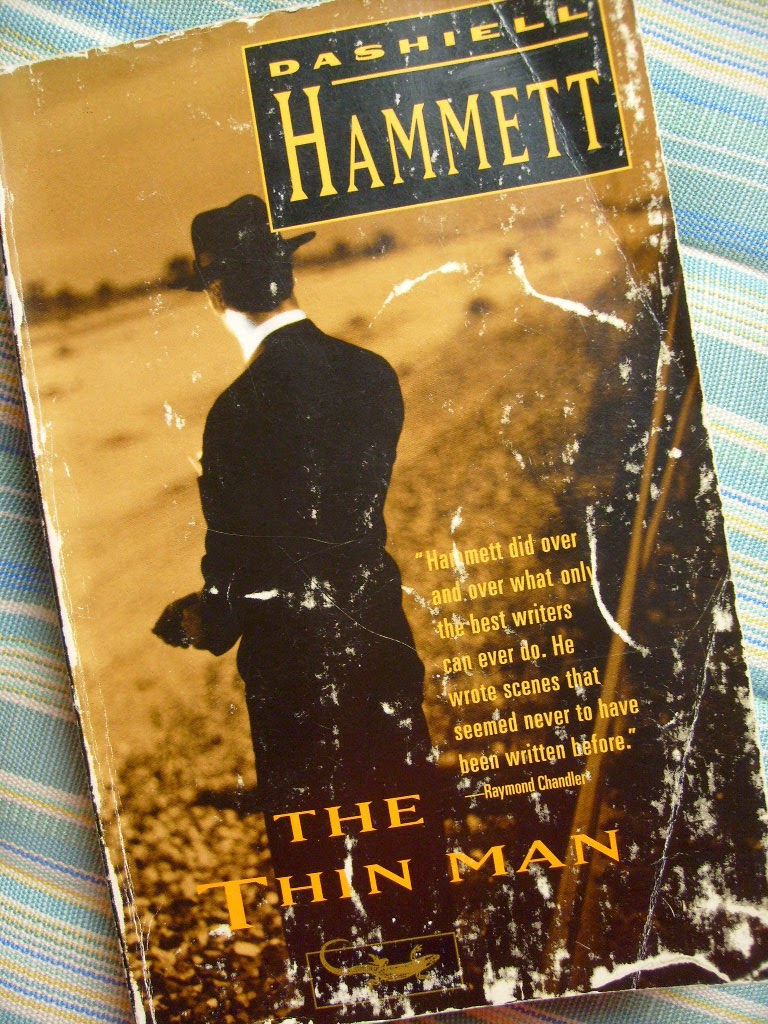
I have had Dashiell Hammett in mind for a long time. He is a fictional character in one of Laurie R King´s novels, "Locked Rooms", which I recently re-read. When blogger Divers and Sundry blogged about suitable reading for Christmas, I decided to try and find "The Thin Man" by Hammett and this rather well-read copy was waiting for me at the library in Kalix.
I enjoyed this read; Hammett has a fast-paced writing style, he doesn´t linger at anything that doesn´t drive the story forward. I confess some of the slang was a bit hard to get, and sometimes I just didn´t get the banter. Likely, I missed the best jokes, but what can you do? I enjoyed it well enough, but not so much that I will be looking for the rest of them; I understand Hammett also wrote some short stories about the main characters, Nick and Nora Charles.
However, I checked out some of the films that was made in the 30´s and 40´s with William Powell and Myrna Loy, and became so infatuated with them that I ordered a four-film-box. A good detective story with a bit of humour is never wrong on a Friday night.
Have I whined yet about the new order of the e-book library? Because of the expense of it - the libraries and the publishers seem unable to reach a sensible decision about this - the libraries have had to severely limit the number of e-books one is allowed to borrow, and the new limit is, unbelievably, two books per month! It used to be five or seven a week, more than one could read, really, but this is ridiculous! My reading friend and I lamented this but decided that perhaps it was time to turn towards the classics. The Swedish Academy has a good, open library with literature they consider part of the Swedish cultural heritage, Litteraturbanken (= the literature bank). I had been considering Karin Boye´s "Kallocain" for years, and my friend was up for it.
Karin Boye was born in 1900, and is mostly known for her poetry, but also wrote novels and worked as a journalist. She also painted, and you can see some of her watercolours here, at the website of the Karin Boye Society. Several of them have been exhibited at Waldemarsudde, the art museum founded by Prince Eugen, who was not just a royal, but one of Sweden´s most prominent painters. After her death, by suicide in 1941, her friends published a book in remembrance of her, and for it Hjalmar Gullberg (who wrote the poem "God in Disguise") wrote a poem called "Död amazon" (= dead amazon), which is still quite well known: "for the Thermopyle of our hearts, some must still give their lives" (my translation).
"Kallocain", from 1940, is probably her best known work internationally, and can be viewed as a precursor to Orwell´s "1984", which was published about a decade later. The narrator of the novel is Leo Kall, inventor of the truth-drug Kallocain. He is a citizen of the World-state, lives in Chemistry City Number 4, which is more or less an underground factory, with his wife Linda and their two youngest children. Their oldest, at eight years old, has already been moved into a reformatory of sorts, where all children go to be shaped into good "fellow-soldiers". The World-state is a severely supervised society, where every home has an "eye" and an "ear" on the wall, behind which supervisors may at any time look in on family life (such as it is: most of their spare time, family members are assigned some kind of policing/supervising duty), and informing on anyone, even family members, not seemingly devoted to the state, is a proud duty, not a dirty secret.
Leo Kall is a fanatic, but about to crack. His supervisor is Edo Rissen, an introverted, thoughtful man and Kall projects all his insecurities on him; he even imagines that Rissen has an affair with Linda. As they start to test the Kallocain drug, Rissen sceptically says that every man over 40 has a guilty conscience, which Kall takes as admission of crimes against the state. The confessions they get from their volunteers are not about crimes as such, but rather "emotional infidelity" to the state, a disturbing longing for human affection and trust, a natural faith in one´s fellow. The police authorities order Kall and Rissen to start training Kallocain interrogators, but it turns out that now, anyone can be convicted. As is Rissen, when Kall finally turns him in. He also steals some of the drug and uses it on his wife, with surprising results.
I found it a captivating read, and fast, at only 130 or so pages. I got quite spooked for a while, as I think anyone with some degree of maturity - as Rissen says, with reasons for a guilty conscience - will recognize that state of awakening from truths earlier taken for granted. I think most teenagers feel what Kall does, as they realize that all families and societies are not alikel, but that there are several ways of doing things and looking at the world, not necessarily on a scale from good to bad, just different. I suspect being a lesbian at the beginning of the century, coming from a middle-class family, would have given Boye a profound insight into being at odds with ideas of what is normal and natural.
You can read "Kallocain" for free on-line, at the University of Wisconsin digital collections, but it is also available through amazon, as is her "Complete Poems". Her most famous poem goes "Javisst gör det ont när knoppar brister, varför skulle annars våren tveka?" (= of course it hurts when buds burst, otherwise, why would spring hesitate? the entire poem can be read in English here) and I think most Swedes with an interest in literature recognize it, even if they are not poetry readers; references abound. The Karin Boye Society even have short recordings of her voice, reading her own poems. (Although, for them to work I had to download them first, could be my browser acting funnily.) She has that very clear enounciation they had in those days.
All in all, a good read. I am quite keen on reading more of her in the future.
A few weeks ago, I saw the first episode of a new detective series on television (available on amazon as "Crimes of Passion"), based on a book series (three novels available in English on Kindle) by Maria Lang (pen name for Dagmar Lange) that was first published in 1949 and that she kept writing until 1990, which featured her rural Swedish version of Lord Peter Wimsey (or so the Wikipedia article on her claims - I find the comparison preposterous), Christer Wijk. I didn´t really know what to expect, I hadn´t read the books, but I was surprised how well made it was (though not perfect, for sure). It has a funny kind of noir vibe to it, as well as a 50´s retro milieu, with a slightly anachronistic adaptation to suit modern (feminist) sensibilities (which I know now, since having read three of the novels). And, of course, excellent actors, some of whom can say some pretty corny dialogue without making the audience too embarassed, particularly Tuva Novotny, who is perhaps the best Swedish actress of her generation.
Actually, my first thought, about five minutes into the first episode, was how much the male body has changed over the last decades. One hears all the time how fashions have changed for the female body, from the 20´s gamine to the 50´s bosomy glamour girl, the 70´s fresh-faced "Charlie" girl to the heroin chic Kate Moss of the 90´s. But think how the male body has changed since body building started to become mainstream in the late 80´s, early 90´s. You know, when I started going to the gym in 1992 or thereabouts, I still had friends who refused to lift a single dumbbell, as they thought it would make them instantly look like Arnold Schwarzenegger, even though they were girls. The pumped up bodies of Schwarzenegger and Sylvester Stallone were controversial in those days, I remember a lot of heated discussions for or against that kind of training.
Now, there are very few actors who doesn´t look like that, to some extent. (And even a fair amount of regular people, at least here, where winter outdoors training for the desk bound male is grim, and the gym a cozy option. I just have to look over at the husband and remember that he comes from a stock of wiry lumber jacks!) But they didn´t look like that in the 50´s (and they ate differently) which is why this first episode felt a bit off to me. Yes, the male actors Ola Rapace (ex-husband of more internationally known Noomi) and Linus Wahlgren do look very dishy in their suits, hats, topcoats, bowties and slipovers. And sleeve garters! Remember those? My dad used to wear them all the time, and I had a pair myself (I nicked some of his old 60´s suits and wore all through the 80´s). Now they accent the fact that both Rapace (particularly Rapace) and Wahlgren have very sexy upper arms. Novotny is made out more like a tomboy, but the other women in the series are gorgeously made out in colourful gowns, pinched waists and high hair.
Maria Lang wasn´t anything we read, in my generation. My mother didn´t read her either (at least I think not). The characters have been much changed. The narrator and our hero, Puck, is not a perky little 50´s academic young wife who stumble over corpses left and right, but rather a serious, introverted career-woman with a taste for analysis and writing crime fiction. Her husband Eje has been changed from what Puck has now become (in the books he is the crime writer), into a bumbling, slightly naiv teacher who goes back and forth between being proud of his wife and jealous of her attachment to his oldest friend and the real hero: police investigator Christer Wijk, who in the books is a skinny, tall, jovial, pipe-smoking man with a taste for checked tweed (even in summer), a father-figure for Puck. In the films, he is a sexy womanizer, a real contender to Eje, at the end of most episodes making due with a widow or other woman left-over from their latest investigation when Puck has turned away from his advances (yeah, his best friend´s wife, but he can´t help himself because of the passion, you see...).
Maria Lang would not have approved, I´m sure, though she was no stranger, even in the 40´s, to writing quite candidly about sex. Still, the films are entertaining, and so are the books, as long as you take them for what they are. I like. Oddly, I like quite a lot, both the books and the films.
I thought for sure I had blogged about Lena Andersson´s novel "Egenmäktigt förfarande - en roman om kärlek" (being translated to English as we speak: "Wilful Disregard: a novel about love" will be released next summer, according to British amazon) but I can´t find the post, so probably I read it while I was on blogging hiatus, in the spring. Well, now I have read her second book about Ester Nilsson, her passionate and not just slightly disturbed heroine, a novel called "Utan personligt ansvar" (= without personal responsibility). I read both in tandem with my reading friend, but I probably wouldn´t have considered it - a novel about love sounded a bit tiresome - if the husband, of all people, hadn´t heard it being read on the radio on his way home from work (he has a 40 minute commute, one-way, most days) and became so engrossed with it that he was quoting from it for weeks! He is not normally a reader of fiction, so of course I had to see what the fuss was about, and my friend jumped aboard.
It makes sense to write about both novels in one single post, as they have a similar topic. Ester Nilsson is a middle-aged academic, poet, student of the world through language, forever searching for the exact words, which to her equals the truth; she is uncompromising in her rock-hard integrity, but also blinded by her passions and able to decieve herself in considerable measures. Her command of language and logic and her ability to convince herself as well as others leads her so far astray that she crosses the line into severe self-delusion and madness not just once, but over and over again. She falls in love.
The first object of her affection is artist Hugo Rask. He is much older than she, he is flattered, both by her youth and the applauding articles she writes about his art. He is single, sort of (there is a woman in another town that he seems to have some kind of long-standing relationship to, but sexually he seems free to stray), he surrounds himself with a team of young artists in his studio, and Ester´s life very soon focuses entirely on how far she can push herself into his circle. She dumps her old boyfriend without a second thought or any feeling of regret, and becomes what can only be described as Hugo Rask´s stalker. He does go to bed with her once or twice, but they are never in a "relationship" (though Ester tries to convince herself that they are); most of the time, he seems unaware of her. She is like an ant in his elephant´s life.
The whole story focuses on what goes on inside Ester, her feelings, her thoughts, her efforts to come closer, to break it off (after having epiphanies of clarity that are muddle every time Rask is kind or just polite to her). It is cringe-making, to say the least. However, it´s not a long novel, and the pain is over fairly soon. I think Andersson has measured out the size of dose of Ester Nilsson one can take fairly accurately.
In the second novel, Ester Nilsson is at it again. This time, she falls for Olof Sten, another older, this time married, man, actor in a play she has written (and later director of other plays she writes). I feel more sorry for her this time, as she is clearly falling into the claws of someone a lot more vicious than Hugo Rask. She buys a car so that she can drive her lover from playhouse to playhouse, from town to town, all the while battling him for the truth of what is going on. It sounds something like this:
Ester: I want to live with you. I will not be your lover. (But of course, she jumps into bed with him every time.)
Olof: We are not in a relationship. I will not leave my wife or be unfaithful to her. (See brackets above.)
It´s very, very tiring. Ester´s girlfriends thinks so too, and after a few years of obsessively discussing Olof Sten with everyone, some of them begin to withdraw from her. If the book had been any longer (220 pages, slightly longer than the first), the reader might have given up as well, but as before, Andersson knows when to quit.
The first of the novels was awarded the prestigious Swedish August Prize last year, and Ester Nilsson has been discussed by everyone. Really, when people like the husband, who normally don´t have time to pick up a novel, throw themselves over the next chapter in the saga of Ester Nilsson, you know that this is something special. It is probably Andersson´s tone of voice: the exact, dissecting manner in which she slices Ester and her lovers open for us to see; this is the opposite of "show-don´t-tell"-writing. And, as tiresome as we find her, we have all been there, to some extent: hopefully self-delusional. Not that everyone interprets the novel the same way. Many seem to find Hugo Rask a predatory a***ole, but I don´t agree. Probably Roy Andersson doesn´t either, as he declared himself to be the real Hugo Rask some weeks ago, only to be ridiculed on the cultural pages of the papers (not that I think he cares in the least). Andersson insists that what she writes is fiction, but the debates have kept up the interest, and perhaps Andersson has written herself into the Swedish literary canon. Time will tell.
There is a very nice interview with Lena Andersson, in Swedish, but I guess Google translate can do something with it. I find I like her. I have always liked what she writes in the paper (she is a regular in Dagens Nyheter, on the editorial page), she is always analyzing those phenomenons that we seem to take for granted, turning the perspective around. She is a true intellectual and reading her will expand your horizon; authors like that are thin on the ground.
Some weeks ago, I got an email from Marta, a lover of Barna Hedenhös, of which I blogged - oh my! - exactly one year ago! Must be some kind of benign sign... Anyway, this led to my discovery of a recent publication on the collected works of Barna Hedenhös´ creator, "Boken om Bertila", or BertilAlmqvist as was his full name, by Nisse Larsson. I immediately walked over to the library and got it, and what a revelation!
I was completely unaware that Bertila was the man behind one of the most iconic images in Swedish history: En Svensk Tiger. These words mean two things: A Swedish Tiger, and A Swede Keeps Silent. It was a variation on those many posters the Brits had, like this one. But because of the word play, it was also an affirmation of the strength of both the nation and its individuals during a time when they needed reassurance. A brilliant image, really, and the words that was part of it made it go beyond the visual. It is so ingrained in the nation´s conscience that it has been re-used for other purposes, like selling Swedish milk and Swedish magazines.
A high ranking military man didn´t like the tiger, he thought it should have been a lion instead, completely missing the point - a story Bertila enjoyed telling.
Bertila´s column, with tall Prime Minister Erlander as the father of the Swedish "folkhem" (the Swedish Welfare State) with the leader of the Farmer´s Party, Gunnar Hedlund, as his supportive wife. You can see more columns here.
Bertil Almqvist was born in 1902, to a middle-class family in Stockholm. He got into drawing and writing funny verse already in school, and pretty much continued to do that for the rest of his life. He was perhaps not the most gifted visual artist of his time, but in combination with his word play, his output was unique. For many, many years, he published a weekly drawn and written column that commented on anything that was happening, from politics to sports and culture. It was called "På tapeten", which means literally "on the wallpaper" and means "the topic of the day". He made a sport of drawing the headline differently each week and in accordance with the topic.
He made all kinds of illustrations: theatre posters, children´s books, campaigns. And, of course, he wrote and drew "Barna Hedenhös": the books, the comics, the films. He died in 1972, while working hard on a film for Swedish Television about the Hedenhös children (he wasn´t just overworked, he was fond of his drink and his cigarettes, too, there is hardly a photo of him without a fag between his lips). He had by then been retired - quite forcibly - from his newspaper column, something that had made him so upset he even complained to the Prime Minister of Sweden! Perhaps he had lost touch with the times. When you look at his works they have very much that 50´s positivity, a stout belief in progress.
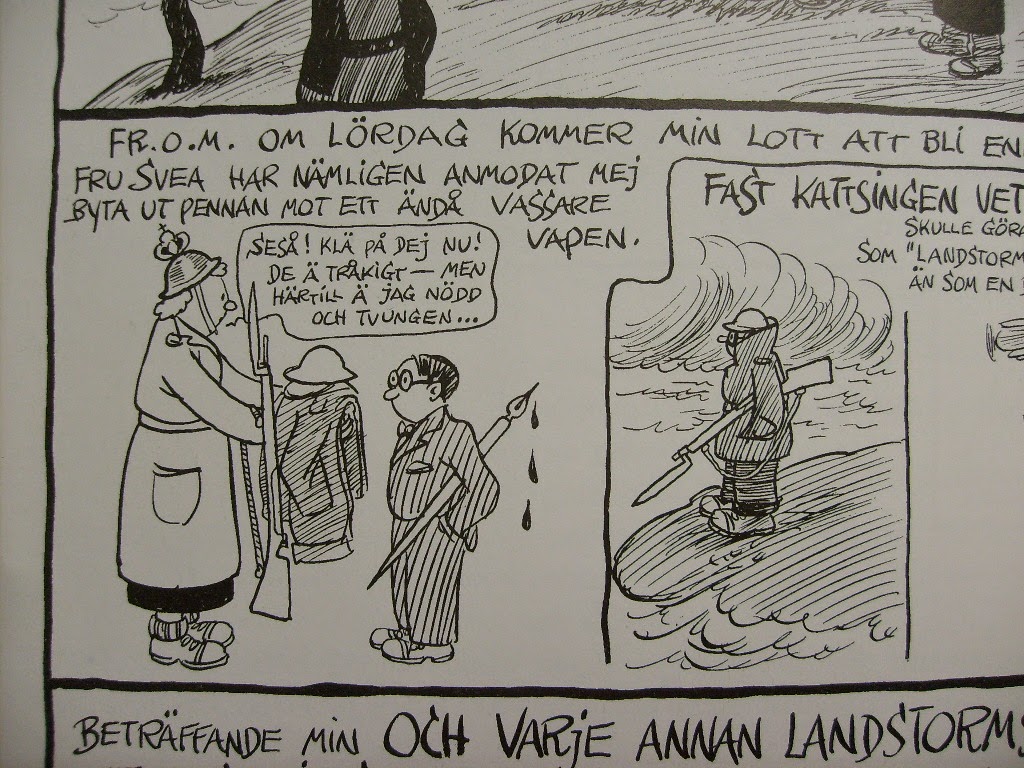
Mother Svea (Sweden) gives Bertila his uniform.
Word play was part of his game and the Swedish language started to change in the 70´s, as a new political and social awareness developed, as Swedes became more internationally aware, and society was being reshaped by immigration and the developement of modern media. Some of the Hedenhös books are no longer reproduced, considered racist and misogynist - which would have offended Bertila, who was a pacifist and a very outspoken advocate of equality and progress, both social, cultural, and technological. For example, he was a keen driver and fiercely lobbied for right-hand traffic for more than 30 years before it became a reality, in 1967. He also had strong convictions about spelling reforms. He did go into the army during the war, but reluctantly so, as he explained in comic form. He thought he could do more for the nation with his pen, and he did that as well, as you already know.
He also composed, which was a surprise to me. He wrote one of the most loved children´s songs in Swedish history, "Droppen Dripp och Droppen Drapp" (performed below by Alice Babs and her daughter Titti), and even recorded songs and put up a revue in 1934, where he sang his own songs in front of fifteen large drawings.
I only knew him for Barna Hedenhös, but I think now that his most lasting work will be "En svensk tiger" - even though perhaps that work has outgrown the memory of the man who created it.
Droppen Dripp och Droppen Drapp (the drop Drip and the drop Drap)
satt på varsin isetapp (sat each on his own icicle)
ovanför vår förstutrapp (above our landing)
Droppen Dripp och Droppen Drapp! (the drop Drip and the drop Drap)
- Hej, sa Dripp till Droppen Drapp (- Hi, said Drip to the drop Drap)
trivs du bra uppå din tapp? (are you happy on your icicle?)
- Åjavars, sa Droppen Drapp (- Oh, allright I guess, said the drop Drap)
fast min sittplats är rätt knapp! (although my seat is rather small.)
- Hördudu, sa Dripp till Drapp, (- Hey listen, said Drip to Drap)
ska vi hoppa ner ikapp, (shall we race each other down,)
ner på våran förstutrapp? (on to our landing?)
Så sa Dripp till Droppen Drapp. (That´s what Drip said to Drap the drop.)
- Hu, så högt! sa Droppen Drapp, (- My, that´s high! said Drap the drop,)
såge helst jag hoppa slapp. (I wish I didn´t have to jump.)
- men det gör väl hipp som happ, (but I guess it´s neither here nor there,)
låt oss hoppa ner i kapp! (let us race each other down.)
Och så hoppa Dripp och Drapp (And then Drip and Drap jumped)
från sin isetapp ikapp, (from their icicles together)
ner på våran förstutrapp (down onto our landing)
- och blev platta som en knapp! (and became flat like a button!)
(my own translation - quick and dirty)
Bertila with his daughter Monne Kristina, to whom he wrote the first Hedenhös book.
I have already told you about Danny Gregory´s fabulous book about creativity, "The Artistic Licence". He is also one of the people behind Sketchbook Skool, which looks like a pretty interesting project. I was curious for something more personal by him, and got this, "Everyday Matters", which is a memoir of sorts, a compilation I would assume, of pages from his own personal illustrated diary, with a no doubt heavily edited text to make a coherent story.
It starts when he and his wife Patti are a young, successful couple in New York, he is an advertiser, she a stylist, they have a dog and a new baby, and the terrible thing happens: she falls onto the railway track and is run over by a train. Her spine is crushed and she ends up wheel chair bound.
This book has none of that cheerful entusiasm that "The Artistic Licence" had, as you can imagine. This is personal, this is an account of what it´s like to have life - as you expected it to be - taken away from you. Gregory starts to draw in an attempt to deal with things - the word he keeps using is "slow"; this new life is slower than it used to be, and that is frustrating. Some things he took for granted are suddenly out of reach. Some things he took for granted now seems incredibly valuable. Other things he took for granted means nothing any more.
These aren´t cute drawings of beautiful still lifes. There is no sentimental glow to any of Gregory´s drawings. His surroundings - as he sees it - is what I recognize when I look around my own home, just the stuff of every day. Gregory draws himself into his new life. What Gregory is communicating to me is a lack of self-awareness - a mindfulness - that I find admirable and difficult to obtain. Perhaps only really difficult times can get you there. Or drawing, I hope.
This post at Austin Kleon´s blog made me smile, as I had just been tossing out a few pages in my diary on how my reading was frustrating me. A prayer-answer, if ever.
I am really into no 14 on his list right now: "I will re-read favorite books the way I watch favorite movies and play favorite records over and over." Actually, I feel a bit like I have gone into some kind of literary fetal position, if that makes any sense. Comfort reading in the extreme, for me anyhow. I am trying to be kind to myself, though, as life is crazy right now, both inside and outside. Things are changing - in a fundamental way - I can feel it and I am eager for it, but it´s not yet ready. It´s like being very, very hungry and having to wait another three hours for the stew to brew. (I don´t suppose stews actually brew, but I like how that rhyme.)
Also, no 8: "I will not finish books I don’t like", no 10: "I will throw a book across the room", and no 21: "If I hate a book, I will keep my mouth shut". Actually, even no 22: "I will make liberal use of the phrase, “It wasn’t for me.”". Yeah. It´s painful to realize someone was hurt by a remark you made and you can´t take it back. So, will I only blog books I like? Can´t really blog something I stopped reading and tossed across the room, I guess. (Though I´m sure I have done.)
As you can tell, I am having a bit of a reading crisis and it´s been coming on slowly all year. It´s just a small part of the whole change, though. Since I stopped working on that novel of mine and started doing other things, reading just isn´t the same, and the reasons for picking up a book has changed. Writing anything, even blogging, has changed. Or rather, is changing. I just made a list of things to work towards, with a deadline that is nine months ahead of me, so the fetal analogy isn´t so far off. I am tempted to make changes happen, make declarations of this and that, but it just isn´t the time. I´ll just wait and see.
As I was doing away with my desk (turning my study into a studio for this winter´s art classes) I found a note to self to go see a librarian about a book. The book in question is "Medelhavsresa" (= trip to the Mediterranean) by Birger Lundquist from 1952. It was published the year he died, only 42 years old.
This is drawings we are talking about, not stories. Birger Lundquist was a famous illustrator (of whom I have written before) at Sweden´s number one daily newspaper, Dagens Nyheter, from the 1930´s. According to the foreword by Georg Svensson, this was his first trip abroad. He set out in the fall of 1937 - to get away from some personal problems (his daughter with colleague and journalist Barbro Alving was born in 1938, so that might have had something to do with it) - and the drawings are from that trip. Some of them were published in the paper at the time, but most not.
Lundquist was a prolific draughtsman, he was never without a pen and a pad according to the legend, which also says that there were some 80.000 drawings among his belongings when he died, and he had given many away, as he was not precious about is art.
He said that he learned how to really draw on this journey, and that he owed much of it to the French artist Jean Launois, whom he met in Oran and Tlemcen. Svensson claims that Launois was an obscure artist no one but Lundquist had heard about, who died from drunkenness in 1948. A quick googling shows he was important enough to have a Wikipedia article, which states that he died in 1942, and there is some of his art on different sites, like this one. He certainly could draw, and I don´t doubt that he taught Lundquist quite a bit, or that they drowned their sorrows together in the strong stuff; there are quite a few drawings in this book from bars.
Most of the drawings - which are only a small selection of what I imagine is a suitcase full, at least - are of people on the streets. Lundquist really knew how to capture a character, sometimes slipping over into caricature, particularly in the drawings he elected to send home to be published. You can really see the fashion of the day in the girls hair and makeup, even if he only uses his reservoir pen - they all look like little Edith Piafs. But he also has some more scenic city views, and it´s amazing to see what he could express with only a pen, and pretty fast too, I think. The energetic, confident line speaks of a restlessness that almost seems manic. Some drawings are watercoloured, but this wasn´t something he did much
I love these drawings, and will forever aspire to be able to work a pen like this. This is urban sketching before the concept existed, and it is just too bad he died so young. I would have loved to see what he could have done as a mature artist.
Throughout, Lundquist makes wonderful sketches of hands, which is very hard.
I love this composition: the minaret, the camels, the robe, hat and the expressive hand. I bet he did this in seconds.
I have never been to Athens, but the husband went earlier this year, and I thought I recognized the mountain on the lower half of the page. I bet he stood on pretty much the same place as Lundqvist did when he took this snap, or what do you think? Or perhaps on the hill in the drawings middleground, depending on what kind of lens he had on.


.jpg)